

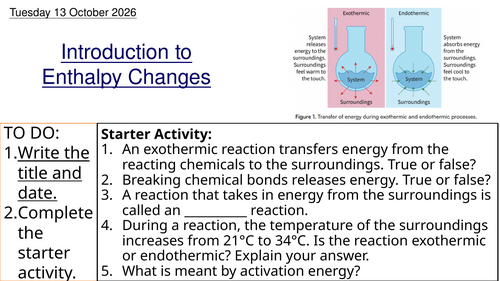

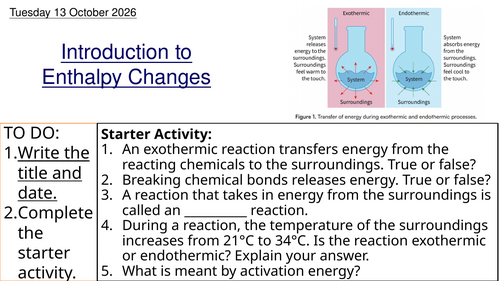
This PowerPoint lesson provides an Introduction to Enthalpy Changes for Pearson BTEC Applied Science Unit 5 Chemistry, covering ΔH, exothermic and endothermic reactions, reaction profiles and activation energy. It is designed to build the core energy-change knowledge students need before progressing to more advanced enthalpy calculations.
Enthalpy is the heat content of a chemical system, while an enthalpy change, ΔH, describes the change in heat content during a process. The lesson introduces the distinction between the system and surroundings and explains the sign convention for exothermic and endothermic reactions. Students learn that exothermic reactions transfer energy to the surroundings and have a negative ΔH, while endothermic reactions absorb energy and have a positive ΔH.
The resource also introduces the Kelvin temperature scale, absolute zero and conversions between °C and K. Students study the relationship ΔH = ΔU + pΔV, standard conditions for enthalpy data, and the use of kJ mol⁻¹. Reaction profile diagrams are developed in detail, including how to identify reactants, products, ΔH and activation energy, and how to calculate these values from energy data. The effect of a catalyst is also explained, emphasising that it lowers activation energy without changing ΔH.
The fully editable PowerPoint (.pptx) includes learning objectives, key terminology, retrieval starters, worked calculations, reaction-profile activities, mini-whiteboard questioning, booklet practice, answer slides and end-of-lesson check-your-understanding questions. Updated in October 2026, it is suitable for classroom teaching, revision, cover work or independent study within Pearson BTEC Applied Science Unit 5 Chemistry.
Something went wrong, please try again later.
This resource hasn't been reviewed yet
To ensure quality for our reviews, only customers who have purchased this resource can review it
Report this resourceto let us know if it violates our terms and conditions.
Our customer service team will review your report and will be in touch.
£2.00