

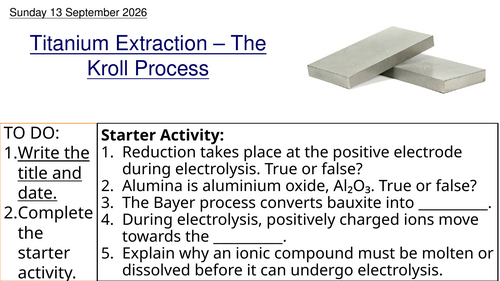

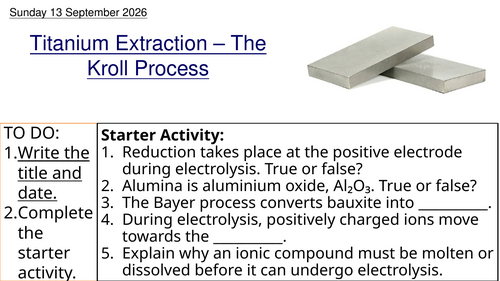
This PowerPoint lesson covers Titanium Extraction and the Kroll Process for Pearson BTEC Applied Science Unit 5 Chemistry, including titanium ores, TiCl₄ formation, purification and reduction. It is designed to help students understand why titanium requires a multi-stage extraction process and why its production is relatively slow and expensive.
The Kroll process is the industrial method used to extract titanium from titanium-containing ores such as rutile and ilmenite. The lesson begins by explaining why titanium cannot be extracted directly from titanium(IV) oxide using carbon, as titanium carbide contamination can form and make the metal brittle. Students then follow the overall sequence from titanium ore to TiO₂, then TiCl₄, and finally titanium metal.
The resource explains how titanium(IV) oxide is heated with chlorine and carbon to form titanium(IV) chloride, which is then purified by fractional distillation. Students then examine the reduction stage, where purified TiCl₄ is reacted with magnesium in a sealed reactor under an inert argon atmosphere. The balanced equations for both major stages are included, together with explanations of why an inert atmosphere is needed and how magnesium chloride and excess magnesium are removed. The lesson also explores why the Kroll process is a costly batch process, including the need for high temperatures, sealed reactors, magnesium and lengthy cooling and processing stages.
The fully editable PowerPoint (.pptx) includes learning objectives, key word definitions, starter questions, process explanations, balanced equations, sorting and matching activities, answer slides, a step-by-step process summary and end-of-lesson check-your-understanding questions. Updated in September 2026, it is suitable for classroom teaching, revision, cover work or independent study within Pearson BTEC Applied Science Unit 5 Chemistry.
Something went wrong, please try again later.
This resource hasn't been reviewed yet
To ensure quality for our reviews, only customers who have purchased this resource can review it
Report this resourceto let us know if it violates our terms and conditions.
Our customer service team will review your report and will be in touch.
£2.00