


Lever Launcher STEM Challenge (9‑Point Engineering Graph)
A hands‑on STEM challenge where learners build a simple lever launcher, test how far it can launch a soft object, and compare two trials using the 9‑Point Engineering Graph. Students sketch their launcher designs, record how they built each version, and observe how changing the lever setup affects the launch distance. This activity is low‑prep, highly engaging, and ideal for primary classrooms, STEM centres, homeschool learning, or makerspace stations.
WHAT’S INCLUDED:
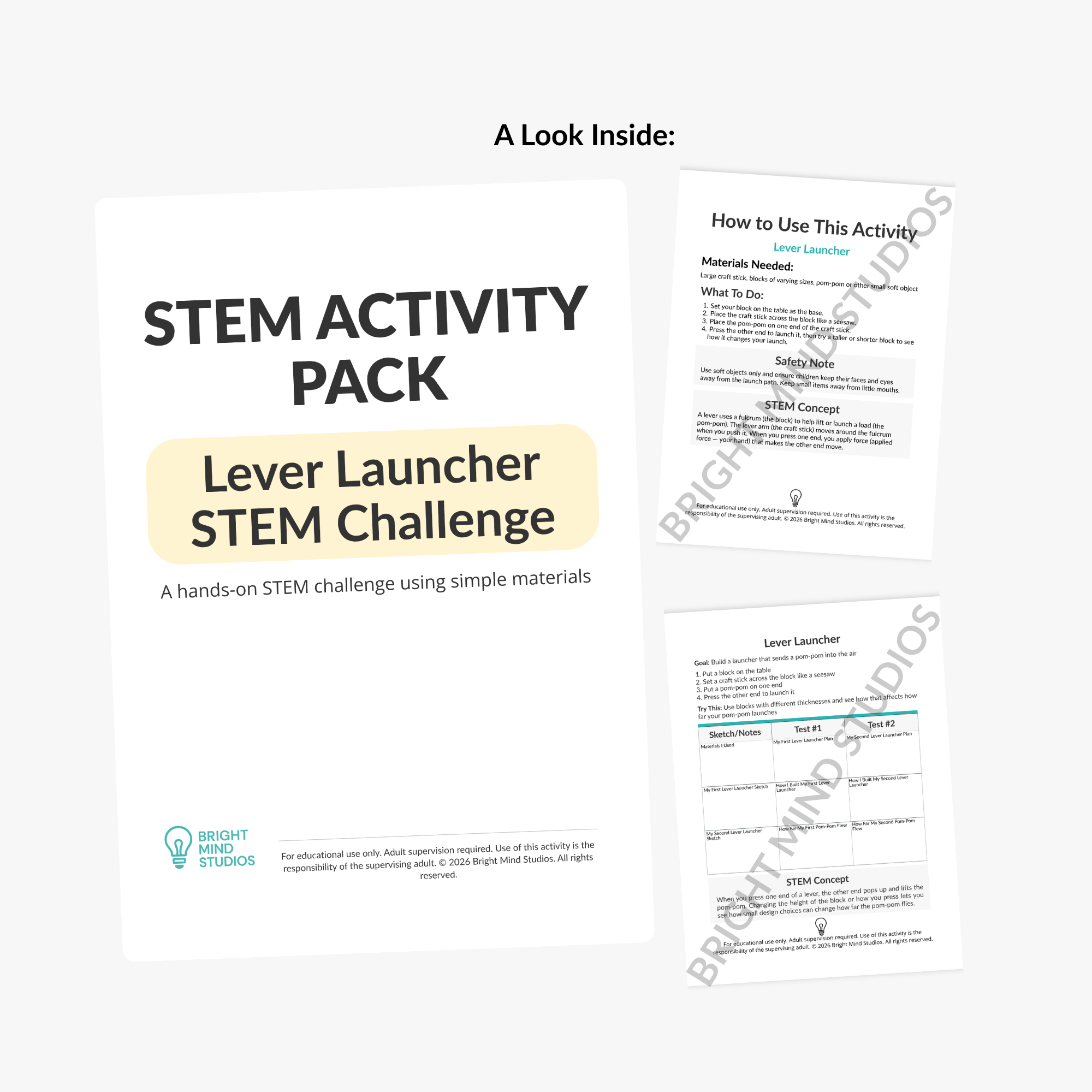
• 3‑page STEM Challenge set: Cover Page, Instructions Page, Activity Page
• Full 9‑Point Engineering Graph for comparing two lever launcher trials
• Clear, consistent directions designed for real classrooms
• Kid‑friendly layout that supports independent exploration
• Printable PDF (A4/Letter compatible)
TEACHER BENEFITS:
• Low‑prep activity using simple, affordable materials
• Consistent layout that supports independent exploration
• Easy to run in whole‑class lessons, small groups, or STEM centres
• Encourages problem‑solving, testing, and redesign
• Suitable for a wide range of ages and abilities
LEARNING CONCEPTS:
• Engineering design process
• Forces and motion (lever, load, effort)
• Testing and comparing two designs
• Recording results using a structured 9‑point data graph
• Observing how changes in setup affect performance
HOW IT WORKS:
Students build a simple lever launcher, test how far it can launch a soft object, and record their results using the 9‑Point Engineering Graph. They sketch each design, note how they built their launcher, and compare how the launch distance changed between the two trials. The challenge naturally scales: younger learners build simple lever setups, while older learners create more stable, refined launchers.
PRINTING & PREP:
• Print pages single‑sided
• Provide simple materials such as craft sticks, blocks, spoons, and soft objects
• Set up a clear space for building and testing
• Adult supervision required for height, motion, or small‑object activities
AGE RANGE:
Ages 5–11 (Primary). Younger learners can participate with support.
PERFECT FOR:
• Classroom STEM centres
• Early finishers
• Makerspace stations
• Homeschool STEM time
• After‑school clubs
• Family STEM nights
FILE DETAILS:
• PDF format (non‑editable)
• Instant digital download
• No physical item shipped
Something went wrong, please try again later.
This resource hasn't been reviewed yet
To ensure quality for our reviews, only customers who have purchased this resource can review it
Report this resourceto let us know if it violates our terms and conditions.
Our customer service team will review your report and will be in touch.
$3.99