


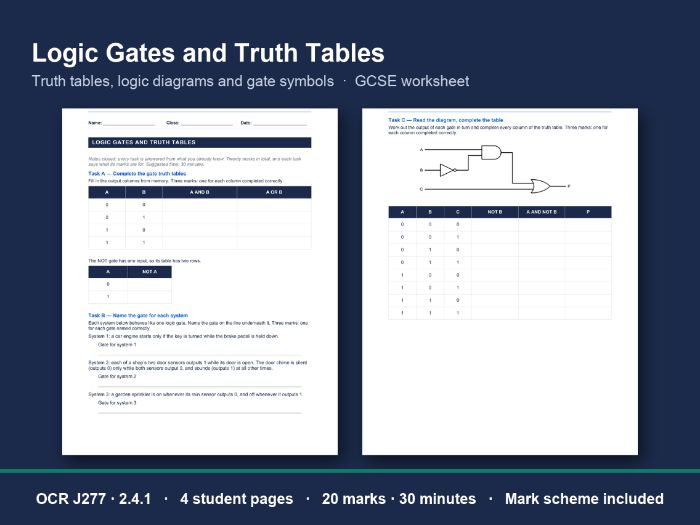
A closed-book GCSE worksheet on logic gates for OCR J277 2.4.1: truth tables, diagrams and gate symbols, 20 marks in 30 minutes, with a full mark scheme.
Five short tasks take students from recalling the three gates to spotting what is wrong with a badly drawn symbol. Each task says what its marks are for, so students know what a complete answer looks like before they start.
What’s inside (6 pages, PDF and editable Word)
- Four student pages (pages 1 to 4), answered with notes closed.
- A full mark scheme (pages 5 and 6), with what to accept and what not to accept, follow-through guidance, the completed truth table and both model diagrams. It starts on an odd page, so a double-sided print keeps it off the back of a student sheet.
The five tasks
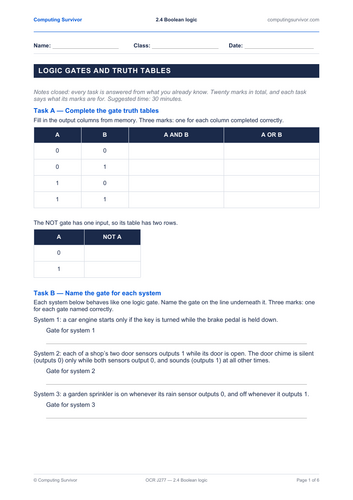
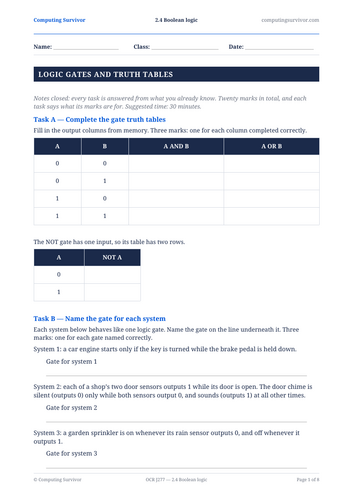
- Complete the gate truth tables: AND, OR and NOT, from memory.
- Name the gate for each system: three everyday systems, each behaving like one gate.
- Read the diagram, complete the table: a three-gate circuit using NOT, AND and OR, traced through all eight rows a column at a time.
- Draw the logic diagram: two expressions to draw, each with one gate feeding another.
- Correct the symbol: three gates drawn wrongly by a student. Say what is wrong with each and what it would do as drawn.
Why it works in a real classroom
- It sticks to the J277 gates. Students draw and use only AND, OR and NOT. Any other shape appears only as a mistake to spot, and no answer needs its name.
- It marks what examiners mark. The scheme marks each drawing the way examiners do, and follows a slip through instead of punishing it twice.
- Editable. The Word version is included, so you can change a name or a scenario to suit your class. The logic diagrams are images.
- Nothing to set up. Print, hand out, collect. There is nothing to install and nothing to log in to.
You need: one copy of pages 1 to 4 per student. Keep pages 5 and 6 back; a cut line marks where the mark scheme starts.
Good for: half a lesson on Boolean logic, homework after teaching 2.4.1, a cover lesson, or Year 11 revision before Paper 2.
Made by a practising computing teacher. The answers are written out in full and checked. If you use it, a review helps other teachers find it.
Something went wrong, please try again later.
This resource hasn't been reviewed yet
To ensure quality for our reviews, only customers who have purchased this resource can review it
Report this resourceto let us know if it violates our terms and conditions.
Our customer service team will review your report and will be in touch.
£3.00