


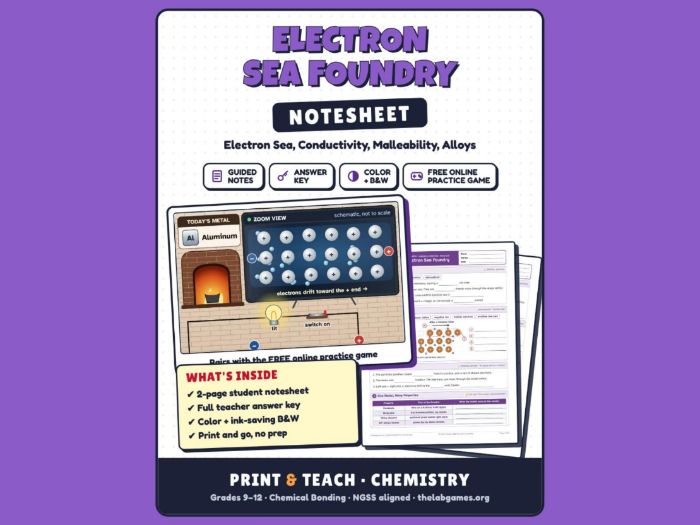
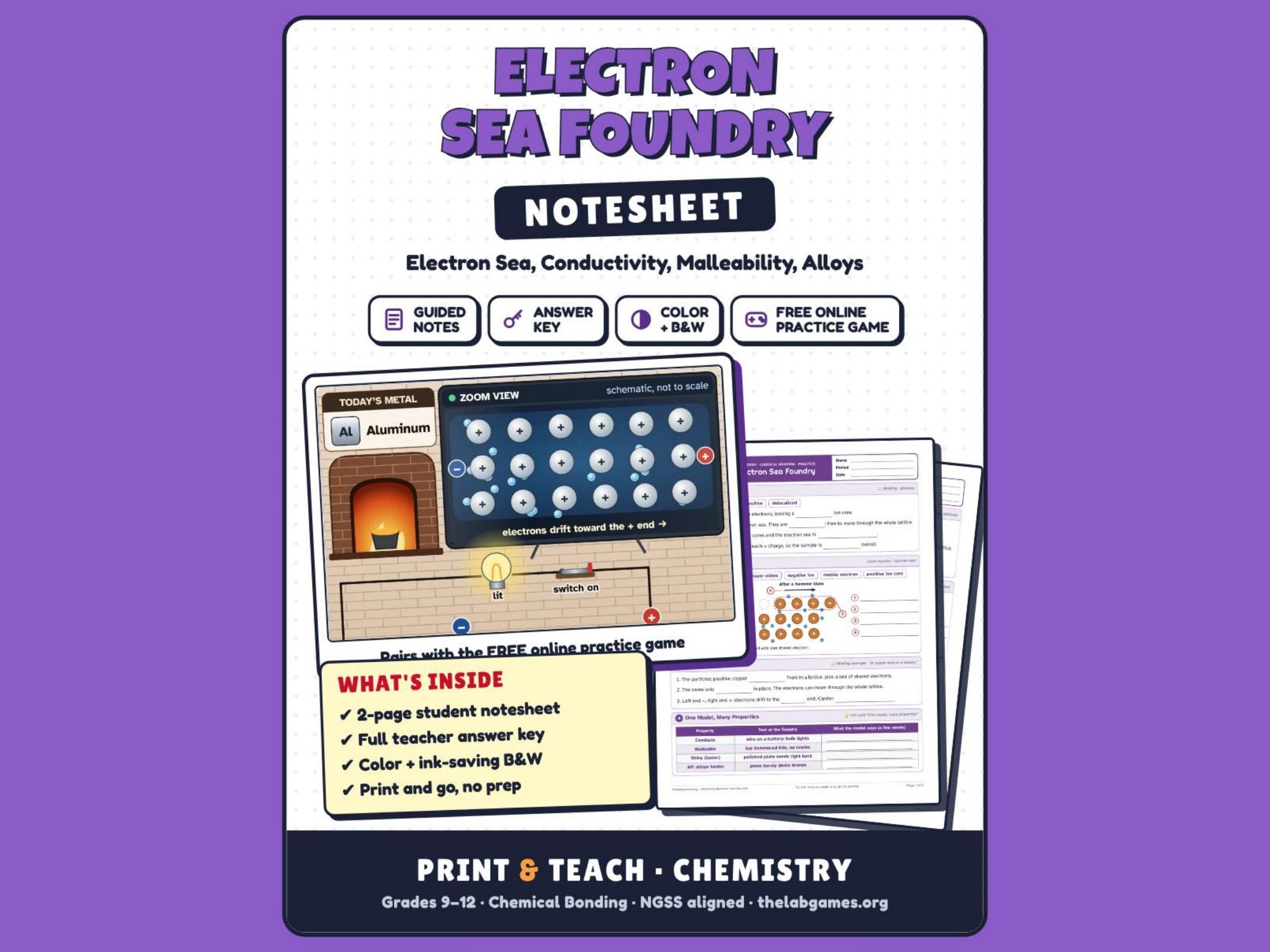
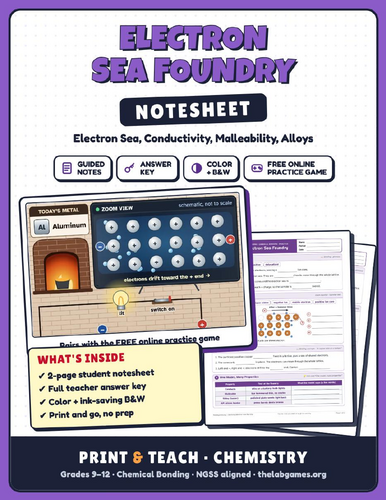
Teach metallic bonding with one simple particle picture. In this roomy, student-friendly 2-page notesheet, students fill in the electron-sea model (positive ion cores in a sea of delocalized electrons), label a zoomed-in metal before and after a hammer blow, and use the model to explain why metals conduct electricity, bend instead of cracking, and shine. Four work orders have students build a metal model, find the charge carrier in a wire, explain malleability and explain reflection, and an AP block sorts bronze and steel into substitutional and interstitial alloys.
It pairs with Electron Sea Foundry, a free online practice game at thelabgames.org where students run a metal foundry’s test bench and watch electrons drift, layers slide and light reflect. Use it in class, for absent-student makeups, or on sub days. A complete teacher key is included.
What’s Included
- Student notesheet (2 pages) in full color AND black & white
- Teacher answer key (red answers) in full color AND black & white
What Students Do
- Background fill-in: positive ion cores, delocalized electrons, metallic bonding and why a metal is neutral overall
- Zoom In on a Metal: label an ion core, a mobile electron, a layer of cores and the direction a layer slides, before and after a hammer blow
- Worked example: what carries the charge in a copper wire on a battery, and which way the electrons drift
- One Model, Many Properties: explain conductivity, malleability, luster and (AP) alloy hardness with the electron sea
- Work orders: build a metal model, a circuit test, a hammer test and a light test with percent absorbed
- AP extension: substitutional (bronze) vs. interstitial (steel) alloys
- My Runs: a log for tracking practice scores
Skills & Standards
- Metallic bonding, electron sea model, delocalized valence electrons, ion cores, electrical conductivity, malleability, luster and reflection, substitutional and interstitial alloys
- Supports NGSS HS-PS2-6, HS-PS1-3
- Grades 9–12 Chemistry (with an AP Chemistry extension)
Great For
- Chemical bonding units
- Comparing ionic, covalent and metallic bonding
- Absent-student makeups
- Sub plans
- Homework or stations
Something went wrong, please try again later.
This resource hasn't been reviewed yet
To ensure quality for our reviews, only customers who have purchased this resource can review it
Report this resourceto let us know if it violates our terms and conditions.
Our customer service team will review your report and will be in touch.
$2.49