The whole of AQA GCSE Geography’s The Challenge of Natural Hazards (Paper 1, Section A) in one bundle: seventeen one-hour lessons, a 12-week homework booklet and a spaced retrieval pack. All three follow the same content order and use the same case studies, key terms and sourced figures, so what you teach in a lesson comes back in homework and in your starters, with spacing built in.
What is in the bundle
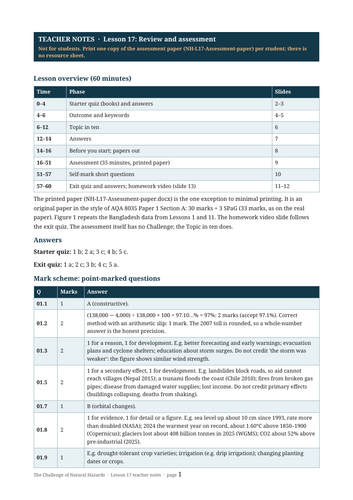
17 one-hour lessons. Seventeen editable PowerPoints (585 slides in all), six two-sided printable resource sheets, a 4-page Section A-style assessment paper (30 marks plus 3 for SPaG), seventeen sets of teacher notes with answers and mark schemes, and a START-HERE guide. The lessons: a five-question starter quiz, an outcome and big question, key words, three learning cycles (short explanation slides, a check for understanding with a reveal slide, and a practice task with a feedback slide and a Challenge), a video slide (YouTube link, QR code and watch-for questions), an original exam-style question with a student-friendly mark scheme and a Level 3 example answer, and a five-question exit quiz. One task in each lesson is a varied activity: a diamond nine, a tsunami-warning mystery, a jury, a “Protect Port Marina” token game, an adaptation advice desk and more. Lesson 16 teaches exam technique for Section A; Lesson 17 is a review lesson with the printed paper.
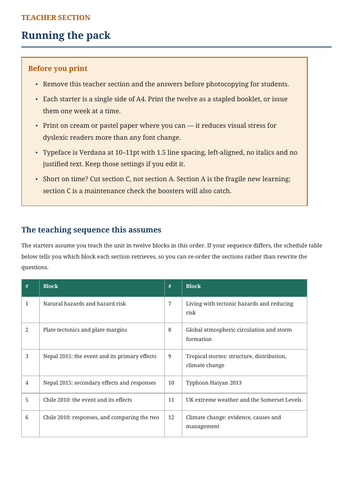
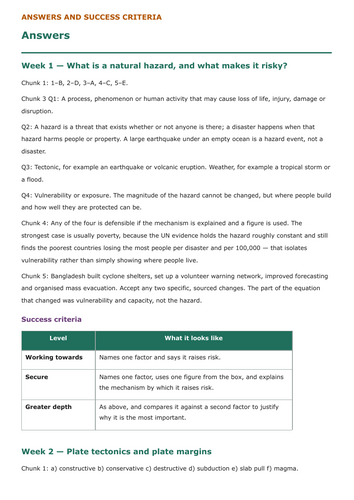
A 12-week homework booklet (100 A4 pages). Each week has five short chunks of about 45 minutes in all: word work with retrieval from earlier weeks, a short reading, check questions, a “think deeper” task and original exam practice, with the scaffolding withdrawn across the term. Full answers, support pages, student trackers and a teacher section are included.
A spaced retrieval pack: twelve weekly “do now” starters and two long-gap boosters, with a mark scheme for every question. Starters revisit the previous block, then earlier content at spaced gaps.
Specification and case studies: AQA GCSE Geography 8035, section 3.1.1 (3.1.1.1 to 3.1.1.4, climate change included). Case studies: Nepal 2015 (lower-income country at the time), Chile 2010 (high-income), Typhoon Haiyan 2013 and the Somerset Levels floods 2013/14.