


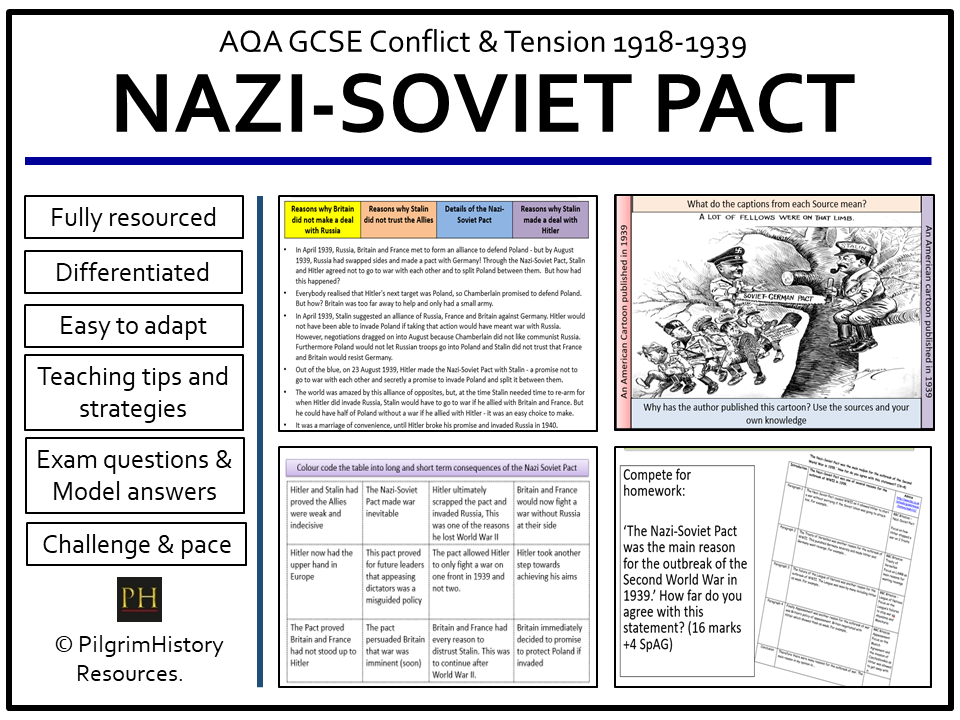
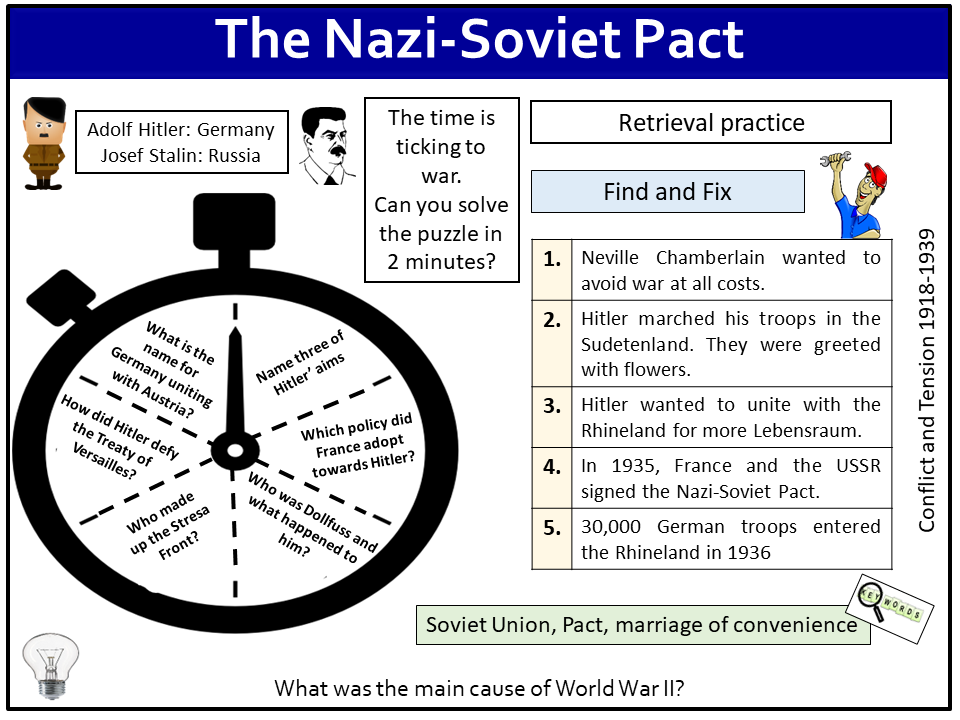
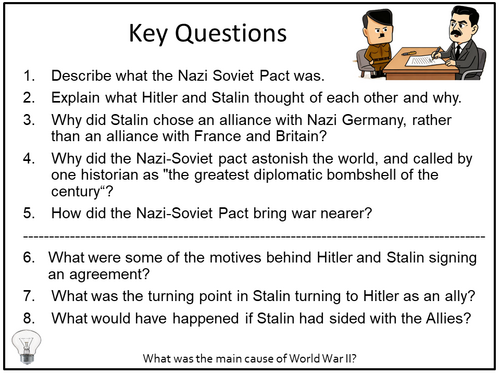
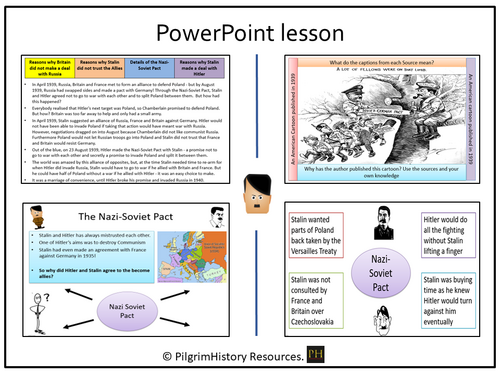
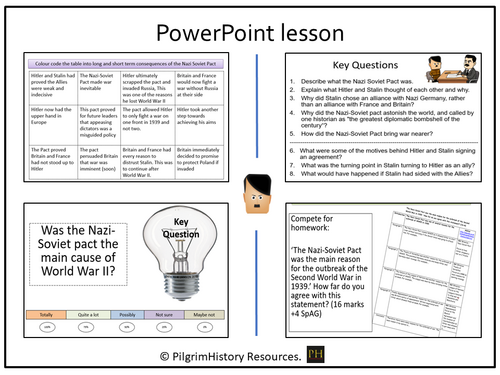
The aim of this lesson is to explain why Hitler and Stalin signed the Nazi-Soviet Pact (Molotov–Ribbentrop Pact) in August 1939 and why Stalin ultimately turned away from Britain and France.
Students explore the background to the pact and the growing mistrust between Stalin and the Western Allies. They examine why negotiations between Britain, France and the Soviet Union failed, and how Stalin became increasingly frustrated by their foreign policy towards Hitler.
Students use differentiated resources, video footage and higher-order questioning to develop their understanding of the events. They also evaluate key contemporary sources to investigate the motives behind the pact and the decisions made by each side.
Towards the end of the lesson, students identify the short- and long-term consequences of the agreement, including its impact on Poland and the outbreak of the Second World War.
They then have the opportunity to practise a 16-mark GCSE exam question, with support and a model answer provided where required.
The plenary focuses on literacy, with students using key words from the lesson to consolidate their understanding of the topic.
The lesson is enquiry based, with a key question introduced at the start using a lightbulb and revisited throughout to demonstrate progress in learning.
The resource includes suggested teaching strategies, retrieval practice, differentiated materials.
It comes in PowerPoint format if there is a wish to adapt and change.
Get this resource as part of a bundle and save up to 30%
A bundle is a package of resources grouped together to teach a particular topic, or a series of lessons, in one place.
Bundle
AQA Conflict and Tension 1918-1939 Complete Bundle
These lessons have been written to deliver the AQA GCSE (9–1) Conflict and Tension, 1918–1939 unit in a clear and accessible way for students. By the end of the unit, students will have a secure understanding of the competing interests of different nations and individuals in the aftermath of the First World War, including the challenges of maintaining peace and the creation of the League of Nations. They will explore key ideas such as national self-determination, international cooperation, and the difficulties surrounding the Versailles Peace Settlement. Students also build an understanding of how tensions developed in the interwar period, leading to the outbreak of the Second World War. This includes evaluating the causes of the war and considering why attempts to prevent further conflict ultimately failed. Throughout, students study the role of key individuals, nations and events in shaping international relations during this period. Each lesson includes a range of differentiated tasks alongside suggested teaching approaches to support delivery. A variety of GCSE-style questions are included throughout, including source analysis, “write an account” questions, and extended 16-mark responses. Guidance, mark schemes and tips are also provided to help students access the higher levels. The lessons in this bundle are: L1: Aims of the Peacemakers L2: Compromise at the Paris Peace Conference L3: The Terms of the Treaty of Versailles L4: Was the Treaty of Versailles Fair? L5: The Wider Peace Settlement (FREE) L6: Introduction to the League of Nations L7: Structure of the League of Nations L8: The Commissions L9: How Successful Was the League in the 1920s? L10: Decline of International Cooperation L11: The Manchurian Crisis L12: The Abyssinian Crisis L13: Was the League Destined to Fail? L14: Hitler’s Foreign Policy Aims L15: Reactions to Hitler’s Foreign Policy L16: German Rearmament and the Road to War L17: Reoccupation of the Rhineland (FREE) L18: The Anschluss L19: The Sudeten Crisis L20: The Nazi-Soviet Pact L21: Why Did the Second World War Break Out? All lessons include retrieval practice activities and are provided in editable PowerPoint format, making them easy to adapt for different classes. Please note, due to TES bundle size limits, Lesson 17 (Reoccupation of the Rhineland – free resource) is available separately here: https://www.tes.com/teaching-resource/resource-12830949 No AI has been used in the creation of these resources. Reviews are always appreciated and help improve future resources.
£40.00
Bundle
AQA GCSE Conflict and Tension Outbreak of War Bundle
The aim of this eight-lesson bundle is to cover the origins and outbreak of the Second World War, exploring Hitler’s foreign policy, the reactions of the major powers and the events that led to war in September 1939. Students begin by examining Hitler’s aims and foreign policy before exploring how Britain, France, the USA and Russia reacted to his actions. They then follow the key events leading to war, including German rearmament, the reoccupation of the Rhineland, the Anschluss with Austria, the Sudeten Crisis and the Nazi-Soviet Pact. The final lesson brings these events together, challenging students to evaluate why the Second World War broke out in 1939 and how far Hitler’s actions, appeasement and the weaknesses of international cooperation contributed to the conflict. The bundle includes a range of activities to develop students’ knowledge, encourage historical analysis and help them reach their own judgements. Suggested teaching strategies, retrieval practice and differentiated learning tasks are included throughout. There are also opportunities to practise typical AQA GCSE exam questions, including source analysis, write an account and the longer 16-mark judgement questions with the additional 4-mark question. The final lesson includes further exam practice, with guidance and examples of how to approach the questions. The eight lessons are organised as follows: Lesson 1: Hitler’s Aims and Foreign Policy Lesson 2: Reactions to Hitler’s Foreign Policy Lesson 3: The Road to War and German Rearmament Lesson 4: Reoccupation of the Rhineland (free resource) Lesson 5: The Anschluss Lesson 6: The Sudeten Crisis Lesson 7: The Nazi-Soviet Pact Lesson 8: Why Did the Second World War Break Out? The resource includes suggested teaching strategies, retrieval practice and differentiated materials. All lessons come in PowerPoint format, allowing teachers to adapt and change the resources to suit their own classes. Any reviews would be gratefully received.
£17.00
Something went wrong, please try again later.
This resource hasn't been reviewed yet
To ensure quality for our reviews, only customers who have purchased this resource can review it
Report this resourceto let us know if it violates our terms and conditions.
Our customer service team will review your report and will be in touch.
£3.00