


What is NMR spectroscopy? Proton NMR? How does proton NMR work? What is tetramethylsilane? Proton NMR chemical shift table? Splitting pattern NMR? All this and more covered in this comprehensive lesson with questions and answers! This is a Year 13 A level lesson for Edexcel International Unit 4 – WCH14, but it can also be used for all UK exam boards. All the slides in this lesson are fully animated and include answers to every mini plenary question and exam question. The breakdown of the slides (which are best opened on Microsoft PowerPoint) is as follows:
Slide 1 - Title and 5-minute starter. The starter is a grid of four questions entitled ‘last week, last lesson, today’s learning and future learning’. Use this generic slide for all your lessons by simply changing the questions and the answers each time.
Slide 2 - Lesson objectives (see thumbnail image)
Slide 3 – introduction to what NMR is used for
Slide 4 – ethanol displayed formula being used to demonstrate different chemical environment
Slides 5 – 6: use this section to prompt students to work out how many proton environments there are in propanoic acid
Slides 7 – 10: use this section to teach students what a low resolution NMR spectrum shows. Print slides 8 and 9 as two slides per sheet for the students
Slides 11 – 15: use this section to teach students how to use an integration trace to work out the simplest ratio of the number of protons in a particular chemical environment
Slides 16 – 18: use this section to teach students how to interpret chemical shift tables, including the effect of branching in alkanes and differing halogen atoms in haloalkanes Print slides 17 and 18
Slides 19 – 21: use this section to show students how to interpret the HNMR spectrum for butanal. All the notes animate on the screen as you click. Print slides 20 and 21 for them
Slide 22 - learning pit stop questions to test students’ understanding so far. Answers animate on the screen when you click
Slide 23 – explains what a high resolution HNMR spectrum shows. This slide gives the definition of splitting pattern
Slide 24 – an example of a high-res NMR spectrum
Slides 25 – 29: the n+1 rule is covered here, plus the names of the splitting patterns
Slide 30 – two isomers of dichloroethane are presented on this slide. Students are asked about the peaks and the splitting patterns for the molecules. Answers animate as you click
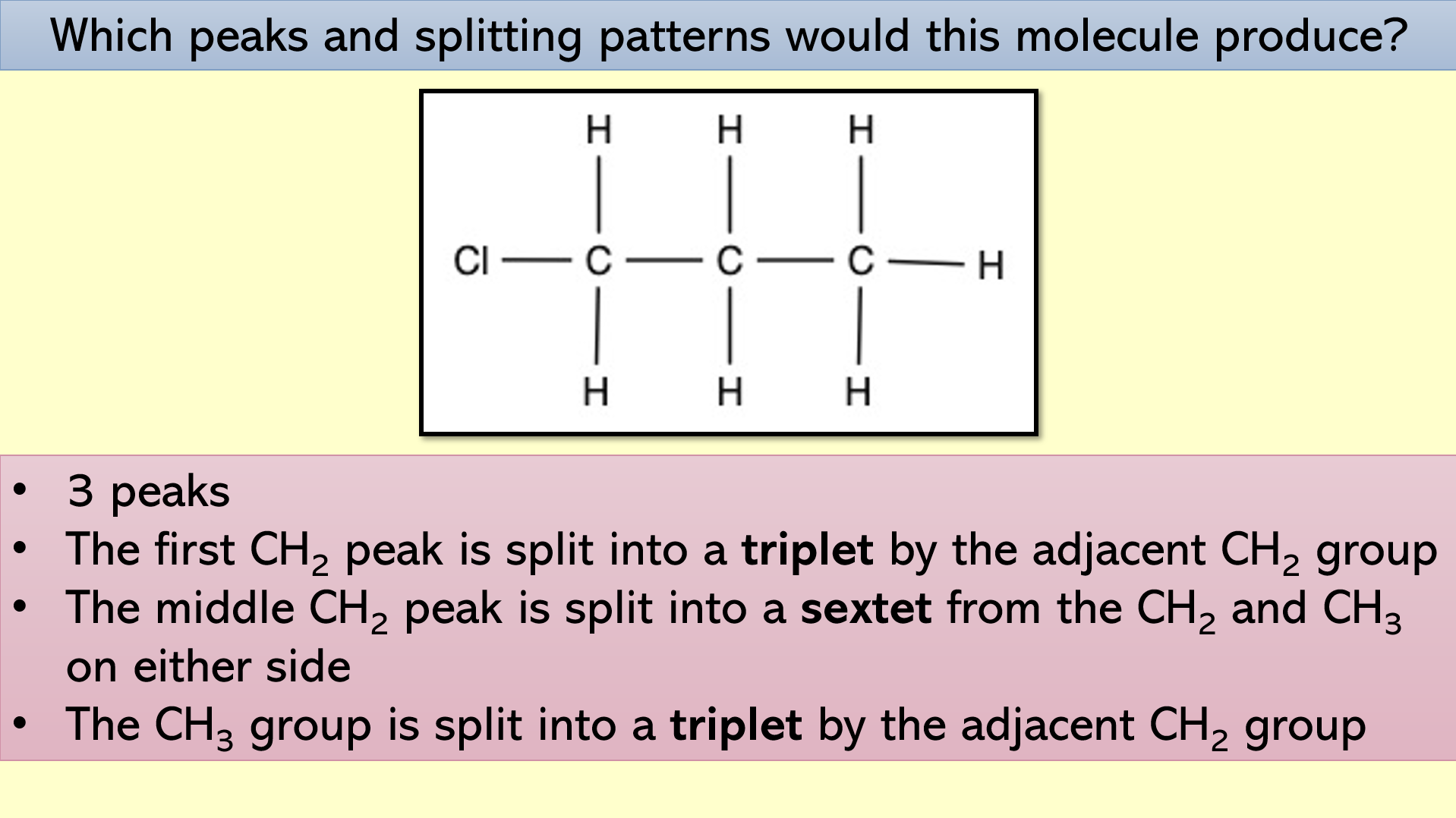
Slide 31 – same as previous slide, but this time for 1-chloropropane
Slide 32 - learning pit stop questions to test students’ understanding so far. Answers animate on the screen when you click
Slides 33 – 44: two worked examples, which requires students to deduce a structure from a molecular formula and proton NMR spectra
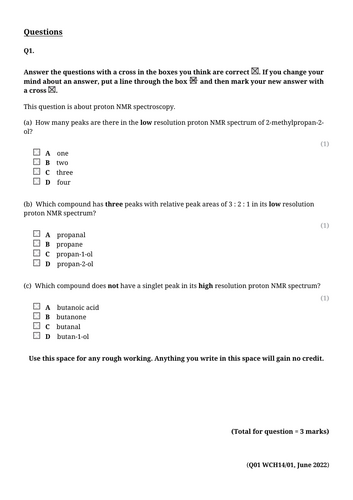
Slides 45 – 53: exam questions with mark scheme answers included with this resource
Please consider leaving a review! This really helps promote our store! Thanks!
Something went wrong, please try again later.
My class really enjoyed this breakdown. Great resource
Report this resourceto let us know if it violates our terms and conditions.
Our customer service team will review your report and will be in touch.
£4.50