


This is a complete A-level Chemistry lesson on cyclic compounds, functional-group priority and naming molecules with multiple functional groups
For Full 2 x Lesson Pack See Here!: https://www.tes.com/teaching-resource/resource-13519881
This fully editable power point is designed for A-level Chemistry: 3.3.1 Introduction to Organic Chemistry 3.3.1.1 Nomenclature. It follows directly from Nomenclature Part 1, moving students from naming more complex branched organic compounds
The lesson uses a highly structured and carefully scaffolded approach to help students understand not only what a systematic name is, but why each part of the name has been selected.
Content covered
Students are supported to:
name and draw cyclic organic compounds;
recognise cycloalkanes and substituted cycloalkanes;
apply the cyclo- prefix correctly;
use the general formula CₙH₂ₙ for cycloalkanes;
compare the general formula of cycloalkanes with that of alkenes;
number a ring to give substituents the lowest possible set of locants;
name substituted cyclic compounds such as dibromocycloalkanes;
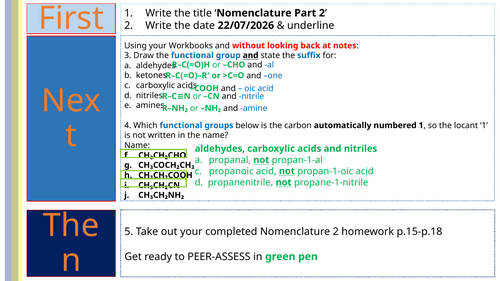
identify aldehyde, ketone, carboxylic acid, nitrile and amine functional groups;
recall the correct structural representation and suffix for each functional group;
recognise functional groups in displayed, structural and skeletal formulae;
understand when the functional-group carbon is automatically carbon 1;
recognise why locant 1 is not normally written for aldehydes, carboxylic acids and nitriles;
identify the principal or highest-priority functional group;
select a parent structure containing the principal functional group;
number the parent structure to give the highest-priority functional group the lowest possible locant;
decide which functional group keeps the suffix;
convert lower-priority functional groups into prefixes;
name compounds containing two or more different functional groups;
use locants, prefixes, suffixes and punctuation accurately;
translate between systematic names and displayed, structural and skeletal formulae;
justify a systematic name using the parent structure, functional-group priority, numbering and substituent positions.
Functional-group priority
The lesson explicitly introduces and applies the following priority order:
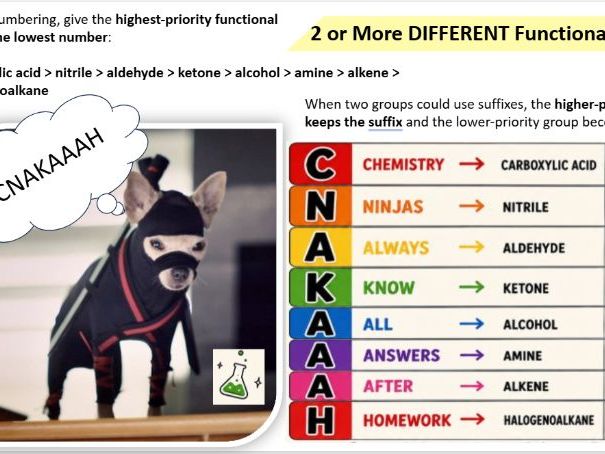
carboxylic acid → nitrile → aldehyde → ketone → alcohol → amine → alkene → halogenoalkane
Students are taught that when a molecule contains two groups that could normally be expressed using suffixes, the higher-priority functional group retains the suffix, while the lower-priority functional group is expressed as a prefix. This is modelled through guided examples before students apply the rule independently.
Something went wrong, please try again later.
This resource hasn't been reviewed yet
To ensure quality for our reviews, only customers who have purchased this resource can review it
Report this resourceto let us know if it violates our terms and conditions.
Our customer service team will review your report and will be in touch.
£4.00