

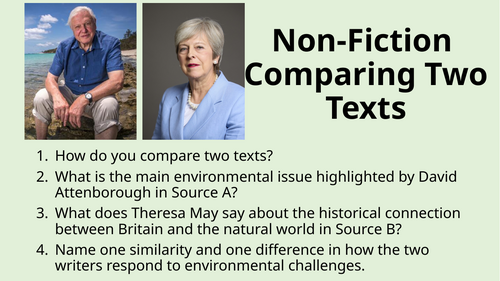

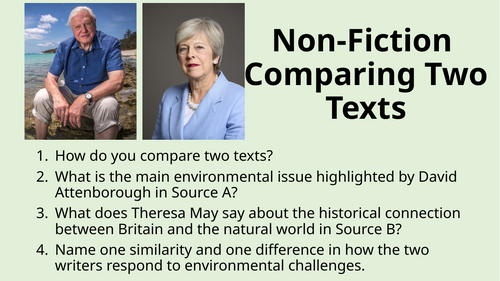
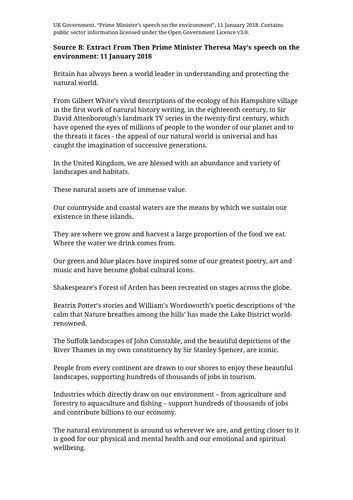
KS3 - A lesson focusing on Comparing Two Texts using David Attenborough’s COP26 Climate Summit Glasgow Speech Transcript and an Extract From Then Prime Minister Theresa May’s speech on the environment: 11 January 2018. A variety of activities included, including an AQA English Language Paper 2 Question 4, a model answer, and more.
Can be used for KS4.
Due to copyright, David Attenborough’s COP26 Climate Summit Glasgow Speech Transcript, but a link to it is in the notes of the first slide. It can also be found online.
**Theresa May’s speech extract is included. It contains public sector information licensed under the Open Government Licence v3.0. Source: UK Government speech, “Prime Minister’s speech on the environment”, 11 January 2018. **
Get this resource as part of a bundle and save up to 77%
A bundle is a package of resources grouped together to teach a particular topic, or a series of lessons, in one place.
Bundle
Non Fiction KS3 - Important Events and Speeches
A total of 17 Lessons with a range of language activities, linked to key skills that pupils will need at GCSE. Also includes creative writing lessons that can be used as writing assessments. Resources include: * 1-2 lessons on Rowan Atkinson’s Speech on freedom of speech. * 1-2 lessons - Creative writing - writing an article on freedom of speech. * Martin Luther King Jr’s “I have a dream” speech. * Marcus Rashford letter to MP’s regarding Free School Meals. * Ghandi and the Kashmir Issue 1948. * Native American Chief Seattle’s 1854 Oration. * Donald Trump, examining his Campaign Rally in New York City on October 27, 2024. * Rhetoric In Speech (ethos, logos & pathos) using David Attenborough's COP26 Climate Summit Glasgow Speech Transcript. * Summarising Two Texts using David Attenborough’s COP26 Climate Summit Glasgow Speech Transcript and an Extract From Then Prime Minister Theresa May’s speech on the environment: 11 January 2018. * Comparing Two Texts using David Attenborough’s COP26 Climate Summit Glasgow Speech Transcript and an Extract From Then Prime Minister Theresa May’s speech on the environment: 11 January 2018. * A lesson on David Attenborough, where pupils write a persuasive letter. Can be used as a writing assessment. * Comprehension questions for David Attenborough's documentary 'A Life On Our Planet.' * Greta Thunberg's "How dare you" speech. * Creative writing lesson on global warming inspired by Greta where pupils write a speech. Can also be used as an assessment. * 2 Lessons examining the Post Office Horizon Scandal. * Girl’s Education, reading Malala’s United Nations speech given on her 16th birthday. * Examining Emma Watson’s Heforshe speech, focusing on evaluation. . **Due to copyright, some of the sources are not included but links can be found in the notes of the first slide to the lesson.**
£9.00
Bundle
David Attenborough Resources
A set of 7 lessons and additional resources on David Attenborough's Davos speech The Garden of Eden is No More, his COP26 Climate Summit Glasgow Speech, and his 2021 address to the UN Security Council. Lessons focus on rhetoric, summary, and comparison. There is also a persuasive writing lesson on the importance of the environment, inspired by his activism. In addition, a worksheet on and inspired by David Attenborough, comprehension questions for Planet Earth and A Life On Our Planet have been included. **Lessons develop students’ ability to:** Analyse rhetoric Identify and summarise key ideas Compare speeches and speakers Explore how speakers communicate important messages Consider how language and rhetorical choices influence an audience **Due to copyright, some of Attenborough's speeches are not included, but a link to each is in the notes of the first slide of each lesson that uses it. They can also be found online.**
£8.00
Bundle
Environmental Speeches: Greta Thunberg and David Attenborough
Explore environmental issues and the power of speech with 10 fully resourced lessons and additional worksheets, quizzes and comprehension activities inspired by Greta Thunberg and Sir David Attenborough. The bundle gives students the opportunity to study real speeches from two influential environmental campaigners while developing the skills they need to understand, analyse, compare and respond to non fiction texts. **In this bundle, students develop their ability to:** Understand and identify purpose and audience Identify and summarise key ideas Analyse language choices Identify and analyse rhetorical techniques Explore tone and its effects Consider how speakers influence and engage audiences Compare the methods used by different speakers Evaluate how effectively speakers communicate their ideas Use evidence to support analytical responses Apply persuasive techniques in their own writing Develop their own creative responses to environmental issues **Greta Thunberg Mini Unit** This section includes a set of 3 fully resourced lessons and 4 additional resources based on Greta Thunberg and her activism on climate change. **Lessons include:** Greta Thunberg's 2019 speech, "Our House Is on Fire" - exploring how Greta communicates the seriousness of the climate crisis Greta's "How Dare You" speech - analysing her language, tone and message Creative Writing Inspired by Greta's Activism - students use the environmental issues raised by Greta as inspiration for their own writing **Additional resources include:** A 4 page worksheet on Greta Thunberg A multiple choice quiz A biography of Greta Thunberg A question worksheet based on the biography The biography and accompanying questions can be used as homework, cover work, an independent lesson resource or an introduction to Greta before studying her speeches. **David Attenborough Mini Unit** The bundle also includes 7 fully resourced lessons and additional resources exploring Sir David Attenborough's speeches and his environmental activism. **Speeches include:** The Garden of Eden is No More - David Attenborough's World Economic Forum speech Attenborough's COP26 Climate Summit Glasgow speech Attenborough's 2021 address to the UN Security Council **Lessons develop students' ability to:** Analyse rhetoric Identify and summarise key ideas Compare speeches and speakers Explore how speakers communicate important messages Consider how language and rhetorical choices influence an audience The section also includes a persuasive writing lesson on the importance of protecting the environment, inspired by Attenborough's activism. **Additional resources include:** A worksheet on and inspired by David Attenborough Comprehension questions based on Planet Earth Comprehension questions based on A Life on Our Planet The resources can be taught as a sequence or used individually alongside an existing scheme of work. You can find the Greta Thunberg resources here for £6: https://www.tes.com/teaching-resource/resource-13542736 You can find the David Attenborough resources here for £8: https://www.tes.com/teaching-resource/resource-13537653 **Due to copyright, some of the speeches themselves are not included. Links to the relevant speeches are provided in the notes on the first slide of each lesson that uses them.**
£12.00
Bundle
Non Fiction SOW Animals & The Environment
At least 20 Lessons (including one lesson spent writing the assessment) - KS3 Unit of work on Non-Fiction with a focus on Animals & The Environment. Could be adapted for KS4. Non-Fiction Texts include: * Article on the global tiger population * Siberian Tiger fact file * Article on the usage of Rhino horn as a medicine * Article on how insects can help catch Rhino poachers * Review of Non Fiction Documentary Blackfish on Orcas/Killer whales * Newspaper article on Orcas/Killer Whales attacking boats * Newspaper article on how people can support Hedgehogs after their population has halved * Animal Testing Facts and Alternatives (PETA article) * Newspaper article on the last circus elephant in Britain * David Attenborough’s COP26 Climate Summit Glasgow Speech Transcript * An extract From Then Prime Minister Theresa May’s speech on the environment: 11 January 2018 * Two lessons on Greta Thunberg, one analysing language in her "How dare you" speech and a creative writing lesson inspred by it. . Resources include: * A writing assessment on Animal Testing and plenty of Language questions that could be adapted to be a reading assessment. * Three creative writing lessons that could be used as an alternative writing assessment - an animal report, a newspaper article on animal attacks, and a persuasive letter. * A range of activities for each lesson * Repeat questions for each lesson * A range of non-fiction texts, including speeches, articles, animal reports, etc * A variety of analytical questions and creative writing activities. * Reflection/plenary activity for each lesson * Lessons based on AQA English Language Paper 2 Questions **Due to copyright, some of the sources are not included but links can be found in the notes of the first slide to the lesson.**
£9.50
Something went wrong, please try again later.
This resource hasn't been reviewed yet
To ensure quality for our reviews, only customers who have purchased this resource can review it
Report this resourceto let us know if it violates our terms and conditions.
Our customer service team will review your report and will be in touch.
£2.00