


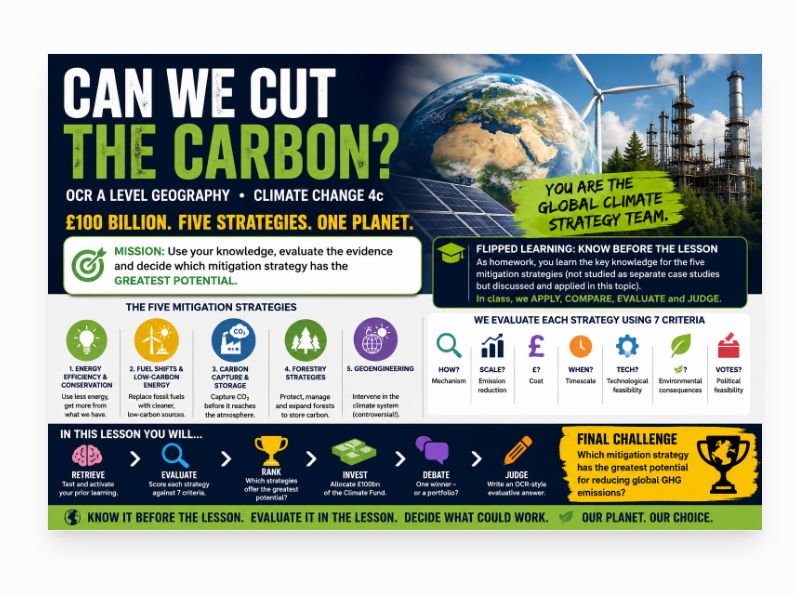

This lesson uses a flipped-learning approach to maximise classroom time for higher-order geographical thinking. As the individual mitigation strategies are not studied as separate detailed case studies within the specification, but are discussed and applied as part of understanding responses to climate change, students acquire the essential knowledge of energy efficiency and conservation, fuel shifts and low-carbon energy, carbon capture and storage, forestry strategies and geoengineering as homework before the lesson. The lesson then moves beyond simple knowledge acquisition: students retrieve and apply their prior learning, assess each strategy against common criteria including emissions reduction potential, cost, timescale, technological feasibility, environmental consequences and political feasibility, and compare their relative strengths and limitations. Through ranking, the £100 billion decision-making task and structured debate, students are required to apply knowledge, evaluate competing approaches and make substantiated judgements, culminating in the OCR-style question, “Which mitigation strategy has the greatest potential for reducing global GHG emissions?”
Get this resource as part of a bundle and save up to 51%
A bundle is a package of resources grouped together to teach a particular topic, or a series of lessons, in one place.
Something went wrong, please try again later.
This resource hasn't been reviewed yet
To ensure quality for our reviews, only customers who have purchased this resource can review it
Report this resourceto let us know if it violates our terms and conditions.
Our customer service team will review your report and will be in touch.
£1.50