


A complete OCR GCSE Media Studies lesson introducing students to camerawork, camera shots and camera angle connotations, with practical analysis tasks, video clip discussion and GCSE-style written response practice.
This fully editable PowerPoint (.pptx) lesson is suitable for GCSE Media Studies students and works well as an introductory media language lesson before analysing film, television, adverts, music videos or set text extracts.
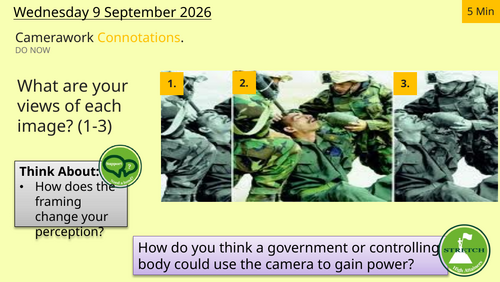
The lesson begins with a Do Now task asking students to consider how camera framing can change perception. Students explore how a government or controlling body could use camera framing to gain power by showing only part of the truth or shaping audience interpretation. This introduces the idea that camerawork is not neutral; it can influence how audiences understand people, events and power.
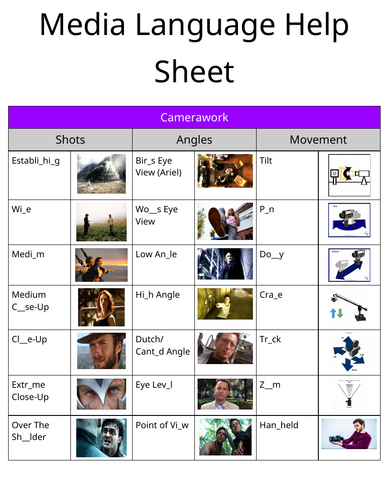
Students are then introduced to the lesson objectives, focusing on using camerawork terminology correctly, identifying examples of camerawork, and explaining the effects created by camera movement, shot type and angle. The lesson specifically supports terminology such as close-up, extreme close-up, medium shot, long shot, establishing shot, low angle, high angle, eye-level, tilt angle and POV.
The lesson develops students’ understanding through a Think Write Pair Share task on identifying camerawork, including how an establishing shot can influence audience expectations about genre, setting and mood. Students also explore why a director may end a scene with a close-up, focusing on emotion, character personality, dramatic tension and audience expectations.
Students then explore how camerawork creates meaning and connotations. The lesson models how a low angle can make a character appear powerful, heroic, threatening or dominant, while a high angle can make a character appear vulnerable, weak, overwhelmed or at a disadvantage. It also explains how an extreme close-up can focus attention on facial expression, emotion and tension.
The lesson includes several understanding checks where students identify different types of camerawork, including medium shot, close-up, low angle, extreme close-up, long shot, high angle, eye-level, tilt angle and establishing shot. These quick checks help secure terminology before students move into extended analysis.
The main activity focuses on movie analysis, asking students: How is camerawork used to create effects? Students use examples from a film clip and are supported with writing structures, note-taking prompts and a camerawork terminology bank. The lesson includes GCSE-style sentence starters to help students write about how camerawork makes the audience feel and how it creates meaning.
The lesson includes a model response analysing how a close-up of Thor lying
This resource is independently created and is not endorsed by OCR.
Something went wrong, please try again later.
This resource hasn't been reviewed yet
To ensure quality for our reviews, only customers who have purchased this resource can review it
Report this resourceto let us know if it violates our terms and conditions.
Our customer service team will review your report and will be in touch.
£6.00