docx, 33.69 KB
docx, 33.69 KB

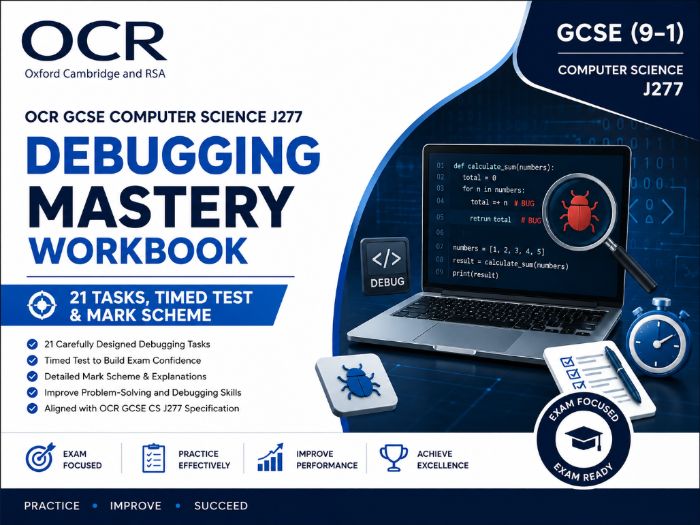
OCR GCSE Computer Science J277 Debugging Mastery Workbook – 21 Tasks, Timed Test & Mark Scheme

Turn your students into confident, exam-ready debuggers — in one resource.

Debugging is the skill that quietly costs GCSE Computer Science students the most marks — and the one teachers have the least ready-made material for. This 29-page workbook fixes that, completely.

Built specifically for OCR GCSE Computer Science (J277), this is a full progression from first-attempt “spot the missing colon” tasks right through to the kind of subtle, multi-layered bugs that separate a Grade 7 from a Grade 9. Every single task follows a rigorous 10-part structure — faulty code, student task, marks available, error identification, why it happens, corrected code, explanation of the fix, test data, expected output, AND the common misconception behind it — so students don’t just fix the bug, they understand it deeply enough to never make it again.

  • What’s inside:

21 fully worked debugging tasks in Python and OCR Exam Reference Language (pseudocode)
6 progressive sections: Find the Error → Explain the Error → Fix the Code → Find Multiple Errors → Debug Under Exam Conditions → Grade 9 Debugging Challenges
All 19 error categories on the spec covered: syntax, logic, runtime, incorrect conditions/loops, off-by-one, incorrect variable updates, incorrect data types, input-handling, selection, iteration, function/procedure, array indexing, algorithmic, Boolean logic, boundary conditions, infinite loops, incorrect initialisation, and incorrect output
A 30-minute, 40-mark Timed Debugging Assessment — genuine exam conditions
A complete, examiner-style mark scheme with accepted alternative answers and grade boundary guidance
Clean, professional formatting — projector-ready or print-ready, straight out of the box

Why teachers love it:

Saves hours of resource-writing time — this is a term’s worth of debugging practice, done for you
Perfect for starters, homework, revision lessons, cover lessons, or a dedicated “Debugging Week”
Genuinely stretches your top-set students with Grade 9-level challenges most resources don’t attempt
Built-in misconception boxes mean less re-teaching and faster progress
Works for whole-class teaching, independent revision, or 1:1 intervention

If your students can write code but panic the moment they’re handed someone else’s broken program, this is the resource that changes that — permanently.

Grab it now and give your Computer Science classes the debugging fluency examiners are actually looking for.

If you found this useful, please leave a review. it really helps!

Check out my other resources and bundles in my TES shop.

Get this resource as part of a bundle and save up to 74%

A bundle is a package of resources grouped together to teach a particular topic, or a series of lessons, in one place.

Bundle

OCR GCSE Computer Science J277 Component 2 PROGRAMMING MASTERY BUNDLE | Python, Pseudocode, Algorithms, Trace Tables & Debugging

💻 **OCR GCSE Computer Science J277 Component 2 Programming Mastery Bundle** Develop stronger computational thinking, algorithmic reasoning and programming skills with this focused collection of OCR GCSE Computer Science learning and examination resources. Designed for students who need structured programming practice and teachers who want ready-to-use activities, this bundle combines Python tasks, OCR Reference Language pseudocode, algorithms, trace tables, debugging exercises and assessment materials. 🐍 **WHAT'S INCLUDED** - **Python Programming Challenges:** Progressive programming tasks designed to practise coding and problem-solving. - **Pseudocode Practice:** Exercises using OCR Reference Language conventions and structured algorithm design. - **Algorithms:** Practice involving computational thinking, searching, sorting and algorithm tracing. - **Trace Tables and Dry Running:** Activities to follow variable values, iteration, selection and program execution. - **Programming Fundamentals:** Questions and exercises covering core programming constructs. - **Producing Robust Programs:** Practice with testing, validation, defensive programming and handling errors where covered by the resources. - **Debugging and Error Analysis:** Activities to identify, explain and correct programming errors. - **Boolean Logic:** Truth tables, logic gates and related problem-solving exercises. - **Programming Languages and IDEs:** Revision of translators, programming language classifications and development environments. - **Answers and Assessment:** Worked solutions, answer keys, mark schemes and diagnostic tools where supplied. 🎯 **IDEAL FOR** - Students developing confidence with programming. - Learners preparing for OCR J277 Component 2. - Teachers planning programming lessons and homework. - Tutors delivering targeted intervention and extension tasks. - Students aiming to improve algorithm tracing, pseudocode accuracy and programming technique. ⭐ **KEY BENEFITS** - Practise applying computational thinking to unfamiliar problems. - Strengthen pseudocode and Python skills. - Develop accuracy when tracing algorithms. - Learn to identify and correct programming errors. - Review solutions and identify weaknesses for further practice. 📦 **DIGITAL RESOURCE INFORMATION** The bundle contains the files identified in the included contents list. The precise file formats, number of tasks and availability of worked solutions depend on the original included resources; please review the preview before purchasing. **Qualification:** OCR GCSE Computer Science **Specification:** J277 **Focus:** Component 2 – Computational Thinking, Algorithms and Programming This is an independent educational resource collection and is not affiliated with or endorsed by OCR.

£16.99

Reviews

Something went wrong, please try again later.

This resource hasn't been reviewed yet

To ensure quality for our reviews, only customers who have purchased this resource can review it

Report this resourceto let us know if it violates our terms and conditions.
Our customer service team will review your report and will be in touch.