


This Year 10 Geography lesson introduces students to two contrasting approaches to food production: agribusiness and organic farming. Learners explore the defining characteristics of each system, from large‑scale mechanised agriculture to small‑scale sustainable methods, before analysing the economic, environmental and ethical trade‑offs involved in feeding a growing population.
Students evaluate the efficiency of mechanised farming, compare the environmental impacts of different production methods, and consider how cost, yield and sustainability influence farming decisions. The lesson encourages critical thinking about the future of agriculture and the challenges of balancing productivity with environmental responsibility.
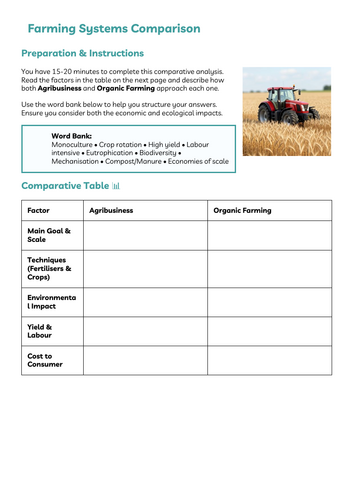
A PPT and worksheet are included, providing a ready‑to‑teach resource that supports comparison, evaluation and structured geographical analysis.
Learning Objective:
To compare different farming systems and evaluate their economic and environmental impacts.
Success Criteria:
- Define the characteristics of agribusiness and organic farming.
- Evaluate the economic efficiency of mechanised agriculture.
- Compare the environmental impacts of different farming methods.
- Analyse the trade‑offs between cost, yield and sustainability.
Something went wrong, please try again later.
This resource hasn't been reviewed yet
To ensure quality for our reviews, only customers who have purchased this resource can review it
Report this resourceto let us know if it violates our terms and conditions.
Our customer service team will review your report and will be in touch.
£2.00