


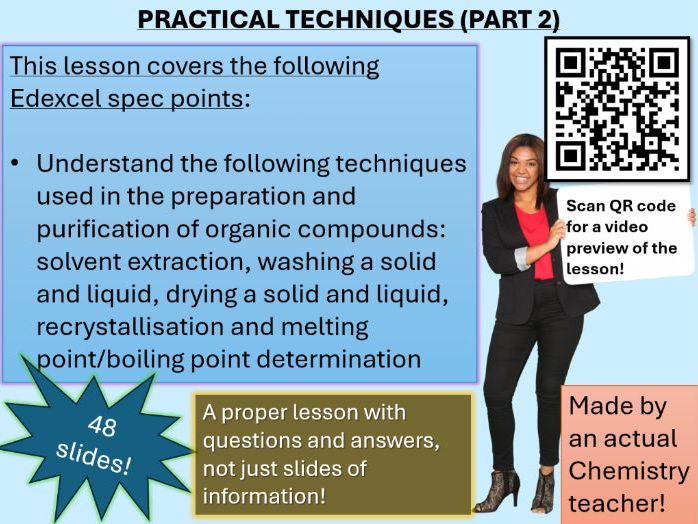
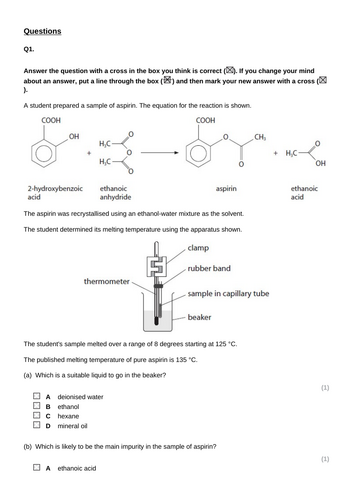
How are the following techniques used to separate/purify organic compounds: solvent extraction, recrystallisation, washing a solid/liquid, and melting point/boiling point determination? All this and more covered in this comprehensive lesson with questions and answers! This is a Year 13 A level lesson for Edexcel International Unit 5 – WCH15, but it can also be used for all UK exam boards. All the slides in this lesson are fully animated and include answers to every mini plenary question and exam question. The breakdown of the slides (which are best opened on Microsoft PowerPoint) is as follows:
Slide 1 - Title and 5-minute starter. The starter is a grid of four questions entitled ‘last week, last lesson, today’s learning and future learning’. Use this generic slide for all of your lessons by simply changing the questions and the answers each time.
Slide 2 - Lesson objectives (see thumbnail image)
Slides 3 – 11: This section goes into the details of solvent extraction. The following is covered: What is solvent extraction, important considerations, a sorting task to help students understand the steps in solvent extraction and a schematic diagram which explains solvent extraction.
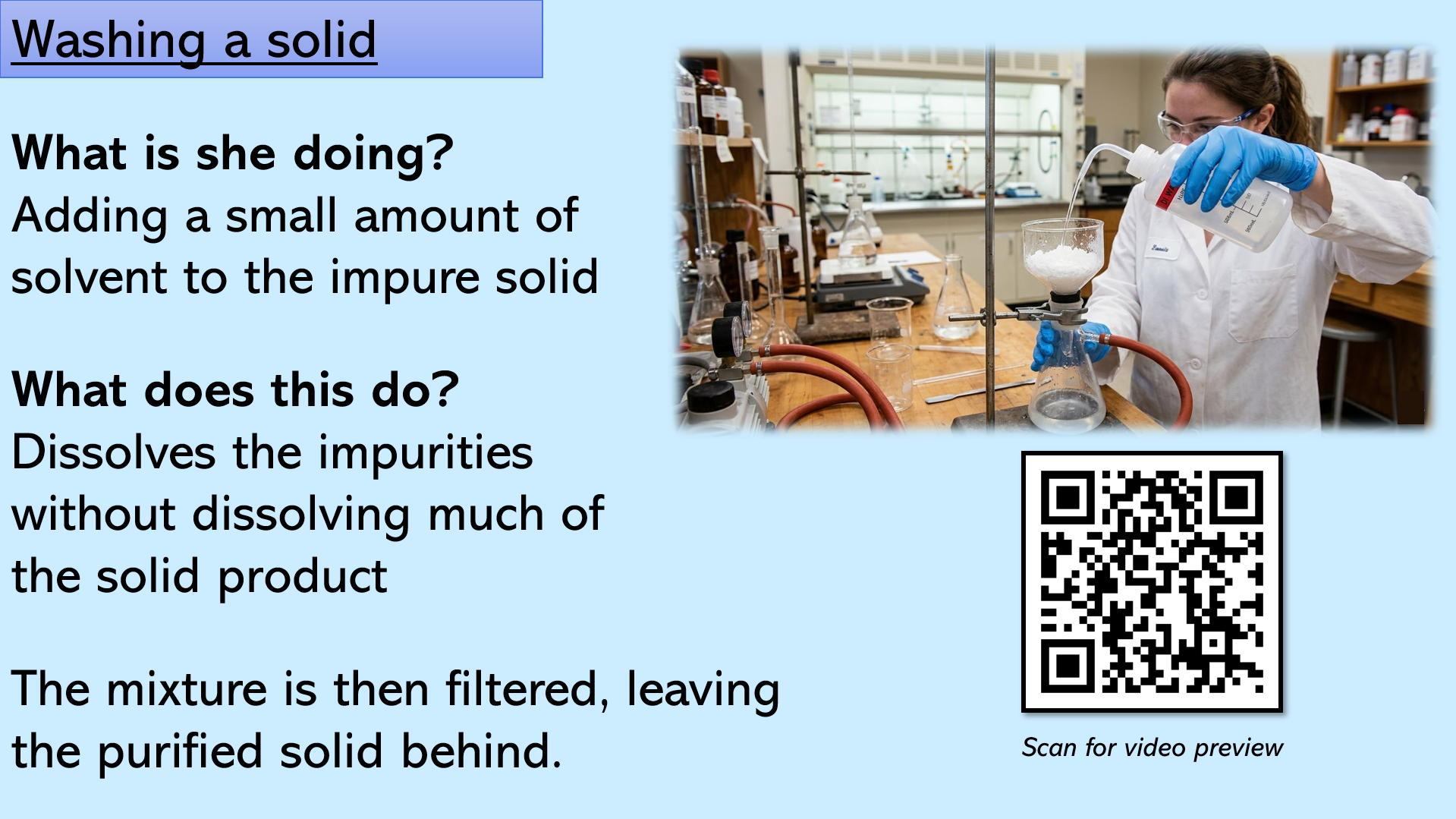
Slides 12 – 20: This section goes into the details of washing solids and washing liquids. The following is covered: what general washing is, how washing a solid is achieved, how washing a liquid is achieved and, importantly, how washing a liquid compares and contrasts with solvent extraction.
Slides 21 – 22: Drying a solid is introduced here. An excellent and humorous video is embedded in the PowerPoint which shows how a desiccator is used to dry a solid
Slides 23 – 27: This section goes into the detail of drying a liquid. The following is covered: normal drying agents used (anhydrous salts, such as calcium chloride), the method for drying a liquid, including how to know if the liquid is dry, how to remove the drying agent from the liquid, and important considerations for the selection of a drying agent
Slides 28 – 33: This section goes into the detail of recrystallisation. The following is covered: what is recrystallisation, the steps of recrystallisation with FULL EXPLANATION OF EACH STEP (this is often omitted from textbooks annoyingly), a clear diagram showing the difference between a Hirsch funnel and a Buchner funnel, and a short, embedded video showing the recrystallisation procedure.
Slide 34 – Mini plenary questions to test for understanding so far. Answers appear on the screen in sequence when you click
Slides 35 – 40: This section goes into the detail of testing the purity of a solid. The following is covered: the difference between a pure solid and an impure solid in terms of melting point, why impure solids have lower melting points, an embedded video showing how melting point apparatus can be used to determine purity of solid acetanilide, and a diagram showing an alternative set-up for testing purity of a solid without melting point apparatus
Watch video
Something went wrong, please try again later.
This resource hasn't been reviewed yet
To ensure quality for our reviews, only customers who have purchased this resource can review it
Report this resourceto let us know if it violates our terms and conditions.
Our customer service team will review your report and will be in touch.
£4.50