


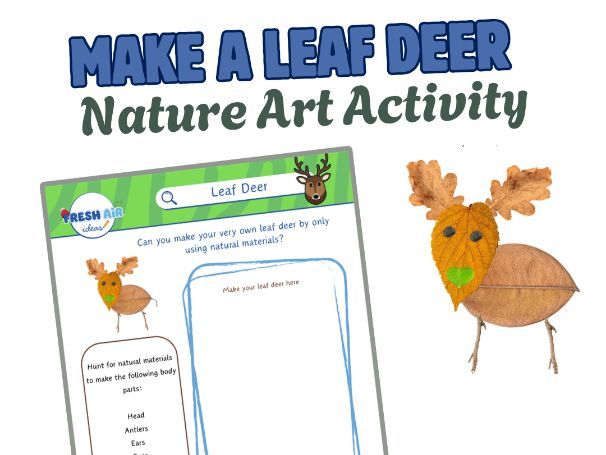
Perfect for Early Years Foundation Stage (EYFS) and Key Stage 1 (KS1), this leaf, nature art activity blends outdoor learning with arts and crafts, focusing on leaf identification and imaginative play through the creation of a beautiful leaf deer.
Preparation
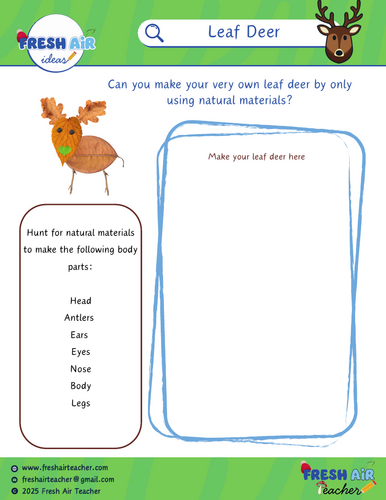
Print the Leaf Deer worksheet A4 or A3 (which features a simple outline of a deer, focusing on the main body shape and head).
Gather glue sticks and provide each child with a clipboard to make working outdoors much easier.
Extra tip: Read a story about woodland animals or deer before starting the activity to inspire their creations and discuss the deer’s key features.
The Hunt
Take your class to a designated outdoor learning space—a playground, school garden, woodland area, or park.
Explain that they are going on a hunt for the materials needed to construct their leaf deer!
Find the Parts
Children need to find different leaves and natural materials (especially twigs and small stones) that can represent the various parts of their leaf deer on the worksheet:
Body: A large, solid leaf or overlapping leaves, ideally with earthy tones (browns, deep reds, greens).
Head: A round or oval leaf, slightly smaller than the body.
Antlers: Crucially, find small, branching twigs! These will form the deer’s antlers.
Legs: Four narrow leaves or short, straight twigs.
Eyes & Nose: Tiny leaves, small petals, or minuscule stones for the facial features.
Create & Glue
Once they have collected their materials, return to a suitable outdoor spot (or back to the classroom).
Using their clipboards for a stable surface, children glue their found natural items onto the worksheet to create their own unique leaf deer.
Encourage them to carefully position the twigs for the antlers and experiment with different leaf colours and textures to create a natural, camouflaged look.
Benefits of Outdoor Learning
Enhanced Observation Skills: Being in nature encourages children to observe details, textures, and colours more closely, which is vital for leaf identification and artistic creation.
Working with Natural Materials: Engaging directly with natural resources like leaves and twigs (for fine motor practice) helps children develop a deeper appreciation for the environment and improves fine motor skills through manipulation and creation.
Hands-on Leaf Identification: A playful way to introduce different leaf shapes, sizes, and textures, encouraging early botany and environmental awareness.
Sensory Exploration: The tactile experience of collecting and working with leaves stimulates sensory development.
Get this resource as part of a bundle and save up to 33%
A bundle is a package of resources grouped together to teach a particular topic, or a series of lessons, in one place.
Something went wrong, please try again later.
This resource hasn't been reviewed yet
To ensure quality for our reviews, only customers who have purchased this resource can review it
Report this resourceto let us know if it violates our terms and conditions.
Our customer service team will review your report and will be in touch.
£1.50