

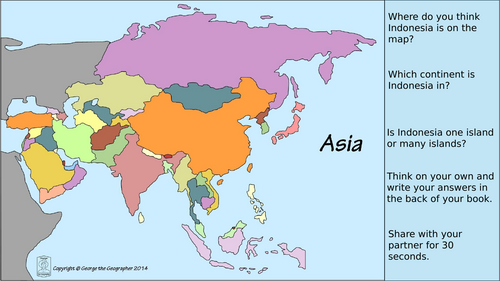

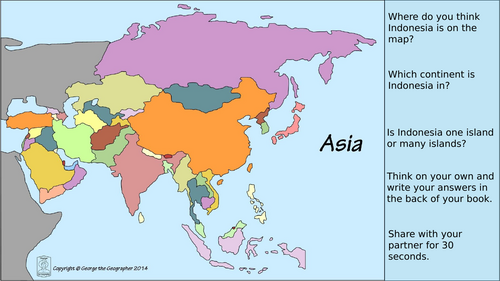
This resource is a Geography lesson PowerPoint focused on Indonesia and palm oil, designed to develop students’ understanding of location, tropical rainforests, and environmental issues. It begins with a starter activity where students identify Indonesia’s location, consider whether it is made up of one or many islands, and recall prior knowledge through discussion and true/false questions.
The lesson then introduces key learning aims: locating Indonesia in Asia, understanding the characteristics of its tropical rainforest biome, and exploring why these environments are vulnerable to damage, particularly from human activities such as palm oil production. Students complete a series of scaffolded, map-based and knowledge-building tasks, including identifying Jakarta’s island, labelling oceans and seas, and recognising Indonesia as an archipelago of over 17,000 islands located on the Pacific Ring of Fire.
Further activities focus on Indonesia’s physical geography and biodiversity, where students match features (e.g., population, natural hazards, biodiversity) to clues and describe landscapes such as rainforests, volcanoes, coral reefs, and mangroves. A structured paragraph-building task helps students summarise key facts using geographical vocabulary like “equator,” “volcanic,” and “diverse.” The lesson also includes a thinking task asking whether it would be easy or difficult to live in Indonesia, encouraging students to apply their knowledge.
A significant portion of the resource explores tropical rainforest structure and importance, including layers of the rainforest, climate conditions (hot and wet year-round), nutrient cycling, and adaptations of plants and animals. Students learn why rainforests are vital, for example in storing carbon dioxide, supporting biodiversity, providing food and medicine, and helping regulate climate.
The lesson culminates in an extended writing task where students evaluate whether Indonesia’s rainforests should be protected. This is highly scaffolded with sentence starters and guidance on structuring an argument, requiring students to give reasons, use evidence, and consider consequences of deforestation.
Overall, this is a well-structured, enquiry-based lesson aimed at KS3 students, combining map skills, knowledge acquisition, environmental awareness, and evaluative writing, with a strong focus on the global importance and vulnerability of tropical rainforests.
Something went wrong, please try again later.
This resource hasn't been reviewed yet
To ensure quality for our reviews, only customers who have purchased this resource can review it
Report this resourceto let us know if it violates our terms and conditions.
Our customer service team will review your report and will be in touch.
£3.00