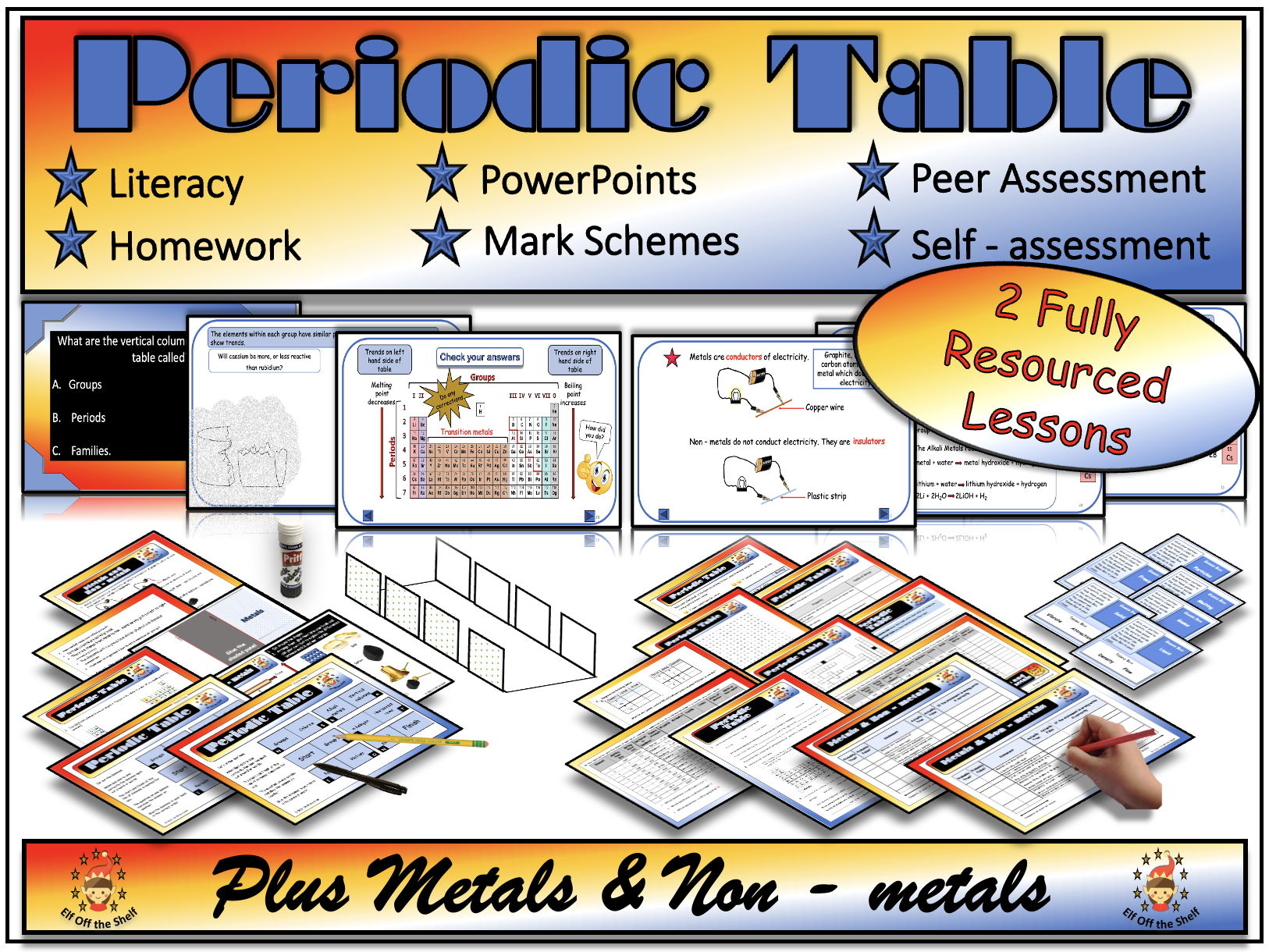
Two fully resourced lessons on the periodic table and the properties of metals and non – metals. Select from a wide range of no-prep, print-and-go resources and activities to tailor each lesson to the precise needs of individual students, small groups or a whole class.
What’s Covered
Metals and Non – metals
Metals are conductors of electricity and heat while non - metals are insulators.
Metals are strong (have high tensile strength) but non - metals are not.
Metals are shiny when freshly cut or polished but non -metals are dull.
Metals are sonorous (make a ringing noise when struck while non – metals do not.
Metals are malleable (can be beaten into shape) and ductile (can be drawn into wires) but non – metals are neither and are brittle (shatter when struck.
Iron, nickel and cobalt are magnetic but all non – metals are not magnetic.
Metals are heavy which means they have a high have a high density because they contain a lot of particles. Non – metals are not heavy.
Metals are all solids at room temperature, except for mercury which is a liquid, as they have high boiling and melting points. Of seventeen non - metals, all are gases except for five which are solids and one which is a liquid.
Both metals are non – metals burn in oxygen to form the oxide.
Metal oxides are alkaline and non -metal oxides are acidic.
Periodic Table
Elements are arranged in the periodic table in order of atomic number.
Metals are on the left of the table and non – metals on the right with a zig – zag line dividing the two.
Some of the metals touching the zig – zag line are semi – metals or metalloids which means they have some properties of metals and of non – metals.
Vertical columns are called groups and horizontal rows are called periods.
Each period starts with metals on the left and end with non – metals on the right.
The elements within each group have similar physical and chemical properties.
Group 1 are the alkali metals. Group 2 are the alkaline earth metals. Group 7 are the halogens. Group 0 are the rare or noble gases. The central block are the transition metals.
On the left – hand side of the table, reactivity increases as you go down a group and on the right – hand side of the table reactivity increases as you go up a group.
Group 1: can be cut with a knife; must be stored under oil; low density – lithium, sodium and potassium float on water; form compounds which are solid at room temperature; form compounds with similar formulae – LiCl. NaCl. Group 7;are all colored; react with hydrogen to form acids; react with metals to form salts.
Alkali metal + water alkali metal hydroxide + hydrogen
lithium + water lithium hydroxide + hydrogen
Group 0 are all inert gases – they do not react with other elements
Transition metals; except for mercury, which is a liquid, these are harder than group 1 metals; have high melting points; react slowly with atmos**pheric oxygen.
What’s Included
Animated PowerPoint for teaching with exit ticket quiz and all answers to classwork and homework) (x2)
Flip it (pupil writes questions to given answers) (x2)
Anticipation Guides (combined starter and plenary) (x2)
Guided notes to support the PowerPoint (x4)
Foldable (students use to make their own notes)
Cut-and-stick activity pupil uses to make their own notes)
Fact sheet (x2)
Homework (x5) plus answers
Fact share worksheet (x2)
12 Taboo cards
Pupil progress self-assessment checklist (x2)
Exit Ticket
Suggested lesson plan showing choices possible between resources (x2)
For each topic there are at least 14 printable resources and it is intended that the teacher uses them to build their own unique lesson to take account of student ability and time available. Literacy, oracy, self-assessment and peer assessment are all built in to the resources. For each topic, these features are clearly marked on a comprehensive one-page flow chart lesson plan which shows where the logical choices between resources can be made.