


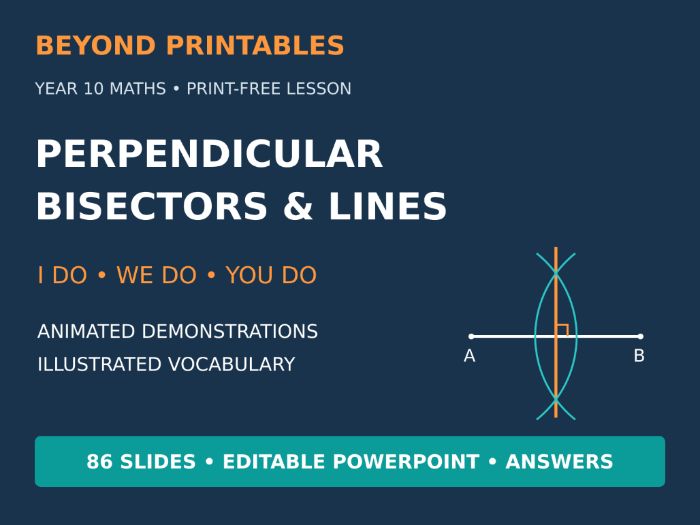
Teach perpendicular bisectors and perpendicular lines with this print-free Year 10 maths lesson. The 86-slide editable PowerPoint combines animated construction demonstrations, illustrated vocabulary, matched modelling, assessment for learning and practice with worked answers.
Pupils learn to construct the perpendicular bisector of a segment, construct a perpendicular through a point on a line, and construct the shortest segment from a point to a line. They keep their compass arcs and explain the equal-distance properties that make each construction work.
WHAT IS INCLUDED
• An 86-slide editable PowerPoint lesson with questions and answers.
• Six grouped retrieval questions and grouped answers.
• Six grouped prerequisite questions and grouped answers.
• Five illustrated vocabulary slides, including circumcentre, equidistant, locus, arc, radius, intersection and the language of congruence proofs.
• A 3 × 2 I Do–We Do modelling grid with three matched pairs.
• Animated construction demonstrations and completed WE DO solutions with visible arcs.
• 20 individual AFL questions, each immediately followed by its answer.
• 12 minimally different practice questions arranged in four controlled-variation blocks, with matching solutions.
• A whole-class task bringing Developing, Secure and Greater Depth together, with one Super Challenge.
• Completed construction diagrams, worked calculations and proof solutions.
• An exit check and matching answers.
• One TES thumbnail, three preview images and this suggested listing copy.
I DO, WE DO, YOU DO
The modelling grid pairs questions 1 and 4, 2 and 5, and 3 and 6. The pairs cover three different construction decisions: bisecting a segment, drawing a perpendicular through a point on a line, and finding the shortest segment from a point to a line.
ILLUSTRATED VOCABULARY
Definitions sit alongside diagrams showing the geometric objects and relationships they describe. Pupils can see the difference between a bisector and a perpendicular bisector, what equidistant means, and how a locus represents all points satisfying a condition. The circumcentre example shows an obtuse triangle with its centre outside the triangle. Supporting vocabulary explains vertices, obtuse angles, congruent triangles, SSS, SAS and “if and only if”.
MINIMALLY DIFFERENT PRACTICE
Four linked blocks vary the segment length, move a point along a fixed segment, change a point’s distance from a line, and change a perpendicular height while keeping the base fixed. The sequence connects accurate constructions with equal distances and Pythagoras’ theorem.
DIFFERENTIATED PRACTICE AND EXTENSION
Developing focuses on perpendicular bisectors and midpoint lengths. Secure develops perpendicular constructions and a Pythagoras calculation. Greater Depth asks pupils to justify the perpendicular-bisector property in both directions and construct an obtuse triangle’s circumcentre.
Something went wrong, please try again later.
This resource hasn't been reviewed yet
To ensure quality for our reviews, only customers who have purchased this resource can review it
Report this resourceto let us know if it violates our terms and conditions.
Our customer service team will review your report and will be in touch.
£3.00