


What’s included
- 36-page PDF in A4 and US Letter
- Grown-up guide with a 10-minute daily routine (revisit, teach, practise, apply), and an EYFS links page with page numbers
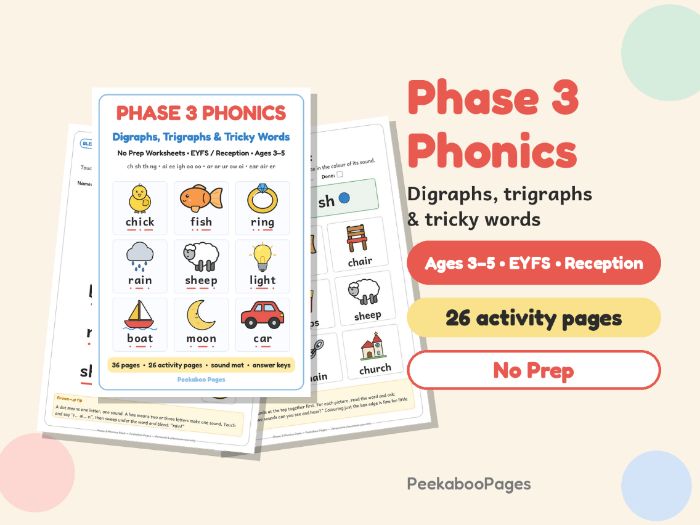
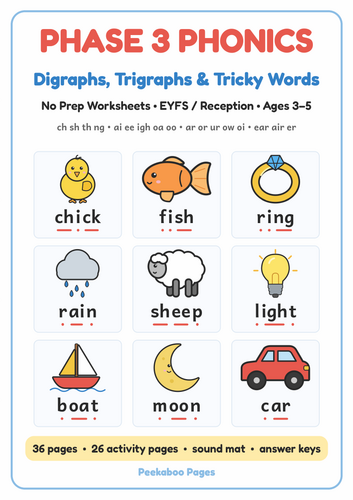
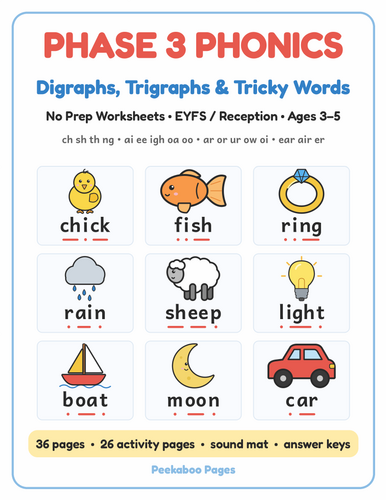
- Phase 3 sound mat: ch sh th ng qu x, ai ee igh oa oo (long and short) ar or ur ow oi ear air er, and j v w z, each with a picture
- 26 activity pages:
- Sound spotting: Spot the Sound (2) and Which Sound Can You Hear? (2)
- Blending: Read & Match with sound buttons (3) and Add the Sound Buttons – dots and dashes (2)
- Segmenting: Sound Boxes – trace and write (3) and Fill in the Missing Sound (2)
- Sound Sort – ch/sh and oa/oo (2) and Read & Colour (1)
- Which Word? – picture–word matching (2)
- Roll & Read dice games (2)
- Phase 3 tricky words – read, trace and write: he she we me be was you they all are my her (2)
- Read & Match Captions (2) and Yes or No? questions (1)
- 4 answer key pages and a “Phonics Superstar” certificate
- A short grown-up tip on every activity page
Skills
- Recognising the Phase 3 digraphs and trigraphs and saying the sound for each
- Blending for reading with sound buttons (a dot for one letter, a line for a digraph or trigraph)
- Segmenting for spelling with sound boxes (one sound per box, even when it is two or three letters)
- Hearing and identifying sounds in words, including long and short oo
- Reading the Phase 3 tricky words
- Reading simple captions and questions for meaning
- Uses only decodable words with Phase 2 and Phase 3 graphemes
How to use
- No Prep: print and go. A dice is useful for Roll & Read.
- Follow the 10-minute daily routine: revisit sounds on the sound mat, teach a sound, practise with one page, then apply with a caption or tricky word.
- Model each page first: touch each sound button, say the pure sound, then blend.
- Pick pages with sounds your children have already been taught – school SSP programmes may order Phase 3 sounds differently.
- Good for whole-class follow-up, small-group interventions, early finishers, continuous provision and home learning.
EYFS links
- Communication and Language: listening carefully to sounds in words, saying words clearly, and answering simple questions about pictures and captions.
- Literacy – Word Reading (ELG): say a sound for each letter in the alphabet and at least 10 digraphs; read words consistent with their phonic knowledge by sound-blending; read aloud simple sentences that are consistent with their phonic knowledge, including some common exception words.
- Literacy – Writing: spell words by identifying the sounds and then writing the sound with letter(s).
- Physical Development – Fine Motor Skills: tracing, writing, colouring and drawing lines.
Research-inspired: designed around a systematic synthetic phonics approach to blending and segmenting practice. It practises these skills through short, playful pages and is not a complete phonics programme or an assessment. It links to the EYFS framework but is not an official DfE resource.
Something went wrong, please try again later.
This resource hasn't been reviewed yet
To ensure quality for our reviews, only customers who have purchased this resource can review it
Report this resourceto let us know if it violates our terms and conditions.
Our customer service team will review your report and will be in touch.
$5.30