


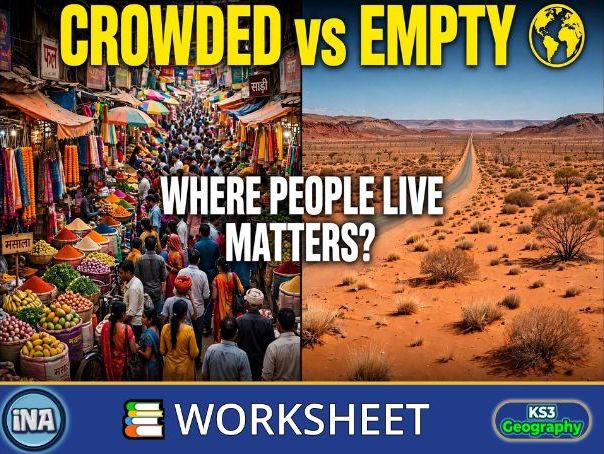
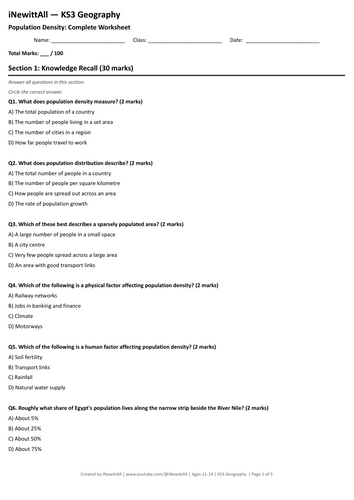
A complete, no-prep 100-mark worksheet on population density — ready to use for lessons, homework, or revision with KS3 Geography students aged 11-14.
Population density describes how many people live in a given area, usually measured as the number of people per square kilometre. It explains why some parts of the world are crowded while others are almost empty.
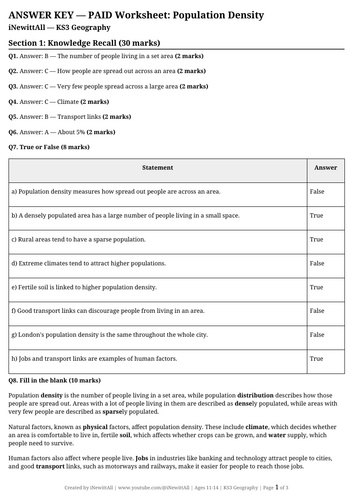
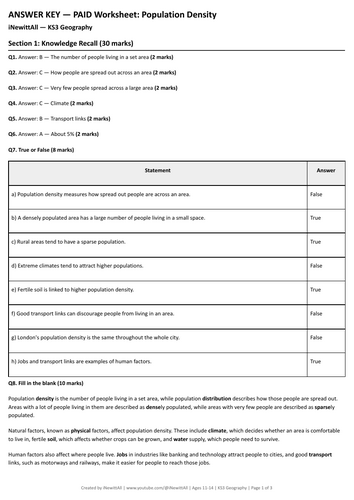
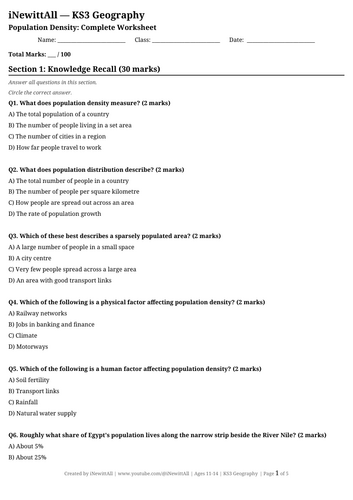
Structured across three sections of progressive difficulty: Section 1 (30 marks) covers key vocabulary and core recall through multiple choice questions, a true or false table and a fill-in-the-blank passage. Section 2 (40 marks) builds understanding through short answer questions on climate, soil and transport links, a physical-versus-human factor classification table, and key term definitions. Section 3 (30 marks) challenges students with extended writing tasks comparing London’s inner-city and suburban density, contrasting Australia and Europe, and analysing why country size alone does not determine population density. A full answer key with detailed marking guidance is included.
Also available: a companion extension pack with four enrichment activities, or save £1 with the complete lesson bundle — both listed on the iNewittAll TES store.
TAGS: population density, KS3 geography, geography worksheet, population distribution, densely populated, sparsely populated, human geography, physical factors, human factors, settlement, KS3 assessment, geography homework, year 7 geography, year 8 geography, geography classroom resource
PRICE: £3
KEY STAGE: KS3
SUBJECT: Geography
Something went wrong, please try again later.
This resource hasn't been reviewed yet
To ensure quality for our reviews, only customers who have purchased this resource can review it
Report this resourceto let us know if it violates our terms and conditions.
Our customer service team will review your report and will be in touch.
£3.00