


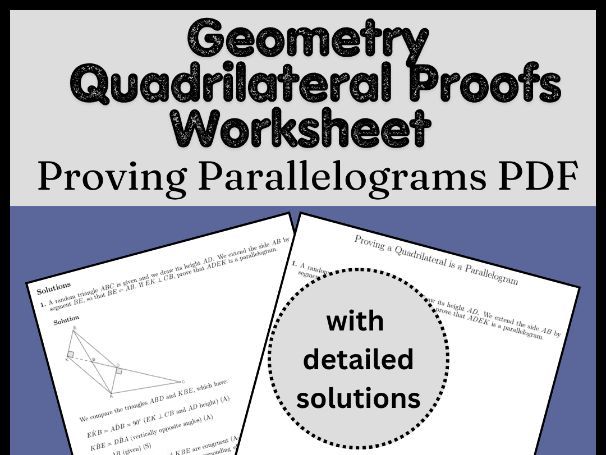
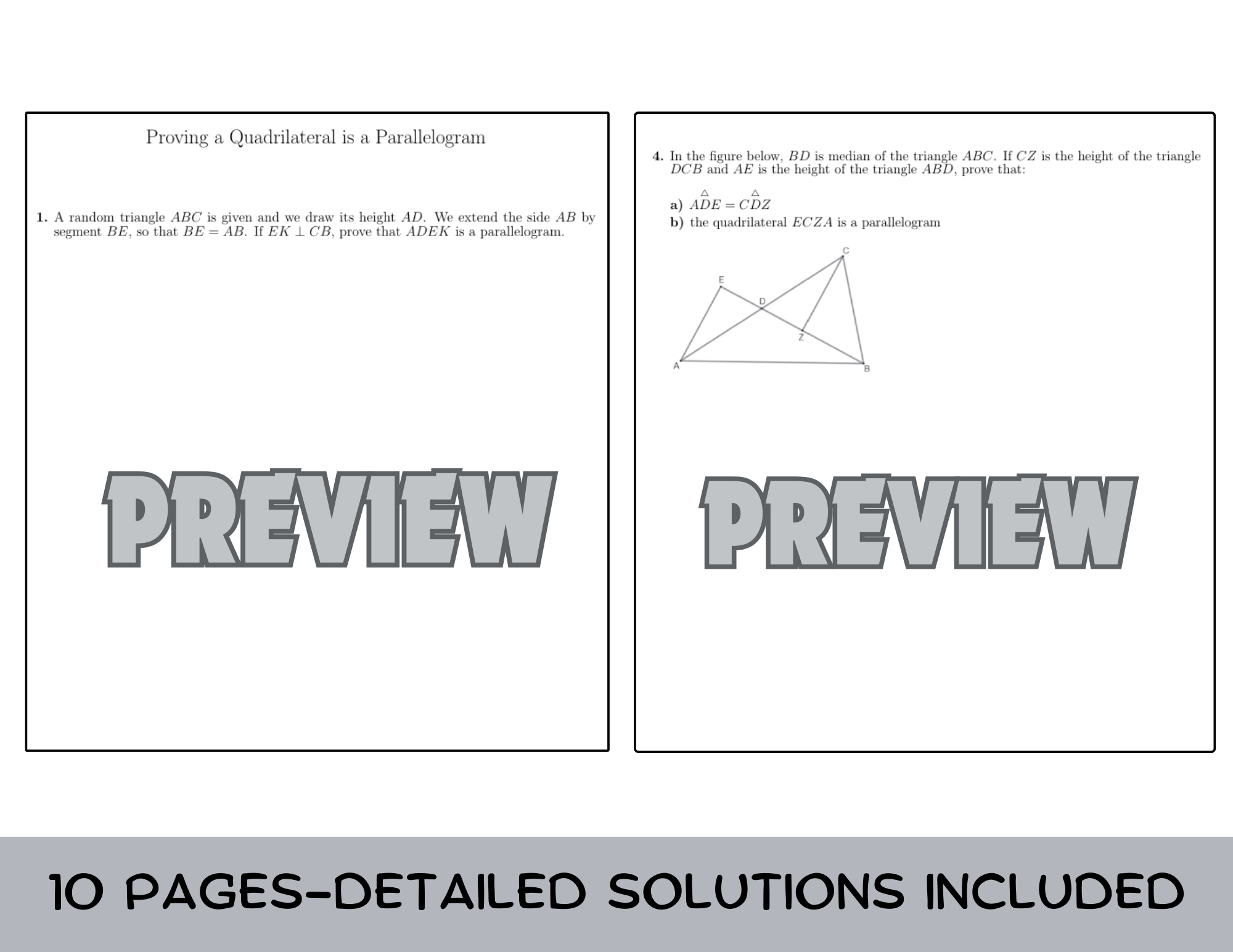
A worksheet on proving a quadrilateral is a parallelogram. Students will have to solve five problems in which they will have to draw the relevant figure (if not given) and then prove that a quadrilateral is a parallelogram either because its diagonals bisect each other or because it has two opposite sides parallel and equal. Detailed solutions included.
Looking for a rigorous, no prep collection of resources to help your secondary maths students master quadrilateral proofs? This advanced practice packet provides a complete learning path, taking students through multi-step geometric proofs that require formal deductive reasoning and properties of congruent triangles.
Whether your classes are just learning to verify geometric shapes or are practicing formal proofs using triangle congruence theorems, this resource has everything you need. Best of all, complete, step-by-step solutions with detailed written justifications and diagram markings are included for every problem to save you hours of marking time or to allow for easy student self-assessment!
What’s Included in This Resource?
This package features a carefully structured problem set complete with full written solutions:
- Triangle Congruence Integration – Every single exercise requires students to compare and prove triangles congruent (using Angle-Angle-Side or Angle-Side-Angle) as a crucial stepping stone to finding matching side lengths or angle pairings.
- Diagonal Property Analysis – Problems that require students to mathematically prove that diagonals bisect each other to definitively conclude that a quadrilateral is a parallelogram.
- Alternate Interior and Vertically Opposite Angle Proofs – Multi-step diagram problems where students utilise parallel lines and vertical angle pairings to establish congruence criteria.
- Median and Height Adjustments – Geometric setups that introduce triangle medians and perpendicular height segments, testing a student’s ability to extract hidden angle and midpoint relationships.
- Full Structural Justifications – Every single diagram problem is paired with a solution that walks students through the geometric reasoning required to defend their final proofs.
Skills Covered:
- Proving a quadrilateral is a parallelogram using opposite sides, angles, or diagonals.
- Identifying congruent triangles using Angle-Angle-Side (AAS) and Angle-Side-Angle (ASA) criteria.
- Utilising geometric line segments including medians, perpendicular heights, and midpoints.
- Working with angles: vertically opposite angles and alternate interior angles.
- Writing clear mathematical justifications based on geometric markings and theorems.
**Curriculum & Key Stage Alignment:
- Key Stages: Key Stage 3 (KS3) Extension & Key Stage 4 (KS4) GCSE Maths
- Exam Board Suitability: Ideal for Higher Tier GCSE (AQA, Edexcel, OCR)
Get this resource as part of a bundle and save up to 47%
A bundle is a package of resources grouped together to teach a particular topic, or a series of lessons, in one place.
Bundle
Properties of Parallelograms Proofs Area & Perimeter Bundle | Geometry
Four worksheets on parallelograms. The two worksheets are on the properties, perimeter and area of parallelograms. The exercises require to find missing sides, angles or diagonals of given parallelograms using their properties (equal opposite sides, equal opposite angles, supplementary consecutive angles, bisecting diagonals), find the perimeter and area of given parallelograms or find the sides and heights of parallelograms whose area or perimeter or both are known. The other two worksheets have exercises that require to determine whether a given quadrilateral is a parallelogram or not. They aim to help students understand the five properties that can be used to prove that a quadrilateral is a parallelogram. Detailed solutions are included. Are your student groups struggling to move from simple area calculations to formal geometric proofs? Do they get confused when using algebra to find missing parts of a parallelogram, or when verifying if a quadrilateral meets the necessary conditions to be a true parallelogram? Take the stress out of your lesson planning with this comprehensive, multi-part geometry resource bundle! This collection features a meticulously scaffolded learning track that transitions students smoothly from foundational calculation problems to rigorous, triangle-congruence proofs. **What is a Parallelogram?** In mathematics, a parallelogram is a flat shape (a special type of quadrilateral) with opposite sides that are parallel and equal in length. To solve complex questions involving these shapes, students must understand their core geometric properties: opposite angles are equal, consecutive interior angles add up to 180 degrees (supplementary), and the two diagonals cut each other exactly in half (bisect). This resource provides the structured exposure students need to recognise these geometric traits instantly and manipulate algebraic expressions to write complete proofs. **What’s Included in This Resource Pack?Part 1: Calculations, Area and Perimeter** * **Algebraic Property Practice:** Problems requiring students to apply core theorems (equal opposite sides/angles, 180-degree interior angle rules, and bisecting diagonals) to set up and solve algebraic linear equations. * **Area & Perimeter Fluency:** Traditional area calculations alongside complex "working backward" problems where students must find missing alternative heights or apply the Pythagorean theorem. **Part 2: Proving Quadrilaterals are Parallelograms** * **Visual & Logical Identification:** 14 diverse quadrilateral diagrams where students must determine if the given markings supply enough mathematical evidence to prove a shape is a true parallelogram. * **Justification Focus:** Forces students to explain their reasoning using definitions like interior supplementary angles, congruent opposite sides, or bisected diagonals. **Part 3: Formal Geometric Proofs** * **Multi-Step Triangle Congruence:** Challenging, structured problems requiring students to use right-triangle altitudes, medians, vertically opposite angles, and alternate interior angles to write out complete geometric proofs. * **Rigorous Theorem Building:** Guides students to apply Angle-Angle-Side (AAS) and Angle-Side-Angle (ASA) criteria to mathematically prove parallelogram rules. **Full Teacher Answer Keys** * Step-by-step solutions are included for every single problem, showing the exact algebraic layouts, complete visual marking confirmations, and fully written-out proofs. This makes them perfect for quick marking, projectable self-assessment, or independent study checks. **Ideal For Curriculum Delivery:** * **KS3 Maths:** Perfect for introducing polygon properties, calculating areas, and applying simple algebraic equations in Years 7, 8, and 9. * **KS4 / GCSE Maths (Foundation & Higher):** Excellent as a comprehensive unit review covering quadrilateral properties, structural reasoning, and triangle congruence proofs. * **Remedial Support / Revision:** High-utility worksheets for intervention groups, homework packages, or independent learning centers. **Why Teachers Choose Our Resources:** * **Ready to Print:** No-prep layout saves valuable preparation time—simply print and copy. * **Scaffolded Progress:** The problem sets intentionally scale in difficulty to build student confidence. * **Spacious Design:** Clean layout gives learners plenty of room to write out their working directly on the sheet. *If you find this maths resource helpful, please leave a review! Your feedback helps create better classroom tools.*
£3.80
Bundle
Geometry Parallelogram Rectangle Rhombus Square Worksheets Bundle
A collection of four worksheets on the properties of parallelograms, rectangles, rhombi and squares. The first worksheet is on the properties of parallelograms, rectangles, rhombi and squares. It consists of two exercises, the second of which has 10 problems. In the first exercise, the students have to match the given descriptions with the corresponding quadrilaterals. In the second, exercise students have to apply their knowledge of the properties of parallelograms, rectangles, rhombi and squares to classify the 10 given quadrilaterals. The second worksheet is on proving a quadrilateral is a parallelogram. Students will have to solve five problems in which they will have to draw the relevant figure (if not given) and then prove that a quadrilateral is a parallelogram either because its diagonals bisect each other or because it has two opposite sides parallel and equal. The third worksheet is on proving a quadrilateral is a rectangle. Students will have to solve five problems in which they will have to draw the relevant figure and then prove that a quadrilateral is a rectangle either because it is a parallelogram and has one right angle or because two opposite sides of it are equal and parallel. The fourth worksheet is on proving a quadrilateral is a rhombus. Students will have to solve seven problems in which they will have to draw the relevant figure (if not given) and then prove that a quadrilateral is a rhombus using one of the following criteria: all its sides are equal, it is a parallelogram and has two consecutive sides equal, it is a rectangle and one of its diagonals divides one of its angles, is a parallelogram and its diagonals intersect at right angles. In addition, they have to prove that pairs of triangles are congruent or line segments are equal using the properties of rhombus. Detailed solutions included. Looking for a comprehensive, no prep collection of resources to help your secondary maths students master polygon properties and geometric proofs? This ultimate multi-packet bundle provides a complete practice path, taking students from basic trait classification all the way to rigorous, multi-step deductive reasoning proofs! Whether your classes are identifying special quadrilaterals from side markings or practicing formal proofs using triangle congruence theorems, this resource bundle has everything you need. Best of all, complete, step-by-step solutions with detailed written justifications and diagram markings are included for every single problem to save you hours of marking time or to allow for easy student self-assessment! **What’s Included in This Comprehensive Bundle?** This package features multiple carefully structured problem sets complete with full written solutions: * **Properties & Classification Matching** – A vocabulary-building challenge that tests student knowledge on the unique properties defining squares, rectangles, rhombi, and parallelograms. * **Visual Classification Exercises** – Multi-faceted diagram problems where students inspect markings, side lengths, and angle values to determine the most specific definition for each shape. * **Diagonal and Perpendicular Property Analysis** – Problems that require students to evaluate whether diagonals bisect each other, intersect perpendicularly, or have equal lengths to identify squares and rhombi. * **Triangle Congruence Foundations** – Proofs that require comparing side and angle criteria to demonstrate triangle congruence (using SAS, ASA, and AAS rules) as a crucial stepping stone to unlocking matching segment properties. * **Isosceles Triangle & Angle Bisector Integration** – Symmetrical geometric setups where students leverage triangle heights, medians, and interior angle bisectors to extract hidden midpoint and right-angle relationships. * **Full Structural Justifications** – Every single diagram and proof problem is paired with a solution that walks students through the exact geometric reasoning required to defend their final answers. **Why Teachers Love This Resource Bundle:** * **Ready to Print:** Just download, photocopy, and you are ready to teach! * **Step-by-Step Answer Keys:** Complete geometric calculations, property markings, and full sentence justifications are provided for every single question, making marking or peer-assessment a breeze. * **Deep Conceptual Focus:** Moves beyond simple recognition by forcing students to identify and write down exactly why a shape qualifies specifically as a rectangle, rhombus, parallelogram, or square. * **Versatile Classroom Use:** Perfect for main lesson tasks, independent classwork, homework assignments, cover work, or revision packs. **Skills Covered:** * Classifying quadrilaterals by their most specific definitions: parallelograms, rectangles, rhombi, and squares. * Identifying parallel lines using supplementary co-interior angle pairs. * Proving a figure is a special quadrilateral using side, angle, or diagonal characteristics. * Identifying congruent triangles using Side-Angle-Side (SAS), Angle-Side-Angle (ASA), and Angle-Angle-Side (AAS) criteria. * Utilising geometric line properties including midpoints, medians, angle bisectors, and perpendicular heights. **Curriculum & Key Stage Alignment:** * **Key Stages:** Key Stage 3 (KS3) Extension & Key Stage 4 (KS4) GCSE Maths * **Exam Board Suitability:** Ideal for Higher Tier GCSE (AQA, Edexcel, OCR) * **Topic:** Geometry and Measures - Properties of Polygons -Quadrilaterals & Geometric Proof
£3.90
Something went wrong, please try again later.
This resource hasn't been reviewed yet
To ensure quality for our reviews, only customers who have purchased this resource can review it
Report this resourceto let us know if it violates our terms and conditions.
Our customer service team will review your report and will be in touch.
£1.80