

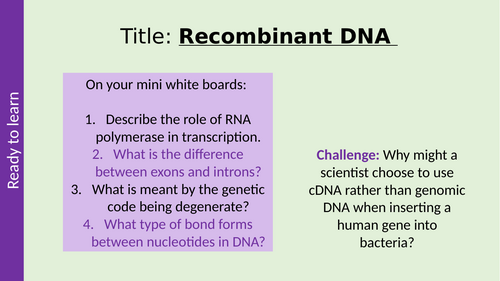

Full lesson PowerPoint for unit 8, 3.8.4.1 Recombinant DNA technology for AQA A Level Biology. No printing required.
Lesson includes a retrieval quiz, new information slides, recall questions, gap fill tasks, a true/false quiz and past exam questions and markscheme answers.
Does not include PCR, this is a separate lesson!
Recombinant DNA technology involves the transfer of fragments of
DNA from one organism, or species, to another. Since the genetic
code is universal, as are transcription and translation mechanisms,
the transferred DNA can be translated within cells of the recipient
(transgenic) organism.
Fragments of DNA can be produced by several methods, including:
• conversion of mRNA to complementary DNA (cDNA), using
reverse transcriptase
• using restriction enzymes to cut a fragment containing the
desired gene from DNA
• creating the gene in a ‘gene machine’.
Specification:
The culture of transformed host cells as an in vivo method to
amplify DNA fragments.
• The addition of promoter and terminator regions to the
fragments of DNA.
• The use of restriction endonucleases and ligases to insert
fragments of DNA into vectors. Transformation of host cells
using these vectors.
• The use of marker genes to detect genetically modified (GM)
cells or organisms. (Students will not be required to recall
specific marker genes in a written paper.)
Something went wrong, please try again later.
This resource hasn't been reviewed yet
To ensure quality for our reviews, only customers who have purchased this resource can review it
Report this resourceto let us know if it violates our terms and conditions.
Our customer service team will review your report and will be in touch.
£3.50