


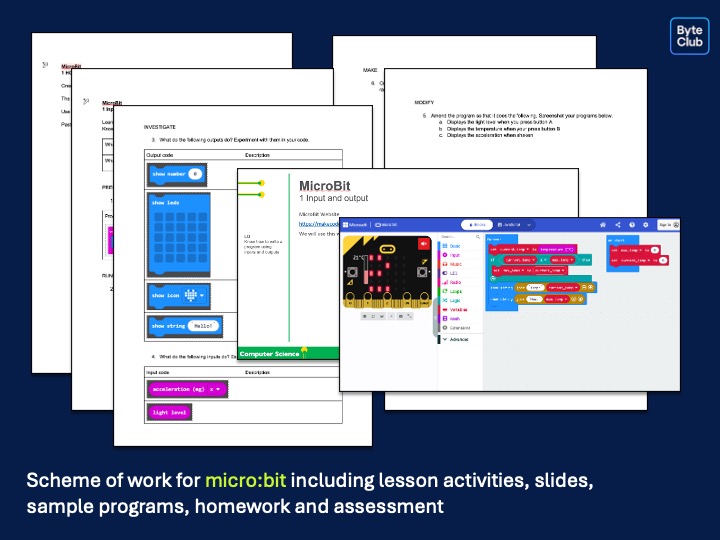

A complete KS3 micro:bit programming scheme of work containing 5 lessons, assessment materials, homework, activities and sample micro:bit files.
A free sample lesson can be downloaded here: https://www.tes.com/teaching-resource/-13609196
This fully resourced unit is designed to introduce KS3 students to the core concepts of programming using the BBC micro:bit. Across five structured lessons, students develop their understanding through practical activities that combine physical computing with key programming concepts.
The scheme contains 5 fully resourced lessons plus an assessment.
Each lesson includes:
• A complete lesson slide deck
• Lesson activities
• Homework
• Sample micro:bit files
• Practical programming tasks
The lessons are structured using the PRIMM teaching approach — Predict, Run, Investigate, Modify and Make — helping students build confidence by first exploring and understanding existing programs before adapting them and creating their own.
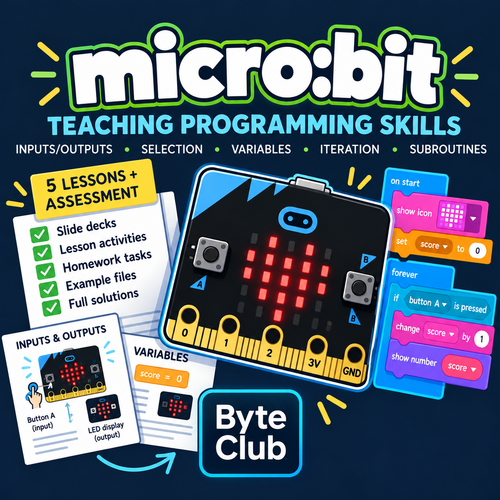
The unit covers a range of essential programming concepts, including:
• Inputs and outputs
• Selection
• Variables
• Iteration
• Subroutines
Students develop their understanding gradually across the unit, using the micro:bit to see how programs can respond to inputs, control outputs, make decisions, repeat instructions, store data and organise code into reusable sections.
The resource is particularly suitable for KS3 Computing or Computer Science, including Year 7, Year 8 or Year 9 students who are learning programming concepts for the first time or developing their confidence with physical computing.
The included assessment can be used at the end of the unit to check students’ understanding of the key programming concepts covered across the five lessons.
This scheme of work can be used as:
• A complete KS3 micro:bit programming unit
• An introduction to physical computing
• A PRIMM-based programming scheme of work
• An introduction to key programming constructs
• A short half-term Computing unit
• Preparation for more advanced graphical or text-based programming
The combination of slide decks, structured activities, homework and sample micro:bit files means the unit can be taught with minimal additional preparation.
A practical and engaging way to teach inputs and outputs, selection, variables, iteration and subroutines while using the PRIMM approach to develop students’ confidence, independence and understanding of programming.
Something went wrong, please try again later.
This resource hasn't been reviewed yet
To ensure quality for our reviews, only customers who have purchased this resource can review it
Report this resourceto let us know if it violates our terms and conditions.
Our customer service team will review your report and will be in touch.
£8.99