


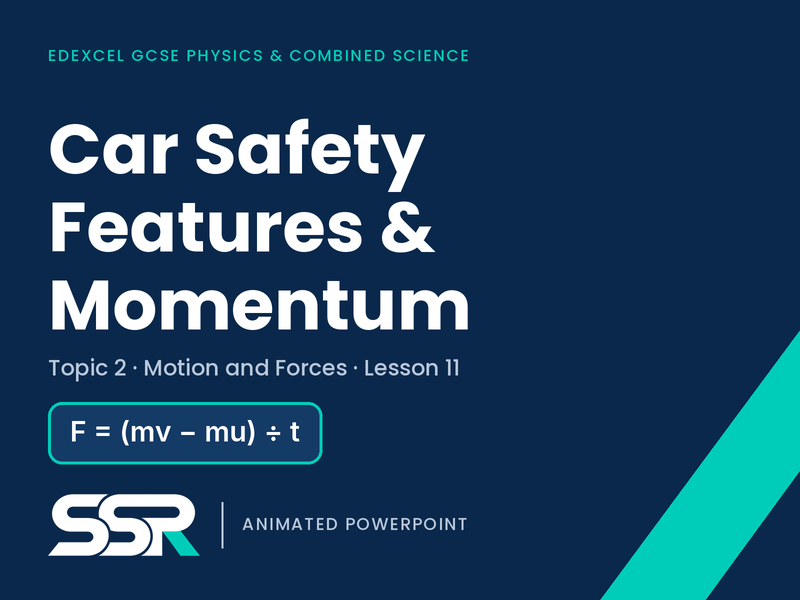
Animated car safety PowerPoint for Edexcel GCSE Physics and Combined Science: crumple zones, seat belts, airbags and crash forces. Topic 2 Lesson 11.
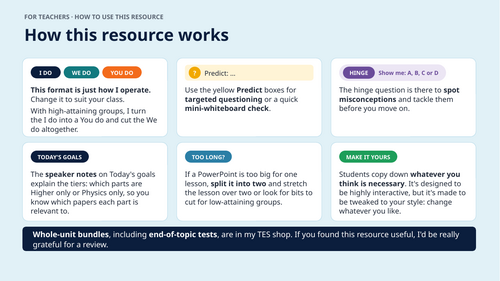
This PowerPoint is written for KS4 classes taking Edexcel GCSE Physics (1PH0) or Combined Science (1SC0), and it takes about 60 minutes. The first block is for both tiers. Force and change in momentum, and estimating crash forces, are Higher only and labelled on every slide. Every slide reveals on click, and the deck is fully editable.
What the lesson covers
Spec 2.31: why a large deceleration is dangerous, comparing braking with a crash into a wall
Spec 2.31: the force on a passenger, using F = m × a
Spec 2.31: how crumple zones, seat belts, airbags and cycle helmets reduce injuries by increasing the stopping time
Spec 2.26 (Higher): force = change in momentum ÷ time, F = (mv − mu) ÷ t
Spec 2.26 (Higher): getting the signs right when an object bounces back
Spec 2.31 (Higher): estimating crash forces using typical masses, speeds and times
What’s inside the 30 slides
A retrieval starter on momentum from Lesson 10, with a both-tier alternative in the notes
Three concept blocks, each with a hinge question and an I do / We do / You do sequence of Edexcel-style exam questions
A levelled 6-mark question on crumple zones, seat belts and airbags, modelled with a plan first
An exam-answer slide on the chain examiners reward: time up, deceleration down, force down
A crash-test calculation with and without a crumple zone, and a gymnast landing on a crash mat
Mini-whiteboard quick-fire checks, a summary slide and an exit ticket
Common mistakes covered
Students often write that a safety feature “absorbs the impact” or “stops the car more quickly”. The lesson shows why those phrases don’t earn marks and replaces them with a set chain: a longer stopping time, a smaller deceleration and a smaller force. The worked numbers make the difference clear, with a 70 kg passenger feeling 350 N when the car brakes and 10 500 N in a crash.
Part of a complete unit
This is Lesson 11 of 12 in my Edexcel GCSE Physics Motion and Forces unit. It connects acceleration (Lesson 3), F = ma (Lesson 7) and momentum (Lesson 10).
Previous lesson: Momentum & Newton’s Third Law Lesson | Edexcel GCSE https://www.tes.com/teaching-resource/resource-13690691
Next lesson: Stopping Distances & Reaction Time Lesson | Edexcel GCSE https://www.tes.com/teaching-resource/resource-13690700
The full unit: all 12 lessons, a revision lesson and two end of topic tests in the Motion and Forces Unit bundle https://www.tes.com/teaching-resource/motion-and-forces-unit-edexcel-gcse-physics-13695559
Last updated: November 2026
Something went wrong, please try again later.
This resource hasn't been reviewed yet
To ensure quality for our reviews, only customers who have purchased this resource can review it
Report this resourceto let us know if it violates our terms and conditions.
Our customer service team will review your report and will be in touch.
£3.50