


Animated stopping distances PowerPoint for Edexcel GCSE Physics and Combined Science: reaction time, thinking and braking distance. Topic 2 Lesson 12.
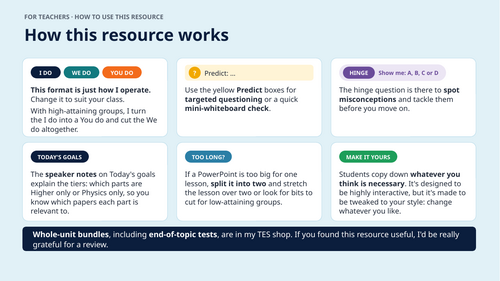
This PowerPoint is written for KS4 classes taking Edexcel GCSE Physics (1PH0) or Combined Science (1SC0), Foundation and Higher, and it takes about 60 minutes. The final block covers the Physics-only content (2.32P and 2.33P) and is labelled on every slide, so Combined Science groups can stop before it. Every slide reveals on click, and the deck is fully editable.
What the lesson covers
Spec 2.27: what reaction time is, and measuring it with the ruler-drop test
Spec 2.30: what makes reactions slower: tiredness, alcohol, drugs, distractions and age
Spec 2.28: stopping distance = thinking distance + braking distance
Spec 2.29: the factors that affect each distance, including speed, mass, brakes, tyres and road conditions
Spec 2.29: why speed makes stopping distance grow so quickly, using Highway Code figures
Spec 2.10 and 2.28: finding thinking and braking distance from a velocity-time graph of an emergency stop
Spec 2.32P and 2.33P (Physics only): estimating stopping distances, and braking distance from kinetic energy and work done
What’s inside the 35 slides
A retrieval starter on the dangers of large decelerations from Lesson 11
A velocity-time graph refresher from Lesson 5
Four concept blocks with hinge questions and I do / We do / You do sequences of Edexcel-style exam questions
A ruler-drop data question with an anomaly, a mean and an estimated reaction time
A no-notes memory check sorting factors into thinking or braking distance
An exam-answer slide on why wet roads matter, saying which distance changes
Mini-whiteboard quick-fire checks, a summary slide and an exit ticket
Common mistakes covered
A common error is putting a factor under the wrong distance, such as saying a wet road increases the thinking distance. The lesson gives a simple rule. The driver affects the thinking distance, the car and the road affect the braking distance, and speed affects both. The emergency stop graphs link stopping distances back to velocity-time graphs.
Part of a complete unit
This is Lesson 12 of 12 in my Edexcel GCSE Physics Motion and Forces unit. After it, use the revision lesson and the end of topic tests to close the unit.
Previous lesson: Car Safety Features & Momentum Lesson | Edexcel GCSE https://www.tes.com/teaching-resource/resource-13690693
Next: Motion and Forces Revision Lesson | Edexcel GCSE https://www.tes.com/teaching-resource/resource-13690703
The full unit: all 12 lessons, a revision lesson and two end of topic tests in the Motion and Forces Unit bundle https://www.tes.com/teaching-resource/motion-and-forces-unit-edexcel-gcse-physics-13695559
Last updated: November 2026
Something went wrong, please try again later.
This resource hasn't been reviewed yet
To ensure quality for our reviews, only customers who have purchased this resource can review it
Report this resourceto let us know if it violates our terms and conditions.
Our customer service team will review your report and will be in touch.
£3.50