pptx, 1.91 MB
pptx, 1.91 MB

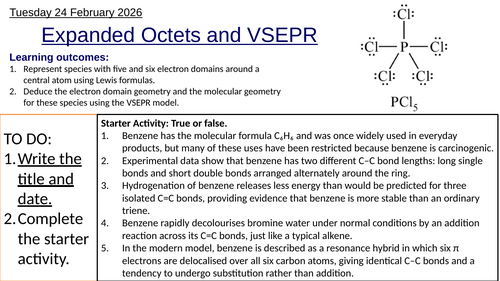
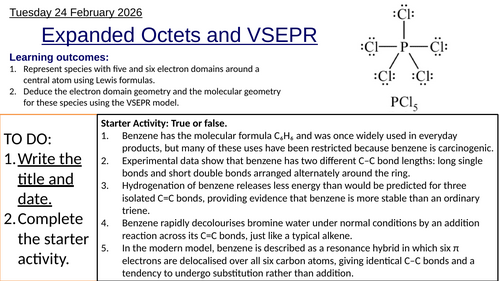
This PowerPoint lesson develops a clear understanding of expanded octets and VSEPR theory, enabling Higher Level IBDP Chemistry students to predict molecular geometry beyond the octet rule. Designed for first assessment 2025, it provides structured guidance for drawing Lewis structures and deducing three-dimensional shapes for species with five and six electron domains.

The octet rule states that atoms tend to achieve eight electrons in their outer shell, but this rule has important exceptions. In this lesson, students explore expanded octets, where central atoms from period 3 or below accommodate more than eight valence electrons, and briefly review incomplete octets. Clear definitions of terms such as electron-deficient and expanded octet are included to strengthen exam precision.

Step-by-step methods are provided for constructing Lewis formulas, calculating total valence electrons, identifying central atoms, and correctly assigning lone pairs. The lesson then applies VSEPR (Valence Shell Electron Pair Repulsion) theory to determine electron-domain geometry and molecular geometry. Five-domain shapes (trigonal bipyramidal, see-saw, T-shaped, linear) and six-domain shapes (octahedral, square pyramidal, square planar) are explained using worked examples such as SF₄, ClF₃, I₃⁻, PF₆⁻, BrF₅ and XeF₄.

Approximate bond angles are predicted using VSEPR, with clear emphasis that IB exams require model-based predictions rather than experimental values. The distinction between electron-domain geometry and molecular geometry is consistently reinforced.

The PowerPoint includes starter activities, structured examples, geometry summaries, and practice questions suitable for HL teaching, consolidation, or revision.

File type included: PowerPoint (.pptx)
Last updated: January 2026 – Lewis structure steps clarified, VSEPR shapes expanded, and HL scope checked against the 2025 IB Chemistry syllabus.

Get this resource as part of a bundle and save up to 33%

A bundle is a package of resources grouped together to teach a particular topic, or a series of lessons, in one place.

Bundle

BUNDLE S2.2 The Covalent Model HL Only Content (IBDP Chemistry)

This comprehensive bundle of PowerPoints covers the Higher Level content of Topic 2.2 The Covalent Model for IBDP Chemistry (first examination 2025). It develops deep conceptual understanding of resonance, benzene, expanded octets, formal charge, sigma and pi bonding, and hybridisation in a structured, exam-focused sequence. The covalent model explains how atoms share electrons to form molecules, and at HL it extends beyond simple Lewis structures to include delocalisation, orbital overlap and electron-domain analysis. This bundle is designed to build that progression logically — from resonance structures through to hybridisation and aromatic stability — ensuring students can connect Lewis formulas, VSEPR theory, bond order, formal charge and orbital theory. Included lessons: • Resonance Structures – electron delocalisation, bond order, ozone, carbonate, nitrate and resonance hybrids • Benzene – historical models, bond length evidence, hydrogenation data, resonance energy and aromatic stability • Expanded Octets & VSEPR – five and six electron domains, trigonal bipyramidal, T-shaped, octahedral, square planar • Formal Charge – selecting preferred Lewis structures and evaluating charge distribution • Sigma and Pi Bonds – orbital overlap, bond strength, restricted rotation, delocalised π systems • Hybridisation – sp, sp², sp³ bonding, excitation, molecular geometry and benzene delocalisation Throughout the bundle, students analyse physical and chemical evidence, compare alternative structures, and apply exam-style reasoning. Clear worked examples, mini-whiteboard tasks, structured explanations and practice questions are included in each lesson. This resource is ideal for teaching, consolidation or HL revision and aligns fully with the 2025 IB Chemistry syllabus. File type included: Multiple PowerPoint files (.pptx) Last updated: January 2026 – sequencing refined and cross-links between resonance, hybridisation and benzene strengthened for conceptual clarity.

£8.00

Reviews

Something went wrong, please try again later.

This resource hasn't been reviewed yet

To ensure quality for our reviews, only customers who have purchased this resource can review it

Report this resourceto let us know if it violates our terms and conditions.
Our customer service team will review your report and will be in touch.