

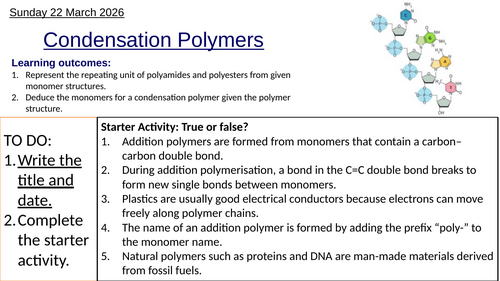

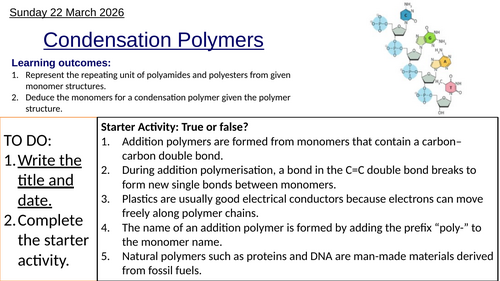
This PowerPoint lesson covers condensation polymers for IBDP Chemistry HL (first examination 2025), explaining how polymers form from monomers with functional groups and release small molecules. It supports students in understanding polymer formation, structure and real-world applications of materials such as polyesters and polyamides.
Condensation polymers are formed when monomers join through reactions between functional groups, producing a polymer and a small molecule such as water as a by-product. Unlike addition polymerisation, this process typically involves molecules with two functional groups (e.g. –COOH, –OH, –NH₂), allowing long chains to form. This lesson helps students represent repeating units, identify functional groups in polymers, and deduce monomers from polymer structures .
This fully editable .pptx PowerPoint is designed for both teaching and revision, with a clear progression from core definitions to more advanced HL applications. Students explore key polymer types including polyesters (formed from dicarboxylic acids and diols) and polyamides such as nylon (formed from dicarboxylic acids and diamines), with step-by-step formation mechanisms and structural diagrams . The lesson also links to biological macromolecules such as proteins, polysaccharides and DNA, highlighting the importance of condensation reactions in living systems.
The resource includes:
• Retrieval starter activity reviewing addition polymers
• Clear definitions of condensation polymerisation and functional groups
• Comparison of addition vs condensation polymers
• Formation and structure of polyesters and polyamides
• Naming conventions such as nylon-6,6
• Links to biological polymers (proteins, carbohydrates, nucleic acids)
• Explanation of condensation vs hydrolysis reactions
• Mini whiteboard activities and practice questions with answers
This lesson is ideal for developing deeper HL understanding of polymer chemistry and preparing students for exam-style questions.
File type included:
• Editable PowerPoint (.pptx)
Last updated: 2026 – enhanced diagrams, clearer explanations of polymer formation, and additional examples linking synthetic and biological polymers.
Something went wrong, please try again later.
This resource hasn't been reviewed yet
To ensure quality for our reviews, only customers who have purchased this resource can review it
Report this resourceto let us know if it violates our terms and conditions.
Our customer service team will review your report and will be in touch.
£2.00