

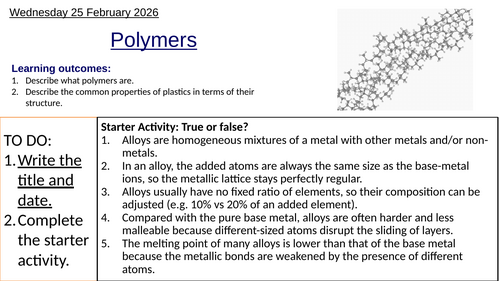

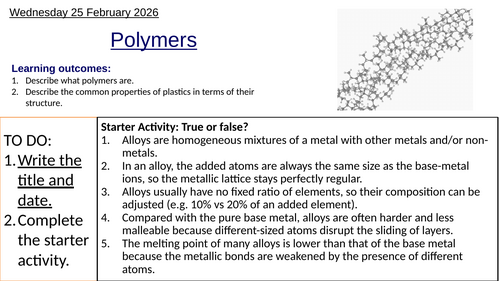
This PowerPoint lesson introduces polymers and explains how their structure determines their physical properties, helping IBDP Chemistry students link covalent bonding to real-world materials. Designed for first assessment 2025, it builds a clear understanding of macromolecules, intermolecular forces and structure–property relationships.
A polymer is a large molecule (macromolecule) formed from many repeating small units called monomers joined by covalent bonds. This lesson defines key terms such as polymer, monomer, structural formula, synthetic polymer and natural polymer, and shows how repeating units are represented using bracket notation and the variable n. Students explore how carbon’s four valence electrons enable the formation of long covalent chains, forming the backbone of most common plastics.
The properties of plastics are explained directly in terms of structure. Strong covalent bonds along each chain provide durability, while weaker intermolecular forces between chains (London dispersion forces, dipole–dipole interactions and hydrogen bonding) control flexibility, rigidity and melting behaviour. Comparisons between polyethene, PVC and Kevlar illustrate how different intermolecular forces lead to very different material properties.
The lesson also compares polymers with molecular solids and giant covalent networks, reinforcing classification skills. Sustainability and environmental context are included through discussion of bioplastics, waste accumulation and global consumption issues.
Starter activities, structured explanations, real-world examples and discussion prompts are included, making this resource ideal for classroom teaching, consolidation or revision.
File type included: PowerPoint (.pptx)
Last updated: January 2026 – sustainability context expanded and structure–property explanations refined in line with the 2025 IB Chemistry syllabus.
Get this resource as part of a bundle and save up to 33%
A bundle is a package of resources grouped together to teach a particular topic, or a series of lessons, in one place.
Bundle
BUNDLE S2.4 From Models to Materials, SL & HL (IBDP Chemistry)
This comprehensive PowerPoint bundle covers S2.4 From Models to Materials for IBDP Chemistry (first examination 2025), linking bonding models to real-world materials and properties. It provides a clear, structured sequence of lessons to help students understand how bonding and structure determine the behaviour and uses of materials. From models to materials focuses on applying bonding theories (ionic, covalent and metallic) to explain the properties and uses of substances. Rather than treating bonding as separate categories, students explore bonding as a continuum, using tools such as the bonding triangle and electronegativity to predict material behaviour and properties . This bundle includes 6 fully editable PowerPoint (.pptx) lessons designed for teaching, revision or flipped learning: • Properties of materials and bonding as a continuum • The bonding triangle and use of electronegativity to classify substances • Alloys, including structure, properties and real-world applications • Introduction to polymers and structure–property relationships • Addition polymers, including mechanisms and naming • Condensation polymers (HL extension), including polyesters and polyamides Each lesson includes retrieval starters, key definitions, worked examples, and exam-style practice questions. Students develop skills in classifying bonding, predicting physical properties (e.g. melting point, conductivity, flexibility), and linking chemistry to applications such as materials design, sustainability and fast fashion. This resource is ideal for IB teachers delivering both SL and HL content, supporting conceptual understanding while preparing students for exam-style questions and real-world application of chemistry. Files included: • 6 × editable PowerPoint (.pptx) lessons Last updated: 2026 – improved explanations of bonding continuum, enhanced application tasks, and stronger links to real-world materials and sustainability contexts.
£8.00
Bundle
BUNDLE S2.4 From Models to Materials SL Content (IBDP Chemistry)
This bundle of PowerPoints covers IBDP Chemistry SL only content of Topic 2.4: From Models to Materials (first examination 2025) and provides a complete, structured sequence of lessons linking bonding models to real-world materials. Designed specifically for the updated IB Diploma Programme specification, this resource helps students move from abstract bonding theory to explaining and predicting material properties. Topic 2.4 focuses on how ionic, covalent and metallic bonding models can be used to understand the physical properties of substances and materials. Across the bundle, students explore bonding as a continuum (using the bonding triangle and electronegativity data), properties of materials, metallic bonding, alloys, polymers and addition polymers. Clear worked examples and structured tasks guide learners in applying models to explain melting point, electrical conductivity, hardness, malleability, brittleness and flexibility. The lessons include: • Starter activities (retrieval and true/false questions) • Clear definitions of key terms (e.g. flexibility, malleability, alloy, electronegativity) • Bonding triangle classification using electronegativity values • Structured explanations linking structure → bonding → properties • Alloy structure (substitutional and interstitial) and phase diagrams • Polymer structure and addition polymerisation • Practice questions and discussion tasks Each file is provided as a fully editable .pptx PowerPoint, allowing you to adapt slides to your class context. This bundle is ideal for teaching, revision, or consolidation of SL 2.4 content and supports conceptual understanding, exam-style thinking and the IB Nature of Science emphasis on models and their limitations. It can be used as a full teaching sequence or as standalone lessons within your DP Chemistry course.
£7.00
Something went wrong, please try again later.
This resource hasn't been reviewed yet
To ensure quality for our reviews, only customers who have purchased this resource can review it
Report this resourceto let us know if it violates our terms and conditions.
Our customer service team will review your report and will be in touch.
£2.00