pptx, 2.51 MB
pptx, 2.51 MB

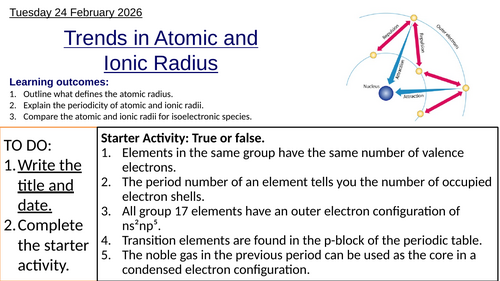
This PowerPoint lesson explains the trends in atomic and ionic radius, helping IBDP Chemistry students understand periodicity through effective nuclear charge and electron shielding. Designed for first assessment 2025, it develops the conceptual depth required to confidently explain and compare atomic and ionic sizes in exam-style questions.

Atomic radius is defined as half the distance between the nuclei of two identical atoms joined by a covalent bond, since the edge of an atom cannot be measured directly in the quantum model. This lesson carefully builds this definition and introduces the concept of effective nuclear charge (Zₑff), explaining how shielding by inner electrons reduces the full nuclear attraction felt by valence electrons.

Students are guided through the periodic trends: atomic radius increases down a group due to additional electron shells and increased shielding, and decreases across a period due to increasing nuclear charge within the same principal energy level. Deviations and measurement differences (covalent vs van der Waals radii) are clearly addressed to strengthen exam accuracy.

The lesson then extends to ionic radii, comparing cations and anions with their parent atoms and explaining size changes in terms of electron–electron repulsion and nuclear attraction. A major focus is placed on isoelectronic species, where students compare ions with the same number of electrons and determine size based on proton number.

Structured explanations, worked examples, periodic table references, and clear summary slides support understanding. Starter activities and practice questions are included for consolidation or assessment.

This resource is suitable for SL and HL students and supports teaching of periodicity in Topic 3.

File type included: PowerPoint (.pptx)
Last updated: January 2026 – explanations refined, isoelectronic comparisons clarified, and content checked against the 2025 IB Chemistry syllabus.

Get this resource as part of a bundle and save up to 33%

A bundle is a package of resources grouped together to teach a particular topic, or a series of lessons, in one place.

Bundle

BUNDLE S3.1 The Periodic Table: Classification of Elements, SL Content (IBDP Chemistry)

This bundle of PowerPoints covers IBDP Chemistry SL Topic 3.1: The Periodic Table – Classification of Elements (first examination 2025) and provides a complete, structured teaching sequence aligned to the updated IB specification. It is designed to build deep conceptual understanding of periodic trends, classification and electron configuration, while preparing students for exam-style explanations. Topic 3.1 focuses on how elements are classified in the periodic table and how their position explains their properties. The periodic table is arranged by increasing atomic number and organised into groups, periods and blocks (s, p, d, f). In this bundle, students explore metals, non-metals and metalloids, group and period relationships, valence electron patterns, periodic trends in atomic radius, ionisation energy, electron affinity and electronegativity, as well as metallic and non-metallic character. The bundle includes the following fully editable .pptx PowerPoint files: • Structure of the Periodic Table • Electrons and the Periodic Table • Trends in Atomic and Ionic Radius • Periodicity of Ionisation Energy, Electron Affinity and Electronegativity • Group 1 and 17 Elements • Metallic and Non-Metallic Continuum • Oxidation States Each lesson contains retrieval starters, clearly defined key terms, worked examples, explanations linked to effective nuclear charge and shielding, mini whiteboard practice, and exam-style questions with answers. The sequence progresses logically from classification and electron configuration to periodic trends and reactivity (Group 1 metals and halogens), before linking structure to acid–base behaviour of Period 3 oxides and environmental chemistry (acid rain and ocean acidification). Oxidation states are included to support understanding of redox and naming conventions. This bundle is ideal for full-topic teaching, consolidation or structured revision of SL 3.1 and supports conceptual understanding, IB Nature of Science links and strong explanation skills required for IB assessment.

£9.00

Reviews

Something went wrong, please try again later.

This resource hasn't been reviewed yet

To ensure quality for our reviews, only customers who have purchased this resource can review it

Report this resourceto let us know if it violates our terms and conditions.
Our customer service team will review your report and will be in touch.