

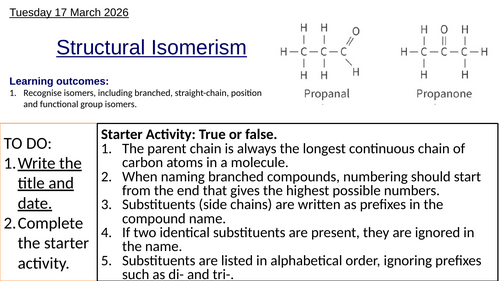

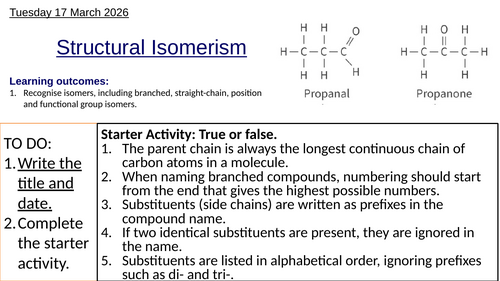
This PowerPoint lesson introduces structural isomerism in organic chemistry for IBDP Chemistry (first examination 2025) and explains how compounds with the same formula can have different structures. It supports students in recognising and classifying different types of isomers, a key concept in understanding organic chemistry.
Structural isomerism occurs when compounds have the same molecular formula but different structural arrangements of atoms. These differences can lead to significant changes in physical and chemical properties. The lesson explores the three main types of structural isomerism: chain isomers (different carbon skeletons), position isomers (same functional group in different positions), and functional group isomers (different functional groups altogether).
This fully editable .pptx PowerPoint is designed for both initial teaching and revision within the IB Diploma Programme. The lesson builds on prior knowledge of functional groups and nomenclature, helping students understand how structural variations arise and how to identify them confidently. Real-world context is included, linking molecular structure to fuel performance and octane rating, reinforcing the importance of branching in hydrocarbons.
The resource includes:
• A retrieval starter activity reviewing nomenclature concepts
• Clear definitions of key terms such as structural isomers, position isomers and functional group isomers
• Explanation of chain, position and functional group isomerism with examples
• Comparison of straight-chain and branched hydrocarbons
• Real-world application linking structure to octane rating and fuel efficiency
• Classification of alcohols, halogenoalkanes and amines as primary, secondary and tertiary
• Visual examples and structured explanations to support understanding
• Mini whiteboard activities and practice questions with answers
This lesson is ideal for developing a deeper understanding of structure–property relationships and preparing students for more advanced organic chemistry topics and exam-style questions.
File type included:
• Editable PowerPoint (.pptx)
Last updated: 2026 – enhanced explanations of isomer types, added real-world applications and improved practice activities for student engagement and understanding.
Get this resource as part of a bundle and save up to 33%
A bundle is a package of resources grouped together to teach a particular topic, or a series of lessons, in one place.
Bundle
BUNDLE S3 Classification of Matter, SL Content Only (IBDP Chemistry)
This bundle of PowerPoints covers the SL content of S3 Classification of Matter for IBDP Chemistry (first examination 2025), bringing together key ideas from the periodic table and introductory organic chemistry in one structured resource. It is designed to help students classify substances based on their structure, composition and properties, while building the knowledge needed for later topics in bonding, reactivity and analysis. In IBDP Chemistry, classification of matter involves organising elements and compounds into meaningful groups so that patterns in their behaviour can be understood and predicted. This bundle supports that aim through two major sections. S3.1 develops student understanding of the periodic table, including its structure, electron arrangement, atomic and ionic radius, periodic trends, Group 1 and Group 17 elements, the metallic and non-metallic continuum, and oxidation states. S3.2 then introduces the classification of organic compounds through types of formula, functional groups, homologous series, nomenclature of straight-chain and branched-chain compounds, and structural isomerism. This fully editable bundle includes 13 PowerPoint (.pptx) lessons: S3.1 Structure of the Periodic Table, Electrons and the Periodic Table, Trends in Atomic and Ionic Radius, Periodicity of Ionisation Energy/Electron Affinity/Electronegativity, Group 1 and 17 Elements, Metallic and Non-Metallic Continuum, and Oxidation States. S3.2 Types of Formula, Functional Groups, Homologous Series, Nomenclature of Straight-Chain Organic Compounds, Nomenclature of Branched-Chain Organic Compounds, and Structural Isomerism. Across the bundle, students are supported with retrieval starters, key word definitions, clear explanations, worked examples and practice questions with answers. These lessons are ideal for first teaching, revision, cover lessons or building a complete SL unit sequence aligned to the IBDP Chemistry specification for first examination 2025. File types included: editable PowerPoint (.pptx) files. Last updated: 2026 – improved sequencing, refined explanations, and enhanced practice activities across both periodicity and organic classification content.
£17.00
Bundle
BUNDLE S3.2 Functional Groups: Classification of Organic Compounds, SL & HL (IBDP Chemistry)
This bundle of PowerPoints covers S3.2 Functional groups: Classification of organic compounds for IBDP Chemistry (first examination 2025), including naming, isomerism and analytical techniques. It provides a complete, structured sequence of lessons to build students’ understanding of organic chemistry from foundational concepts through to HL analysis skills. Functional groups are specific groups of atoms within organic molecules that determine their chemical properties and reactions. By identifying functional groups, chemists can classify compounds, predict reactivity and systematically name molecules. This bundle supports students in developing these essential skills, progressing from basic formula types through to spectroscopy and structural determination. This fully editable bundle includes 12 PowerPoint (.pptx) lessons, carefully sequenced to support both SL and HL teaching. Early lessons focus on foundational knowledge such as types of formula, homologous series and nomenclature, before progressing into structural and stereoisomerism. The later lessons develop higher-level analytical skills, including mass spectrometry, IR spectroscopy, ¹H NMR and combining techniques to identify unknown compounds. The bundle includes: • Lesson 1: Types of Formula • Lesson 2: Functional Groups • Lesson 3: Homologous Series • Lesson 4–5: Nomenclature (straight-chain and branched-chain) • Lesson 6: Structural Isomerism • Lesson 7–8 (HL): Stereoisomerism (cis–trans and optical) • Lesson 9–12 (HL): Mass spectrometry, IR spectroscopy, ¹H NMR and combining analytical techniques Across the lessons, you will find: • Retrieval starter activities and clear key definitions • Step-by-step explanations and worked examples • Visual representations of structures and isomers • Links between structure, bonding and analytical data • Practice questions with answers for consolidation This bundle is ideal for teaching the full S3.2 topic or for structured revision, helping students build confidence in organic chemistry and prepare effectively for IB exam questions. File types included: • 12 editable PowerPoint (.pptx) files Last updated: 2026 – improved lesson sequencing, added HL analytical content, and enhanced practice questions aligned to IB assessment objectives.
£16.00
Bundle
BUNDLE S3.2 Functional Groups: Classification of Organic Compounds, SL Content (IBDP Chemistry)
This comprehensive PowerPoint bundle covers IBDP Chemistry SL Topic 3.2: Functional Groups – Classification of Organic Compounds (first examination 2025), supporting students in building a strong foundation in organic chemistry. It is ideal for teaching, revision, and exam preparation, with clear explanations and structured progression across lessons. Functional groups are specific groups of atoms within organic molecules that determine their chemical properties and reactions. This bundle helps students identify, classify, and apply their understanding of functional groups across different homologous series, while developing essential skills in representation, naming, and recognising isomerism. The bundle includes six fully editable PowerPoint (.pptx) lessons, each designed to build on prior knowledge: • Types of formula (molecular, structural, condensed, skeletal, stereochemical) and carbon’s catenation • Functional groups and classification of organic compounds • Homologous series, trends in physical properties and intermolecular forces • IUPAC nomenclature of straight-chain organic compounds • IUPAC nomenclature of branched-chain organic compounds • Structural isomerism, including chain, position and functional group isomers Each lesson includes: • Retrieval starters (true/false) to activate prior knowledge • Clear definitions of key terms and IB-specific language • Step-by-step explanations and worked examples • Visual representations of molecules and structures • Mini whiteboard activities and practice questions with answers The resource is carefully sequenced to support conceptual understanding, from basic representations of molecules through to more complex ideas such as isomerism and structure–property relationships. It is suitable for classroom teaching, independent study, or flipped learning. File types included: • 6 × Editable PowerPoint (.pptx) files Last updated: 2026 – includes improved sequencing, additional examples, enhanced practice tasks, and clearer links to IB specification requirements for first examination 2025.
£8.00
Something went wrong, please try again later.
This resource hasn't been reviewed yet
To ensure quality for our reviews, only customers who have purchased this resource can review it
Report this resourceto let us know if it violates our terms and conditions.
Our customer service team will review your report and will be in touch.
£2.00