


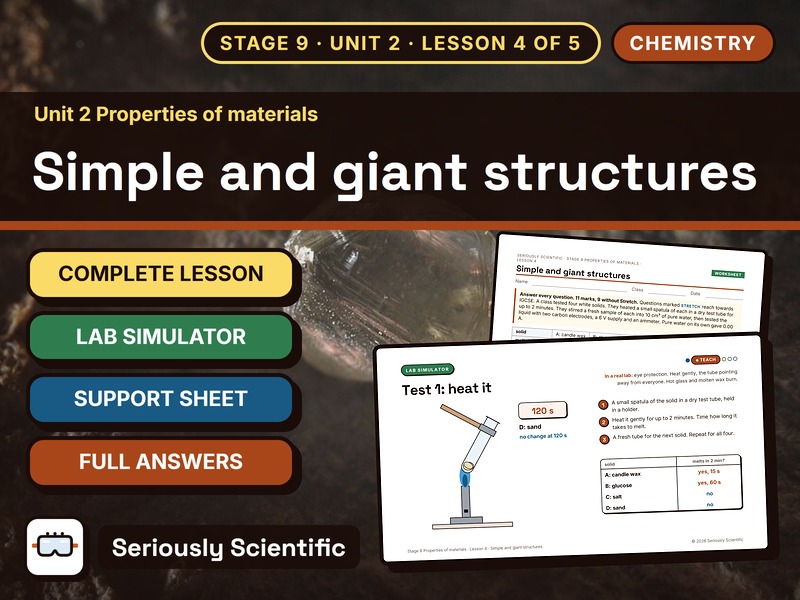
A complete, editable 50-minute lesson on simple and giant structures for Cambridge Lower Secondary Science Stage 9: a PowerPoint with teacher notes, a differentiated worksheet, homework and full answers.
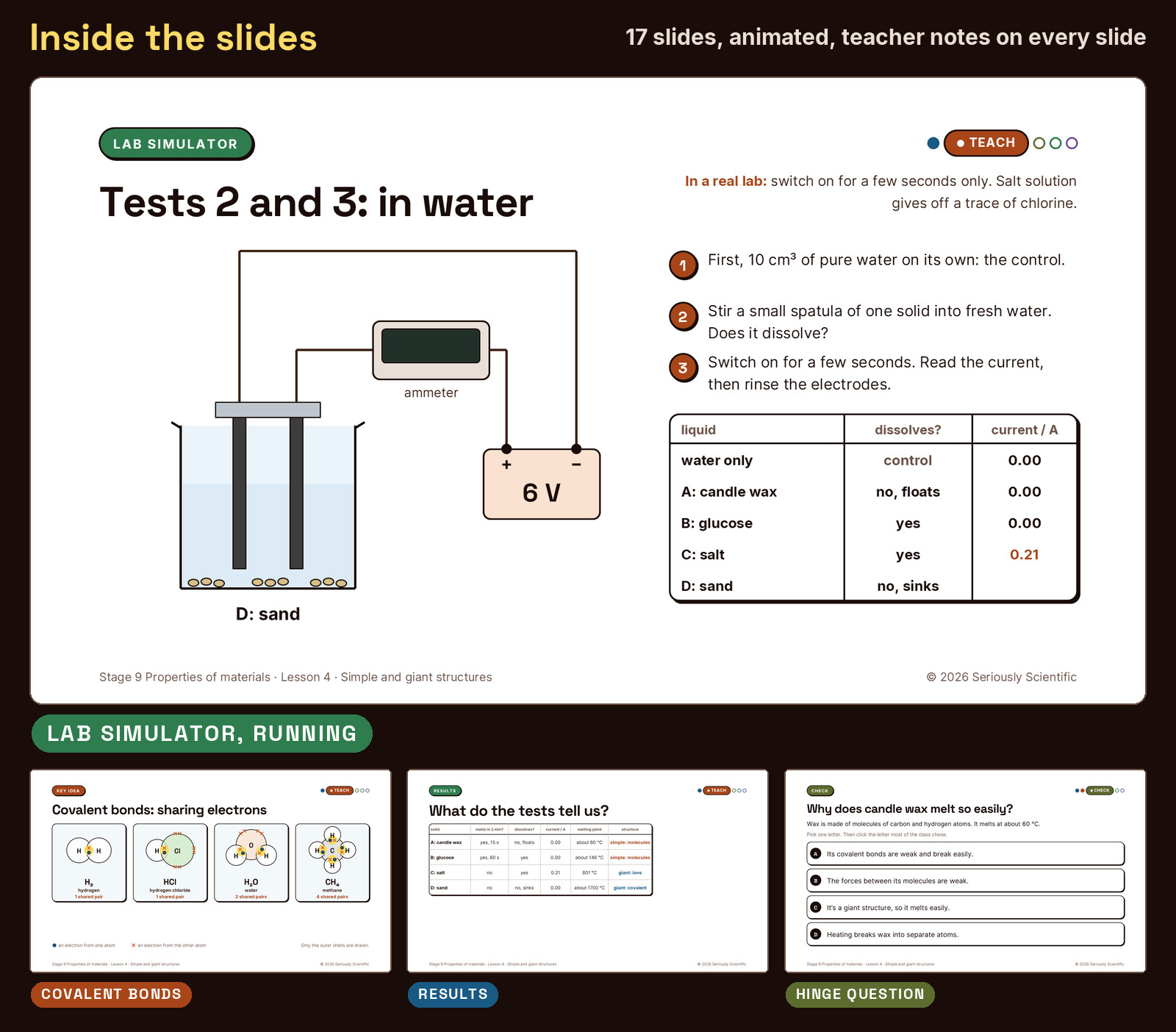
Lesson 4 of 5 in Unit 2 Properties of materials, covering framework codes 9Cm.02, 9Cm.03 and 9Cp.04. Its 17 slides open with recall cards that turn over, the success criteria and key vocabulary to check with a click. Then the Lab simulator runs the practical on screen. After a hinge question and practice, the lesson ends with an exit ticket and a confidence check.
By the end, students can:
- Describe a covalent bond as a shared pair of electrons.
- Show the shared pairs in H₂, HCl, H₂O and CH₄ molecules.
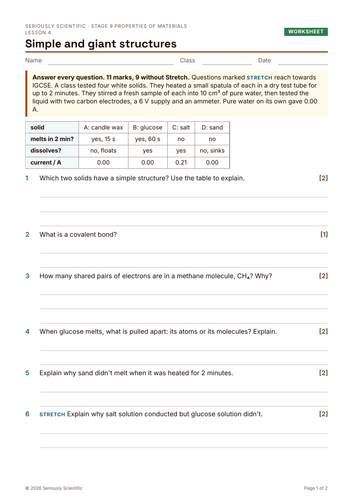
- Sort solids into simple and giant structures from test results.
- Explain why simple substances melt at low temperatures.
- Explain why salt solution conducts electricity (Stretch).
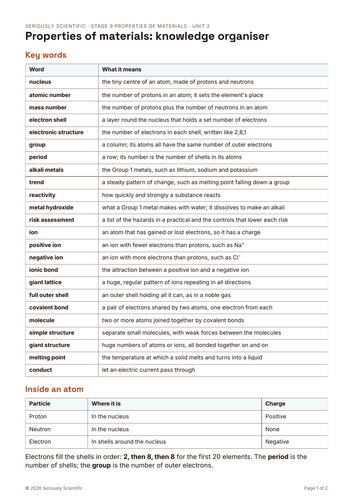
Key vocabulary: covalent bond, molecule, simple structure, giant structure, melting point and conduct.
What’s in the download
- PowerPoint deck, 17 slides, with teacher notes on every slide.
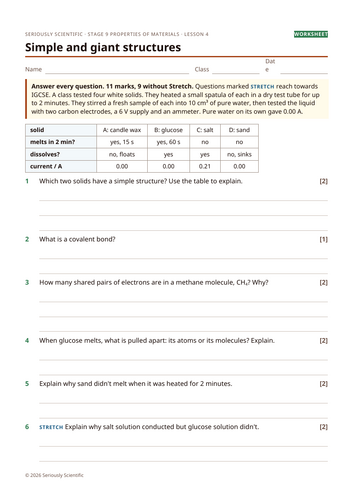
- Worksheet, 11 marks (9 without Stretch), with mark scheme.
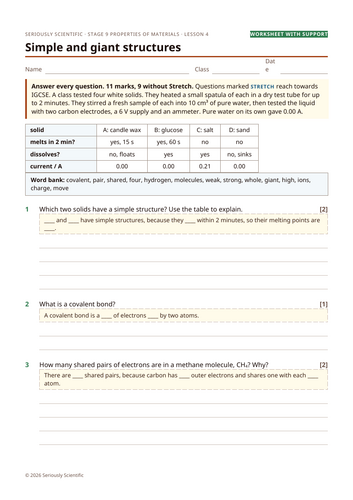
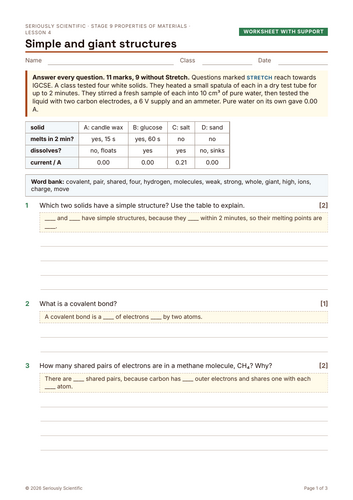
- The same worksheet with support: a word bank and a sentence starter for each question.
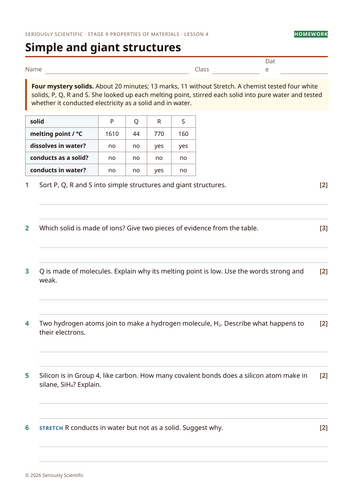
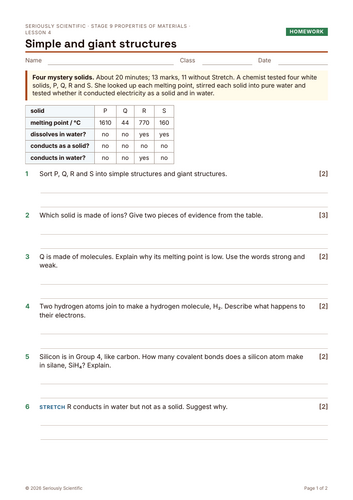
- Homework, about 20 minutes: four mystery solids, 13 marks (11 without Stretch), with mark scheme.
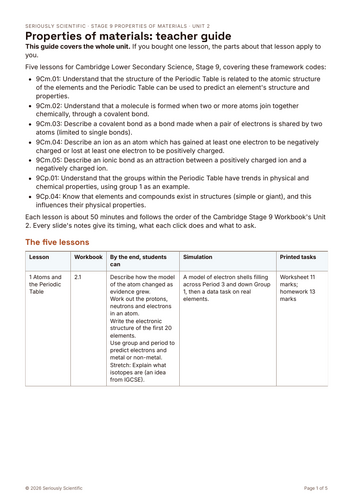
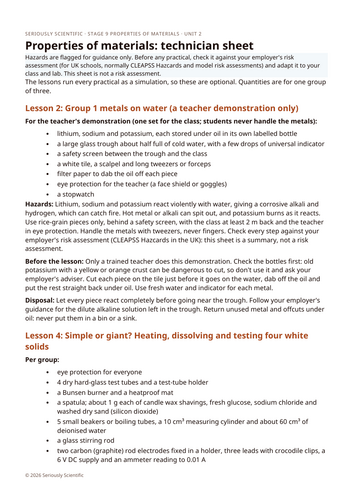
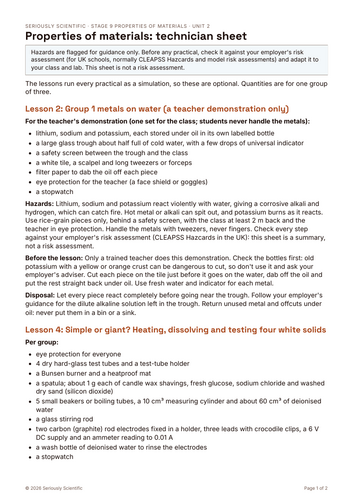
- The unit’s teacher guide, knowledge organiser and technician sheet.
- The worksheets, homework and technician sheet come as editable Word and PDF; the teacher guide and knowledge organiser come as PDF.
Cambridge Lower Secondary Science framework codes
- 9Cm.02: understand that a molecule is formed when two or more atoms join together chemically, through a covalent bond.
- 9Cm.03: describe a covalent bond as a bond made when a pair of electrons is shared by two atoms (limited to single bonds).
- 9Cp.04: know that elements and compounds exist in structures (simple or giant), and this influences their physical properties.
- 9Cm.05 (revisited).
Thinking and Working Scientifically
- 9TWSc.01, 9TWSp.03, 9TWSp.05 and 9TWSa.03.
Outside Cambridge
- Covalent bonds and simple and giant structures go beyond England’s KS3 programme of study.
- For IGCSE, the Stretch part (explain why salt solution conducts electricity) reaches towards it; this is a Stage 9 lesson, not an IGCSE resource.
Good to know
Good preparation for the Cambridge Lower Secondary Checkpoint Science test. The Lab simulator is a complement to the real practical, or a backup when the lab isn’t free. Best presented in Microsoft PowerPoint, where every animation, click and sound plays as designed. Written in UK English.
All the questions, data, drawings and animations are my own work. Independent resource, not produced or endorsed by Cambridge University Press & Assessment.
I keep my packs up to date. If it works for your class, a review helps other teachers find it.
Something went wrong, please try again later.
This resource hasn't been reviewed yet
To ensure quality for our reviews, only customers who have purchased this resource can review it
Report this resourceto let us know if it violates our terms and conditions.
Our customer service team will review your report and will be in touch.
£3.50