


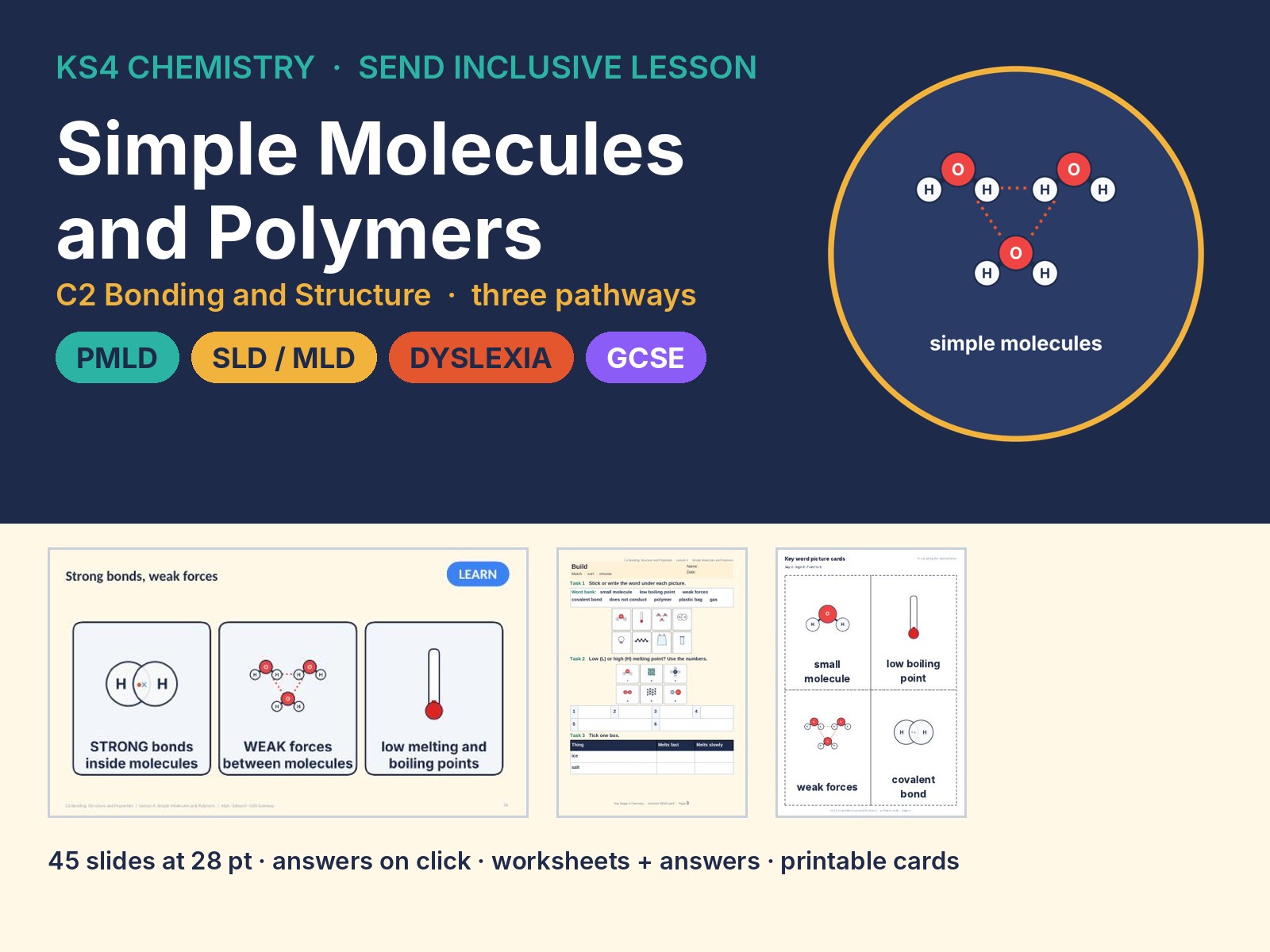
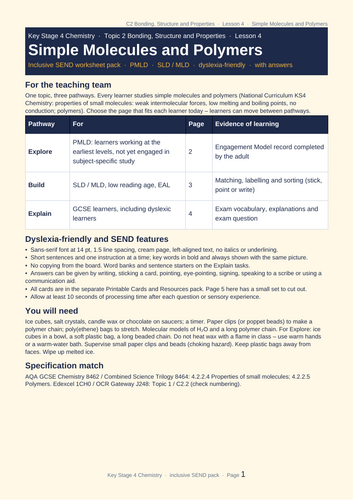
Inclusive SEND science lesson on Simple Molecules and Polymers for Key Stage 4 – one lesson with three pathways for PMLD, SLD / MLD and dyslexic GCSE learners. 45 slides at 28 pt, answers on click, worksheets with answers and 19 pages of print-ready cards. Why does ice melt so easily while plastics stay solid? An inclusive KS4 lesson on small molecules, intermolecular forces and polymers for special schools and mixed-ability classes.
Everyone studies the same National Curriculum topic at the right level, so the whole class learns together.
Three pathways in one lesson
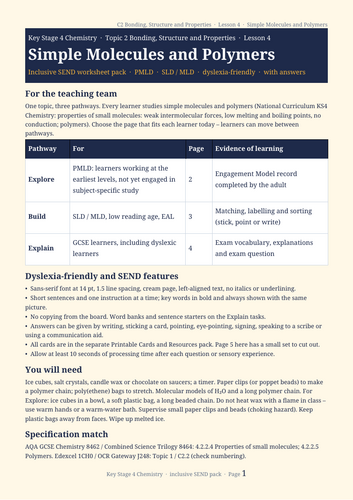
- Explore (PMLD / sensory learners): a sensory story with melting ice, a stretchy bag and a long chain. Includes an Engagement Model observation record for the adult to complete.
- Build (SLD / MLD, low reading age, EAL): match pictures to words, sort low and high melting substances and make a paper-clip polymer – by sticking, pointing, signing or writing.
- Explain (GCSE, dyslexia-friendly): explain low boiling points using intermolecular forces, explain why polymers are solids and answer an exam question.
What’s included
- 45-slide editable PowerPoint – every word at least 28 pt, cream background, no italics, one idea per slide, a picture on every teaching slide and answers revealed one click at a time
- Visual timetable with Now / Next, feelings check-in, sensory starter, ‘I can’ objectives, key words with pictures, show-me checks, picture hinge question, exam question with mark scheme and plenary
- Multi-sensory practical: a melting race and a paper-clip polymer chain
- 6-page worksheet pack (Word + PDF) in 14 pt with 1.5 line spacing: teacher guide, sensory story and engagement record, Build tasks, Explain tasks, cut-out cards and full answers
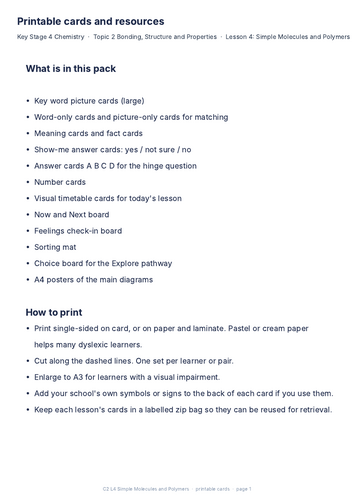
- 19-page Printable Cards and Resources pack (PDF) with cut lines: key-word picture cards, word cards, picture cards, matching cards, yes / not sure / no cards, A–D, number and answer cards, visual timetable cards, Now and Next board, feelings board, sorting mat, choice board and A4 posters
- Teaching-team notes: adult roles, resources, safety, misconceptions and Ofsted SEND links
Key words: small molecule, low boiling point, weak forces, covalent bond, does not conduct, polymer, plastic bag, gas
Curriculum
- National Curriculum Key Stage 4 Science (Chemistry): bonding, structure and the properties of matter
- AQA GCSE Chemistry 8462 / Combined Science Trilogy 8464 – 4.2.2.4 Properties of small molecules; 4.2.2.5 Polymers
Ideal for special schools, SEND resource bases, intervention groups, alternative provision and mainstream classes that need adaptive teaching.
Keywords: SEND science, special needs science lesson, PMLD sensory story, SLD, MLD, dyslexia friendly, adaptive teaching, inclusive science, KS4 chemistry, GCSE chemistry, simple molecules, intermolecular forces, boiling point, polymers, visual timetable, communication cards, Engagement Model
Something went wrong, please try again later.
This resource hasn't been reviewed yet
To ensure quality for our reviews, only customers who have purchased this resource can review it
Report this resourceto let us know if it violates our terms and conditions.
Our customer service team will review your report and will be in touch.
£4.50