


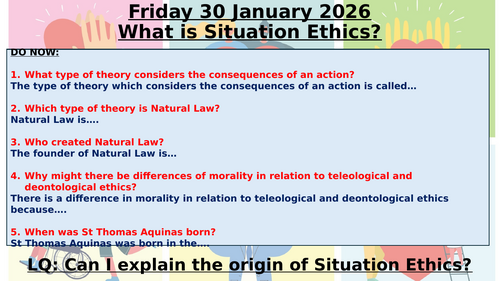
This resource provides a comprehensive introduction to Situation Ethics as part of the OCR A Level Religious Studies specification (Religion and Ethics). It explores Situation Ethics as a teleological, relativist, and agape-centred ethical theory, focusing on its key thinker, principles, and applications.
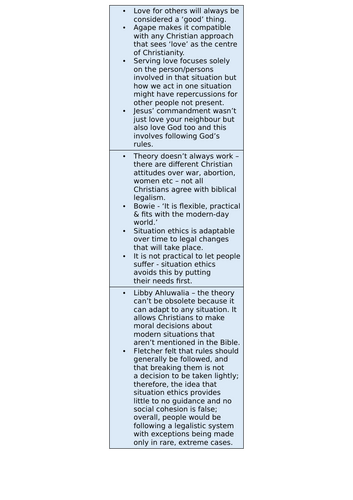
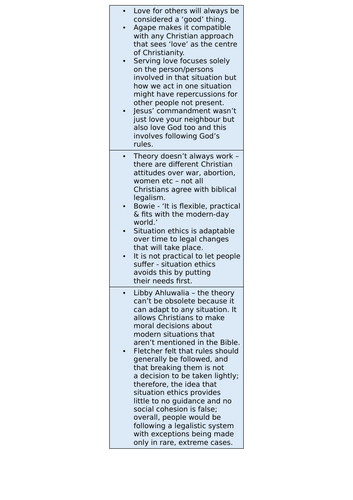
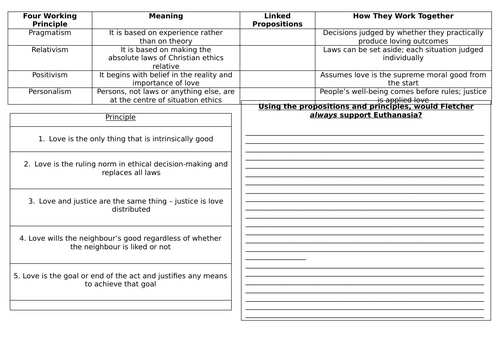
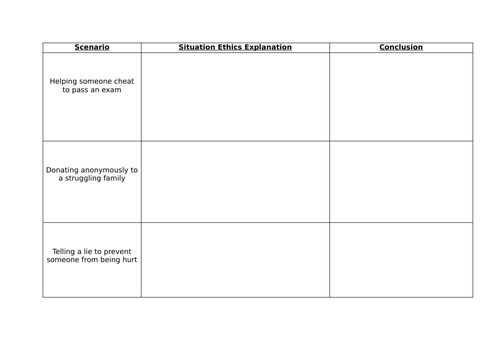
Students are guided through the origins of Situation Ethics with Joseph Fletcher, including the central role of agape love and the rejection of legalism and antinomianism. The resource develops secure AO1 knowledge through detailed explanations of the six propositions and the four working principles (pragmatism, relativism, positivism, and personalism), alongside applied ethical scenarios to build understanding.
The later sections introduce Fletcher’s understanding of conscience, including the idea that conscience is a verb rather than a noun and a process of creative moral decision-making. Synoptic links to Aquinas’ Natural Law and moral absolutism are included to strengthen students’ evaluative and comparative skills.
Throughout, structured tasks, exam-style questions, and ethical debates support both AO1 knowledge and AO2 analysis and evaluation, preparing students for extended writing questions and synoptic assessment. This resource is designed to scaffold learning, encourage critical thinking, and develop exam confidence, making it well-suited for Year 12 students studying Situation Ethics within the OCR A Level Religion and Ethics course.
**This resource includes: **
- Fully resourced PowerPoint covering the Situation Ethics and Conscience section of the OCR specification.
- High-quality explanations of all key concepts, scholars, and terminology, including Fletcher, agape, propositions, and working principles.
- Retrieval practice and structured DO NOW starters to consolidate prior learning.
- Student activities, paired discussions, and guided debate tasks.
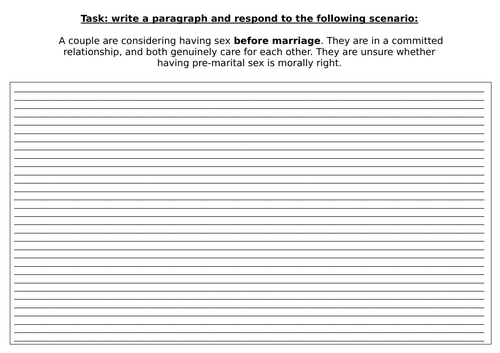
- Real-world ethical applications, including sexual ethics (pre-marital sex) and euthanasia.
- Explicit AO1 knowledge-building tasks and AO2 evaluation frames, including model answers and discussion prompts.
- Comparative tasks exploring Situation Ethics vs Natural Law and conscience in Aquinas vs Fletcher.
- Challenge and stretch questions to extend higher-ability students.
- Exam-style questions, including extended essay preparation tasks and evaluation prompts.
- Summary activities, plenaries, and exit tasks to assess understanding and retention.
Something went wrong, please try again later.
This resource hasn't been reviewed yet
To ensure quality for our reviews, only customers who have purchased this resource can review it
Report this resourceto let us know if it violates our terms and conditions.
Our customer service team will review your report and will be in touch.
£5.00