


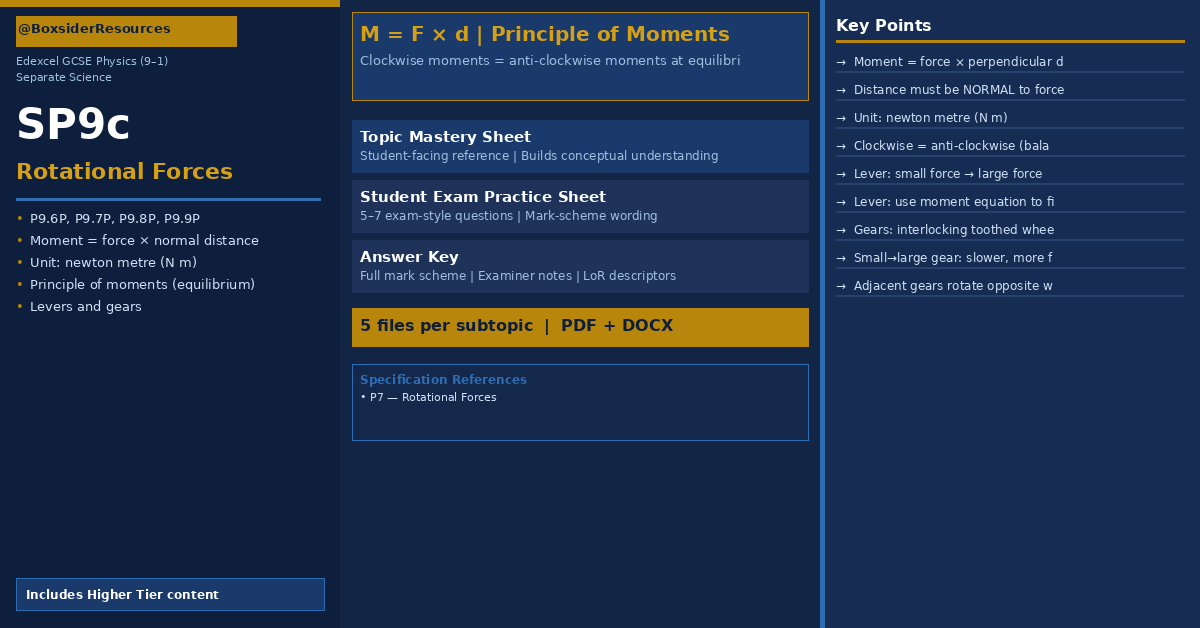
A focused three-component revision and exam practice pack for SP9c, covering the complete Edexcel Separate Science Physics specification for moments, the principle of moments, levers and gears (P9.6P–P9.9P).
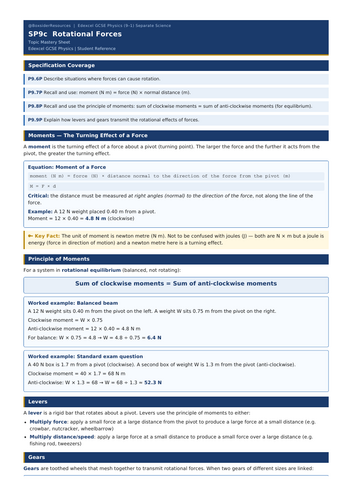
Topic Mastery Sheet covers the moment equation M = F × d with emphasis on the critical requirement that the distance must be measured normal (perpendicular) to the direction of the force - not along a slant line - as this is the most reliable source of calculation errors; the principle of moments stated and applied through two worked examples at increasing difficulty (the standard 12 N / 0.40 m beam, and the exam-standard 40 N / 1.7 m scenario that appears in the mark scheme); the operation of levers as a direct application of the moment equation, distinguishing force-multiplying from distance-multiplying configurations; and gear operation, including the rule that adjacent gears rotate in opposite directions and how gear size determines the trade-off between speed and force.
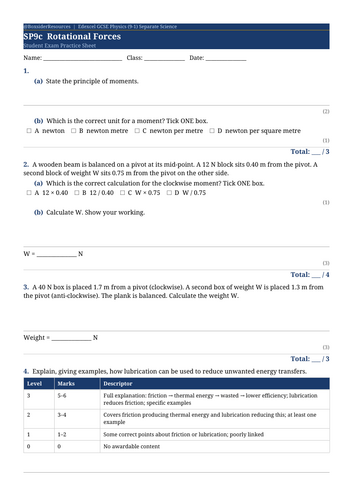
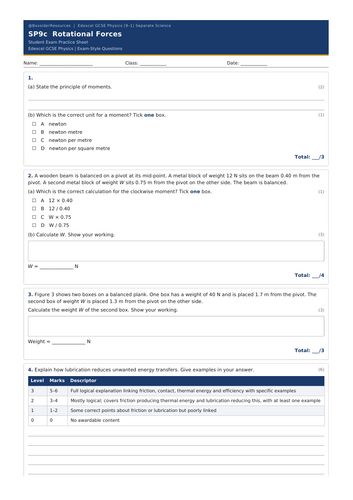
Student Exam Practice Sheet includes a two-part principle of moments question (state the principle; identify the correct unit from an MCQ); two moment calculation questions of increasing difficulty requiring students to apply the principle of moments to find an unknown weight; and a six-mark Level of Response question on how lubrication reduces unwanted energy transfers, requiring students to link friction, thermal energy production, efficiency and practical examples. Question format matches the Edexcel test style.
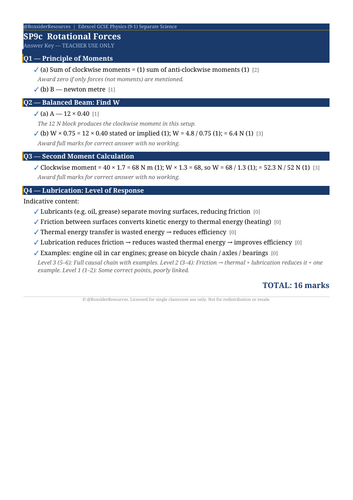
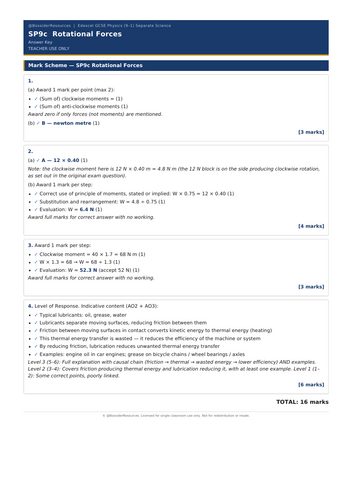
Teacher Answer Key provides a complete mark scheme with examiner notes specifying that the principle of moments question awards zero marks if only forces (not moments) are mentioned; that full marks are awarded for correct numerical answers with no working shown; and full indicative content with level descriptors for the lubrication LoR question, including the required causal chain (friction → thermal energy → wasted → reduced efficiency → lubrication reduces friction).
©BoxsiderResources. Licensed for single classroom use by the purchasing teacher. Not for redistribution or resale.
Something went wrong, please try again later.
This resource hasn't been reviewed yet
To ensure quality for our reviews, only customers who have purchased this resource can review it
Report this resourceto let us know if it violates our terms and conditions.
Our customer service team will review your report and will be in touch.
£4.99