


What is standard electrode potential? Standard hydrogen electrode? What is the role of the salt bridge? What is a high resistance voltmeter? What is the electrochemical series? All this and more covered in this comprehensive lesson with questions and answers! This is a Year 13 A level lesson for Edexcel International Unit 5 – WCH15, but it can also be used for all UK exam boards. All the slides in this lesson are fully animated and include answers to every mini plenary question and exam question. The breakdown of the slides (which are best opened on Microsoft PowerPoint) is as follows:
Slide 1 - Title and 5-minute starter. The starter is a grid of four questions entitled ‘last week, last lesson, today’s learning and future learning’. Use this generic slide for all your lessons by simply changing the questions and the answers each time.
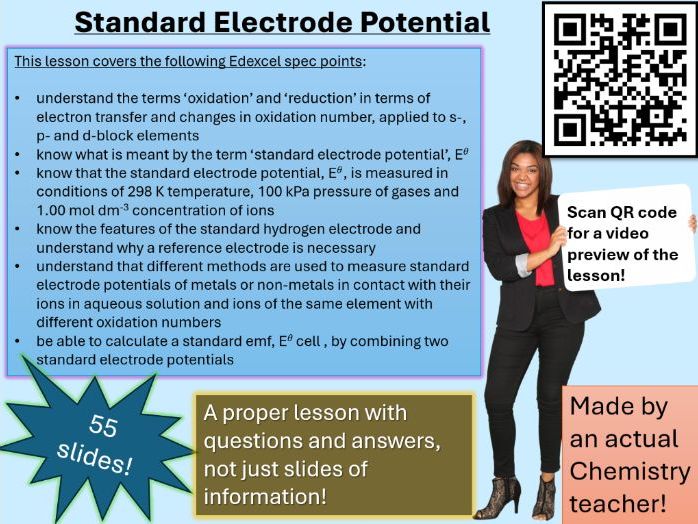
Slide 2 - Lesson objectives (see thumbnail image)
Slide 3 – Hinge question: what happens when a metal reacts? The answer animates on the screen when you click
Slides 4 – 7: explains how ease of oxidation of a metal is linked to its reactivity. Diagram of a half cell in water can be printed for students with slides 6 – 7
Slide 8 – definition of electrode and electrolyte using the same half-cell from slide 5
Slide 9 – students presented to the term electrode potential using the same half-cell
Slide 10 – introduce students to the idea of placing a metal in solution containing ions of that metal to get to equilibrium quicker
Slide 11 – an electrode is also known as a half-cell
Slides 12 – 13: comparing half-cells
Slide 14 - learning pit stop questions to test students’ understanding so far. Answers animate on the screen when you click
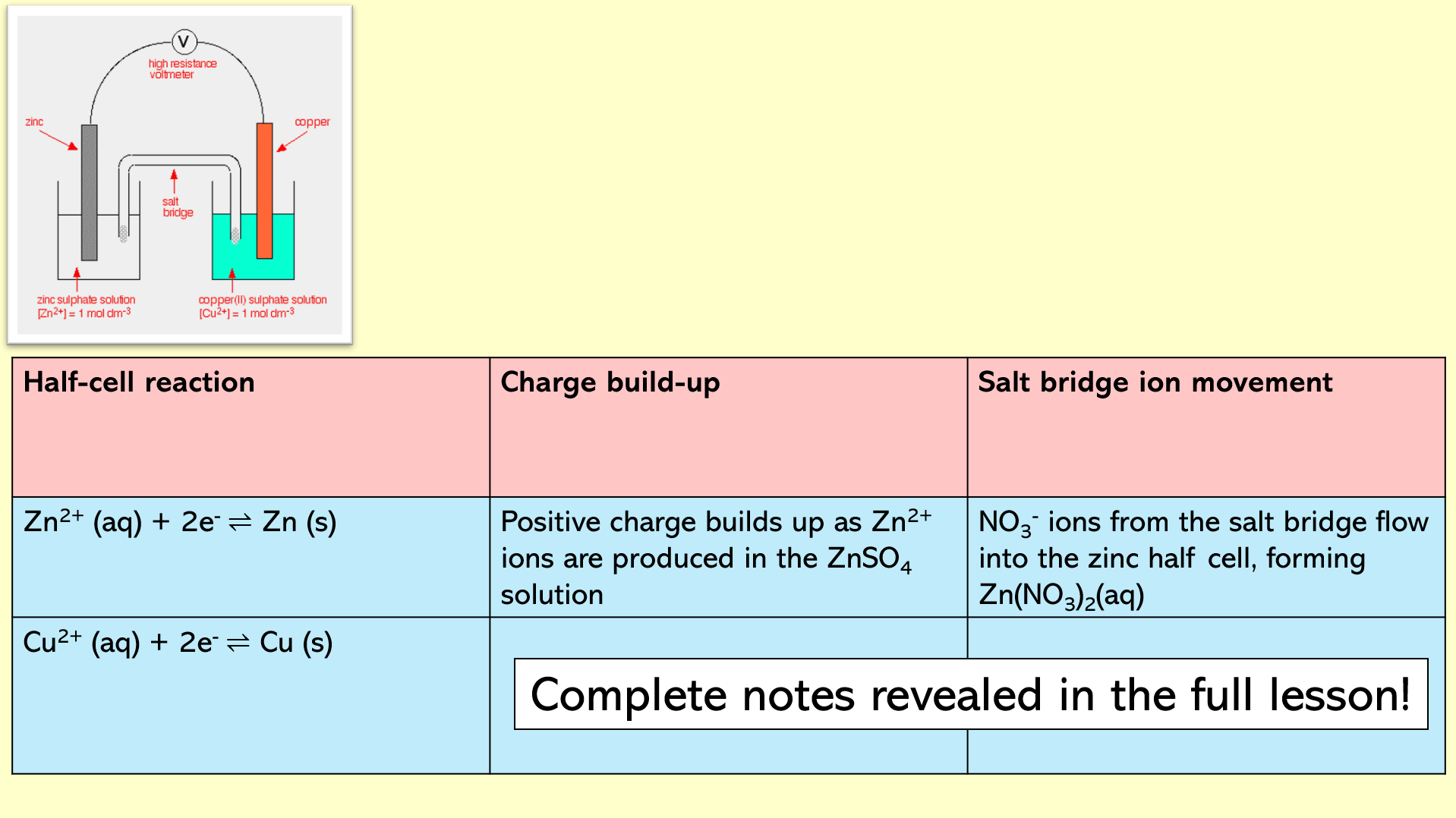
Slides 15 – 17: introduction to electrochemical cells using zinc and copper electrodes
Slides 18 – 22: this section is about the salt bridge. It explains the role it serves and what would happen if it was not present
Slides 23 – 25: this section is about the high-resistance voltmeter. It details how it works and what would happen if there wasn’t one present
Slide 26 – the Nernst equation is mentioned here in case students want to do some extra reading
Slides 27 – 31: the standard hydrogen electrode (SHE), including a printout diagram on the hidden slides
Slides 32 – 33: more information about the standard hydrogen electrode, including the platinum foil covered in porous platinum.
Slides 34 – 36: slides address what the observations would be when a zinc electrode is connected to a SHE. This includes what the reading on the voltmeter would be, with an explanation
Slide 37 - learning pit stop questions to test students’ understanding so far. Answers animate on the screen when you click
Slides 38 – 40: definition of standard electrode potential, with its significance explained
Slides 41 – 45: drawing the apparatus of different redox systems
Slides 46 – 49: explanation of the electrochemical series
Please consider leaving a review! This really helps promote our store! Thanks!
Something went wrong, please try again later.
Takes out the stress of lesson planning. Thanks
Report this resourceto let us know if it violates our terms and conditions.
Our customer service team will review your report and will be in touch.
£4.50