

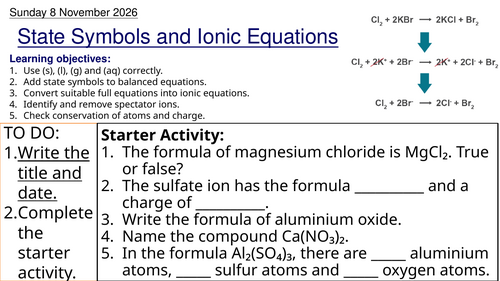

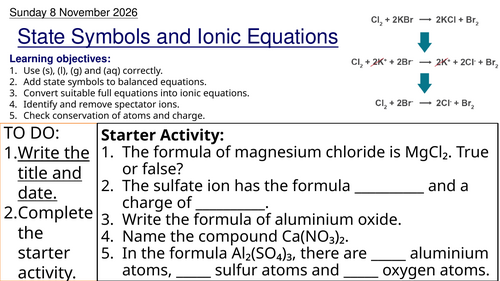
This comprehensive OCR A Level Chemistry PowerPoint lesson teaches students how to use state symbols and construct ionic equations through step-by-step explanations, worked examples and practice activities.
Designed for OCR Chemistry A (H032/H432), Module 2: Foundations in Chemistry, this resource covers specification point 2.1.2(b) – Compounds, Formulae and Equations. It is ideal for Year 12 students developing their understanding of chemical equations and the processes involved in writing balanced ionic equations.
The lesson introduces the four state symbols, (s), (l), (g) and (aq), explaining how they represent solids, liquids, gases and substances dissolved in water. Students practise applying state symbols to balanced chemical equations and interpreting information provided in reaction descriptions.
The PowerPoint then introduces ionic equations as simplified chemical equations showing the particles directly involved in a reaction. Students learn to distinguish between full chemical equations and ionic equations, identify spectator ions and understand why unchanged ions are removed.
Clear worked examples demonstrate how to separate aqueous ionic compounds into their constituent ions, retain the correct state symbols and cancel spectator ions to produce simplified ionic equations. Particular emphasis is placed on checking that both atoms and electrical charge are conserved.
Students progressively apply these skills to precipitation reactions, including the formation of silver chloride, barium sulfate and calcium carbonate. Structured practice activities, knowledge checks and worked answers support understanding and independent problem-solving.
The resource includes a starter activity, key terminology, detailed explanations, guided examples and opportunities for assessment for learning.
Supplied as an editable PowerPoint presentation (.pptx), this resource is suitable for classroom teaching, independent practice, revision and consolidation.
Last updated: November 2026.
Something went wrong, please try again later.
This resource hasn't been reviewed yet
To ensure quality for our reviews, only customers who have purchased this resource can review it
Report this resourceto let us know if it violates our terms and conditions.
Our customer service team will review your report and will be in touch.
£2.00