


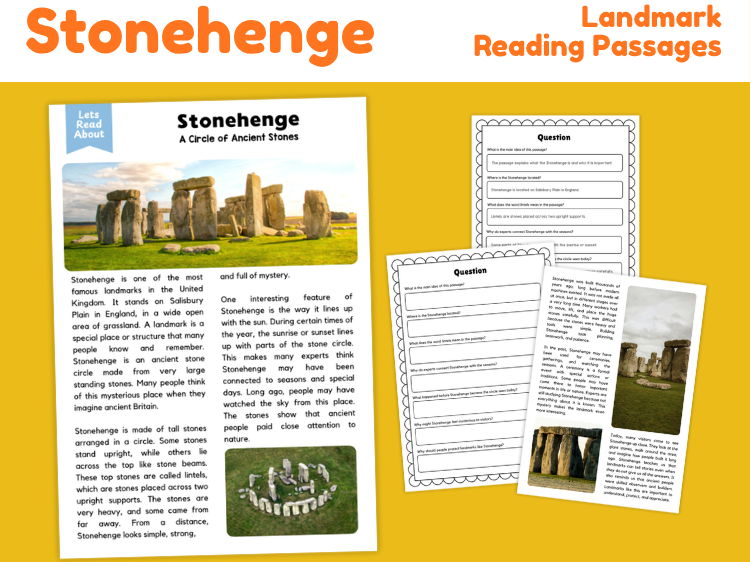
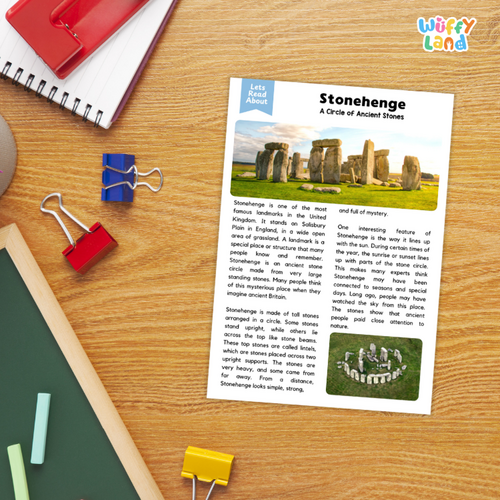
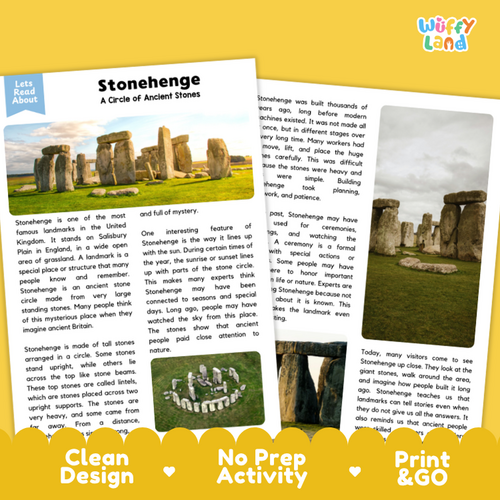
Explore one of the world’s most mysterious prehistoric monuments with this engaging Stonehenge reading comprehension resource.
Students will learn about Stonehenge on Salisbury Plain in southern England and discover how prehistoric communities created this remarkable monument thousands of years ago.
The reading passages explain that Stonehenge was built in stages over many centuries. Work began around 3000 BC, while the famous stone circle was raised around 2500 BC during the late Neolithic period.
Students will discover the two main types of stone used at Stonehenge: the large sarsen stones and the smaller bluestones. They will learn that some bluestones came from the Preseli Hills in Wales, more than 250 kilometres away, and explore the mystery of how prehistoric builders transported and raised such heavy stones using simple tools and teamwork.
The resource introduces important architectural features including upright stones, horizontal lintels and trilithons. Students will also learn how Stonehenge was used for burials and ceremonies and how its main axis was carefully aligned with the Sun during the summer and winter solstices.
The passages explain that archaeologists still do not know exactly why Stonehenge was built. Evidence suggests it had important ceremonial, spiritual and seasonal meanings for the communities who created and used it.
Students will also discover Stonehenge’s importance today as part of the Stonehenge, Avebury and Associated Sites UNESCO World Heritage Site.
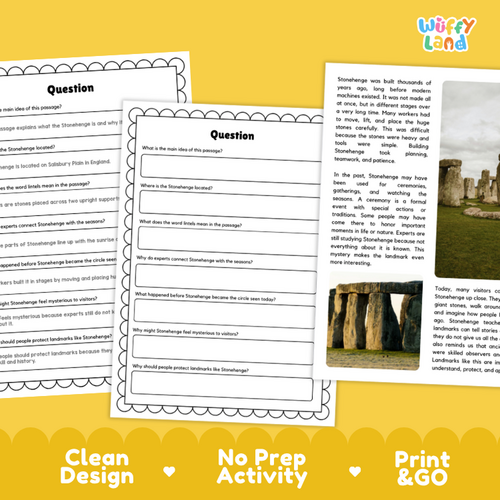
The included comprehension questions encourage students to identify key information, recall historical facts, understand vocabulary and use evidence to think about the possible purpose of this ancient monument.
What’s included:
- Stonehenge reading passages
- Landmark facts and history
- Location on Salisbury Plain, England
- Neolithic Britain
- Construction beginning around 3000 BC
- Stone circle around 2500 BC
- Sarsen stones
- Bluestones from Wales
- Stone transportation and construction
- Lintels and trilithons
- Burial and ceremonial use
- Summer and winter solstice alignment
- Heel Stone
- Stonehenge mysteries and theories
- UNESCO World Heritage connection
- Landmark vocabulary
- Reading comprehension questions
- Written response activities
- Print-and-go worksheets
Perfect for history lessons, famous landmarks, prehistoric Britain, Stone Age studies, ancient monuments, archaeology, geography, reading comprehension, social studies, homeschool learning, literacy centres and independent work.
Students can build reading comprehension, vocabulary and historical thinking skills while discovering how prehistoric communities created one of the most extraordinary stone monuments in the world.
File type: Printable PDF
Preparation: Print and use
Something went wrong, please try again later.
This resource hasn't been reviewed yet
To ensure quality for our reviews, only customers who have purchased this resource can review it
Report this resourceto let us know if it violates our terms and conditions.
Our customer service team will review your report and will be in touch.
£3.00