pptx, 34.03 MB
pptx, 34.03 MB
png, 417.03 KB
png, 417.03 KB
png, 348.33 KB
png, 348.33 KB
png, 419.37 KB
png, 419.37 KB

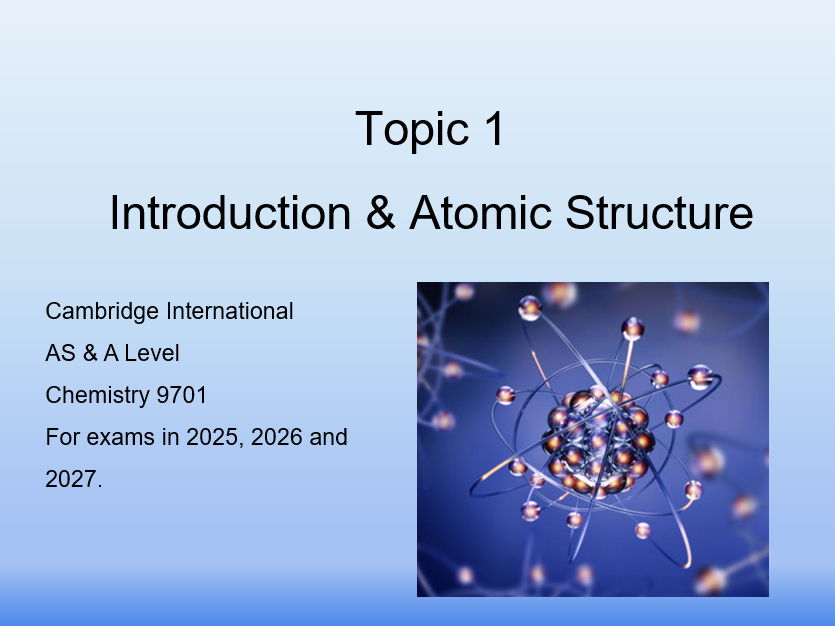
Four lesson unit for Topic 1 Atomic Structure CIE AS/A Level Chemistry (9701). Clear explanations, definitions and equations that match CIE texts/exams. A ready to teach unit ideal for new and experienced teachers.

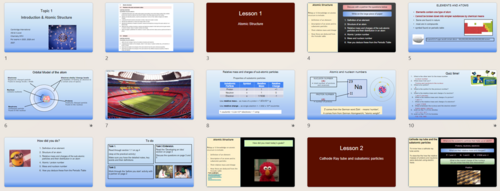
This PowerPoint directly addresses the specification points shown on slides 2–3, including:
• 1.1 Particles in the Atom & Atomic Radius
• 1.2 Isotopes
• End-of-topic questions linked to CIE exam style

What This Resource Provides
• Carefully planned, ready-to-teach PowerPoint
• Click in animations, giving teachers the option to model, annotate or write on the board—perfect support for early-career teachers.
• Detailed specification Points covered on beginning slides
• Clear learning goals and starter tasks
• Bold, textbook-aligned definitions matched to CIE exam language
• Equations fully sequenced with correct subscripts
• Worked examples / model questions with answers always provided
• Animations, YouTube links, diagrams
• Retrieval, AfL, consolidation, and plenaries
• Experimental methods and analysis where relevant
• End-of-unit assessment questions and reflection activities
• Each lesson uses a steady “explain → check → apply” model
• Follows the Cambridge A Level course book
• All content matched to the Cambridge International 9701 specification

Lesson 1 – Atomic Structure
Students revisit prior Yr 11 knowledge and build a strong foundation on:
• Definitions (element, atom, subatomic particles)
• Relative mass/charge and how values link to the Periodic Table
• Atomic/proton number, nucleon number, symbols and notation
Includes structured partner discussion, guided notes, and a quiz checking precise understanding.
Pedagogy: Core concepts are delivered in short chunks followed by partner talk, board-writing opportunities, and an AfL quiz before independent textbook-linked tasks.

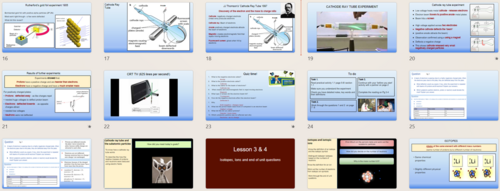
Lesson 2 – Cathode Ray Tube & Subatomic Particles
Explores the experiments that uncovered the structure of the atom:
• Thomson’s cathode ray tube work
• Mass-to-charge ratio of the electron
• Behaviour of protons, neutrons and electrons in electric/magnetic fields
• Rutherford scattering
Includes diagrams, step-by-step animations and a detailed AfL quiz.
Pedagogy: Information is revealed gradually (“click-in”) to allow teacher questioning, followed by textbook questions and practical-linked reading tasks.

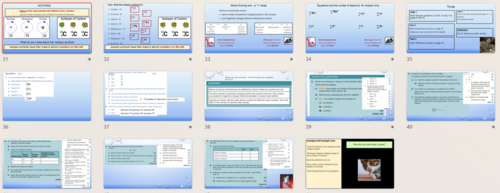
Lessons 3 & 4 – Isotopes, Ions & End-of-Unit Questions
Covers:
• Definition and identification of isotopes
• Constructing isotopic symbols
• Electron number in ions (cations/anions)
• Multiple worked examples
• Full end-of-unit exam-style questions and self-evaluation
Pedagogy: Students apply learning in structured tasks, then synthesise the topic by writing their own summary and completing exam questions for consolidation.

Get this resource as part of a bundle and save up to 28%

A bundle is a package of resources grouped together to teach a particular topic, or a series of lessons, in one place.

Bundle

Complete CIE AS Level Chemistry (9701) Quality Bundle – Topics 1–18 (Including Spectroscopy)

This full CIE AS/A Level Chemistry (9701) high quality bundle provides every PowerPoint resource needed to teach Topics 1–18, including 22.2 mass spectroscopy. The set follows the Cambridge specification precisely, with definitions, explanations, equations and examples aligned to the official textbook and past papers. Saves weeks of planning and preparation Topics covered: 1. Atomic Structure 2. Electrons, Orbitals & Ionisation Energy 3. Mass & The Mole, Mass Spectrometry, Formulas & Reacting Masses 4. Bonding, Shapes, Metallic/Ionic/Covalent, Electronegativity & IMFs 5. States of Matter 6. Enthalpy & Hess’ Law 7. Redox Reactions 8.1. Equilibrium 8.2. Acids & Bases 9. Rates of Reaction 10. Rates of Reaction 11. Periodicity 12. Group 2 13. Group 17 (Halogens) 14. Nitrogen and Sulfur 15. Introduction to Organic Chemistry 16. Hydrocarbons 17. Halogenoalkanes 18. Alcohols, Esters & Carboxylic Acids 19. Carbonyl Compounds 22.2 Spectroscopy: Key Features • Consistent starter slides showing lesson number, title and learning goals, followed by a retrieval starter or short warm-up activity • Chunked explanations so content is delivered in manageable sections, each followed by a quick check for understanding • Click-in animations allowing teachers to model thinking live, annotate, or reveal diagrams, equations and definitions gradually • Guided practice leading into independent work, with examples modelled clearly before students attempt tasks matched to CIE phrasing • Plenaries linked directly to the lesson goals, helping students reflect on what they’ve learned • End-of-topic assessments with CIE-style exam questions and answers provided Topics 1-5 Full Lessons Key Features • Bold, exam-aligned definitions that match Cambridge textbook and mark scheme language • Fully worked examples for calculations, mechanisms and explanations—showing formula, rearrangement, substitution and final answer • High-quality diagrams and animations explaining mechanisms, energetics, equilibria, structure and trends • Scaffolded calculation walkthroughs covering entropy, Gibbs free energy, pH, buffers, Kc/Kp, rate equations, enthalpy and more • Step-by-step mechanisms presented using clear curly-arrow notation • Summary tables and concept overviews at the end of each topic for rapid revision • Exam-style questions throughout, ideal for class practice or homework • Perfect for teacher modelling, board work and student note-taking during content-heavy lessons PowerPoints 6–18 — Knowledge-Rich, Example-Driven Presentations These later units focus on high-quality subject knowledge, ideal for direct instruction, revision lessons, flipped learning or teacher subject-knowledge enhancement. They prioritise clarity, worked examples and exam preparation. Key Features • Bold, exam-aligned definitions that match Cambridge textbook and mark scheme language • Fully worked examples for calculations, mechanisms and explanations—showing formula, rearrangement, substitution and final answer • High-quality diagrams and animations explaining mechanisms, energetics, equilibria, structure and trends • Scaffolded calculation walkthroughs covering entropy, Gibbs free energy, pH, buffers, Kc/Kp, rate equations, enthalpy and more • Step-by-step mechanisms presented using clear curly-arrow notation • Summary tables and concept overviews at the end of each topic for rapid revision • Exam-style questions throughout, ideal for class practice or homework • Perfect for teacher modelling, board work and student note-taking during content-heavy lessons . Why This Bundle? • 100% aligned to the Cambridge International 9701 specification • Ideal for complete course delivery, revision, or intervention • Supports new teachers with structured pedagogy (Topics 1–5) • Supports advanced students with knowledge-dense worked examples (Topics 6–18) • Consistent formatting across all topics

£90.00

Reviews

Something went wrong, please try again later.

This resource hasn't been reviewed yet

To ensure quality for our reviews, only customers who have purchased this resource can review it

Report this resourceto let us know if it violates our terms and conditions.
Our customer service team will review your report and will be in touch.