Complete CIE A2 Chemistry (9701) High Quality Bundle – Topics 19–30
This A2 Chemistry bundle provides every PowerPoint required to teach Topics 19–30 of the Cambridge International A Level Chemistry (9701) syllabus. All content aligns precisely with the CIE textbook and exam expectations, including advanced physical, inorganic and organic chemistry.
Topics Include:
19. Lattice Enthalpy & Born–Haber Cycles
20. Electrochemistry
21. Further Equilibria
22. Reaction Kinetics (A2)
23. Entropy & Gibbs Free Energy
24. Transition Metals
25. Benzene & Electrophilic Substitution
26. Carboxylic Acids & Acyl Derivatives
27. Organic Nitrogen Compounds
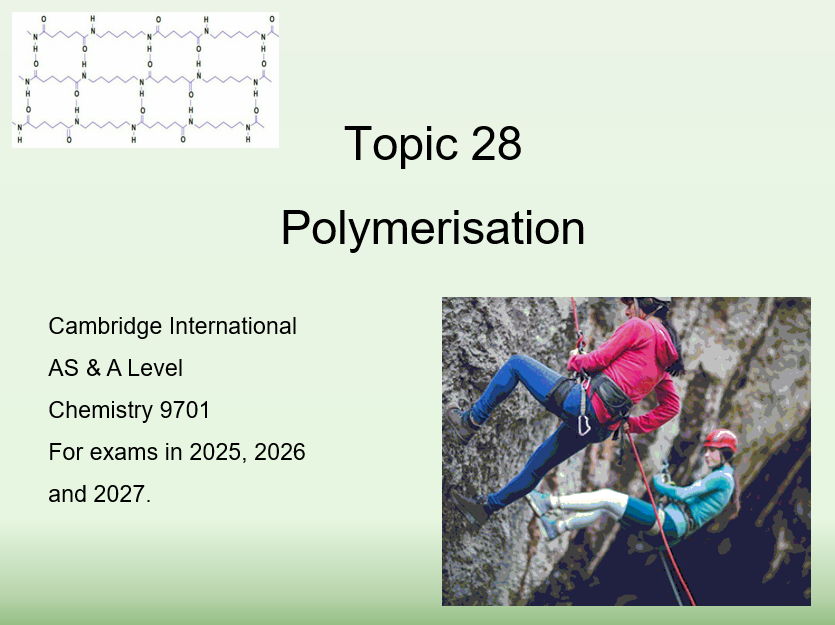
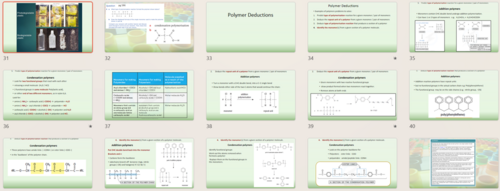
28. Polymerisation
29. Organic Synthesis
30. Analytical Chemistry (Chromatography, GLC, NMR, Spectroscopy)
Topics 19–22 — Fully Planned, Ready-to-Teach Lesson Units
These PowerPoints follow a structured, lesson-based format with consistent pedagogy to support both new and experienced A Level teachers. Each unit is fully sequenced so teachers can deliver challenging A2 content with clarity and confidence.
Key Features
• Starter slides with lesson number, title and learning goals in a yellow box
• Retrieval starters or warm-up questions at the beginning of each lesson segment
• Chunked explanations for complex ideas (Born–Haber cycles, electrode potentials, feasibility, kinetics)
• Click-in animations for modelling, annotation, and gradual reveal of diagrams, equations and steps
• Worked examples embedded throughout, followed by short AfL checks
• Independent practice tasks matched to CIE exam phrasing
• Plenaries linked to initial learning objectives
• End-of-topic assessment questions in full exam style
Topics 23–30 — Knowledge-Rich, Example-Driven PowerPoints
These later A2 topics are designed as high-quality content presentations packed with clear explanations, fully worked examples, high-level diagrams and exam-focused structure. They are perfect for direct teaching, revision, flipped lessons or teacher subject-knowledge support.
Key Features
• Exam-aligned definitions in bold, matching Cambridge mark scheme language
• Fully worked calculation examples, including ΔG, entropy, Ksp, Kpc, rate laws, redox, and spectroscopic interpretation
• Mechanisms and processes explained step-by-step, including transition-metal redox cycles, electrophilic substitution on benzene, nucleophilic acyl substitution, peptide formation and more
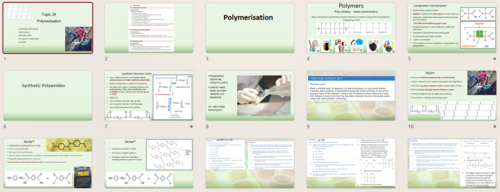
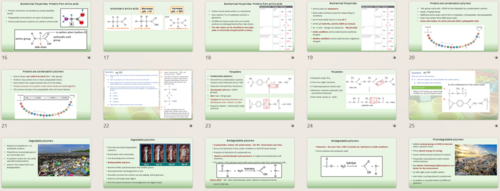
• High-quality diagrams and animations for energetics, transition-metal complexes, ligand substitution, orbital splitting and polymer formation
• Scaffolded walkthroughs for complex A2 calculations (Gibbs free energy, partition coefficients, buffer pH, solubility product, Nernst equation)
• Summary tables of conditions, reagents, mechanisms and functional-group transformations
• Exam-style questions throughout, ideal for modelling or independent work
• Perfect for note-taking, revision and board modelling during fast-paced A2 lessons
Why Choose This A2 Bundle?
• Covers the entire A2 syllabus (9701)
• Consistent structure and formatting across all topics
• Ideal for complete course delivery, revision or intervention
• Supports early-career teachers with structured pedagogy (Topics 19–22)
• Supports high-attaining A2 students with rich content and worked examples (Topics 23–30)
• Saves extensive planning time while maintaining teacher autonomy