


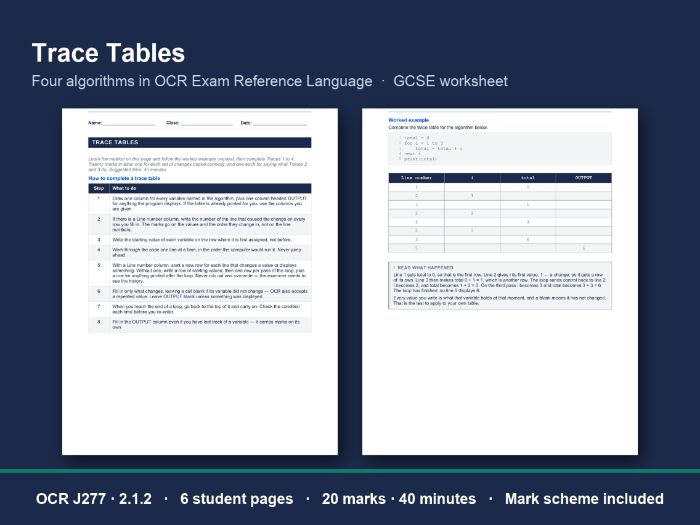
A GCSE trace tables worksheet for OCR J277 2.1.2: a method, a worked example and four algorithms to trace. 20 marks in 40 minutes, with a full mark scheme.
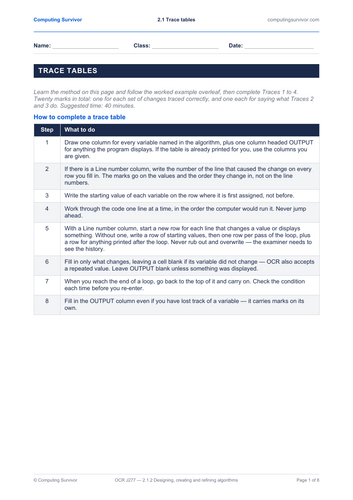
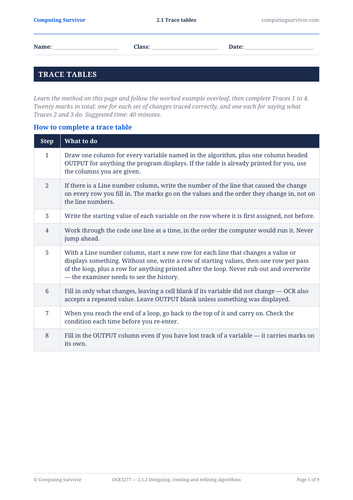
Students learn an eight-step method for completing a trace table, follow a worked example of a for loop, then trace four algorithms written in OCR Exam Reference Language, one to a page. Every trace comes with its table printed: the columns are given, and there are more rows than the trace needs.
What’s inside (8 pages, PDF and editable Word)
- Six student pages (pages 1 to 6): the method, the worked example with an explanation of every row, and Traces 1 to 4.
- A full mark scheme (pages 7 and 8), with every completed trace table and the mark points for each. It starts on an odd page, so a double-sided print keeps it off the back of a student sheet.
The four traces
- Selection: an if-else that decides which message to display.
- A while loop with MOD and DIV, then a mark for saying what the algorithm calculates.
- An array read by a for loop, then a mark for saying what the algorithm finds.
- A string read one character at a time.
Traces 1 and 2 use a Line number column, and Traces 3 and 4 use the one-row-per-pass layout, so students meet both styles OCR prints.
Why it works in a real classroom
- A slip is not punished twice. The output mark follows through from the student’s own table, and in Trace 1 a wrong branch costs one mark, not two.
- It marks what examiners mark. Line numbers carry no marks, and repeated values and an extra loop-counter row are accepted.
- Editable. The Word version is included, so you can change a name, a number or a scenario to suit your class.
- Nothing to set up. Print, hand out, collect. There is nothing to install and nothing to log in to.
You need: one copy of pages 1 to 6 per student. Keep pages 7 and 8 back; a cut line marks where the mark scheme starts.
Good for: a lesson on algorithms, homework after teaching 2.1.2, a cover lesson, or Year 11 revision before Paper 2.
Made by a practising computing teacher. The answers are written out in full and checked. If you use it, a review helps other teachers find it.
Something went wrong, please try again later.
This resource hasn't been reviewed yet
To ensure quality for our reviews, only customers who have purchased this resource can review it
Report this resourceto let us know if it violates our terms and conditions.
Our customer service team will review your report and will be in touch.
£3.00