pptx, 3.62 MB
pptx, 3.62 MB
PNG, 318.2 KB
PNG, 318.2 KB
PNG, 320.21 KB
PNG, 320.21 KB

Why do historical events happen, and what are their consequences?

This lesson introduces one of the most important concepts in History by helping students understand how historians explain the causes and consequences of events. It provides an excellent foundation for developing historical enquiry and analytical thinking, enabling students to recognise that most events have multiple causes and a range of short- and long-term consequences.

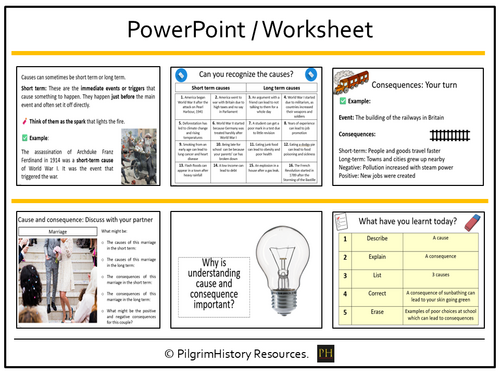
Students begin by identifying the causes of a variety of events before categorising them into short-term causes, long-term causes and trigger events. Through carefully structured activities, they learn to distinguish between immediate developments and the deeper political, economic, social or cultural factors that often lead to historical change.

The lesson then explores the concept of consequence, encouraging students to classify outcomes into immediate and long-term effects while considering both intended and unintended consequences. These activities help students develop a more sophisticated understanding of how historical events shape the future.

A range of differentiated independent tasks allows students to apply these skills by making connections, explaining relationships and reaching reasoned judgements about causes and consequences. Many of the examples are drawn from everyday situations as well as historical contexts, helping students embed these important concepts before applying them to future historical enquiries.

By the end of the lesson, students will be able to evaluate the relative importance of different causes and consequences, supporting their ideas with evidence and developing stronger analytical and written arguments.

Included in this lesson:
Fully editable PowerPoint l
Introduction to cause, consequence and historical enquiry
Activities exploring short-term, long-term and trigger causes
Consequence categorisation and judgement tasks
Differentiated independent activities
Suggested teaching strategies throughout

Please leave a review if you find this resource useful. Your feedback is greatly appreciated

Get this resource as part of a bundle and save up to 26%

A bundle is a package of resources grouped together to teach a particular topic, or a series of lessons, in one place.

Bundle

KS3 History Skills Complete Bundle

These lessons are designed to enable students to think like real historians and prepare for assessment and exam techniques! They build up mastery in the essential historical skills of inference, the use of sources, chronology, analysis, cause and consequence, enquiry, interpretation and significance. Baseline Assessment Test: This can be used to assess what students know and which historical skills have they acquired from primary school. What is History: This is an ideal lesson to introduce the subject by focusing on the skills required by historians to investigate the past, including chronology and time. Inference: Students will learn how to ‘read between the lines’ of evidence and developing the critical skills of drawing conclusions from clues in both written and visual sources. This lesson will also build their analytical thinking, essential for understanding past perspectives and motivations. Cause and Consequence: Students examine how and why events occurred and the impact they had. This will encourage deeper thinking about the causes and effects of decisions and actions throughout history. Interpretation: Through guided tasks, learners examine different views about the past and develop their own, supporting them with evidence. This will help them build evaluative skills and support extended argument writing. Significance: Students are challenged to assess what makes an event, individual or development important, helping them in their future studies to make value judgments supported by historical criteria. Change and continuity: This lesson will help students understand the significance of change and continuity in history by exploring the evolution of medical treatment over time. Beginning with key definitions and historical context, it encourages critical thinking about why and how methods of treatment have developed from medieval practices to modern healthcare. The lesson supports AO1 and AO2 skills and supports thematic understanding. Historical investigations: The Princes in the Tower lesson will encourage students to evaluate conflicting sources, question reliability and come up with their own evidence-based conclusions about this unsolved historical mystery. These skills are not only vital for exam success, but are also transferable across subjects and essential for developing critical and reflective thinkers. These lessons are perfect for KS3 and can be used as standalone skills lessons, revision tools or embedded into wider schemes of work. The lessons are broken down into the following: L1 Baseline Assessment Test L2 What is History? L3 Historical Sources L4 Cause and consequence L5 Historical significance (X Factor) L6 Historical Inferences L7 Historical interpretations L8 Change & Continuity (Free resource) L9 Historical investigation – Princes in the Tower The resources all come in PowerPoint format if there is a wish to edit and change. Any reviews would be gratefully received.

£19.50

Reviews

Something went wrong, please try again later.

This resource hasn't been reviewed yet

To ensure quality for our reviews, only customers who have purchased this resource can review it

Report this resourceto let us know if it violates our terms and conditions.
Our customer service team will review your report and will be in touch.