


A one-page framework showing teachers how to use AI at five stages of learning so students think harder, not less. Practical prompts with pedagogy built in.
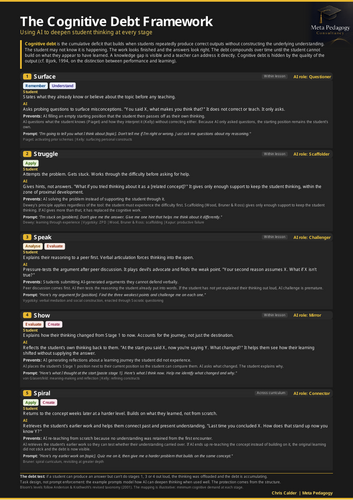
Cognitive debt is what builds when students produce correct outputs without constructing the understanding behind them. The work looks right but the learning hasn’t happened. This framework gives teachers a five-stage structure for using AI in lessons that prevents students offloading thinking to the tool.
The five stages are: Surface (AI as Questioner, probing what the student already knows without correcting), Struggle (AI as Scaffolder, giving hints not answers within the zone of proximal development), Speak (AI as Challenger, pressure-testing arguments the student has already articulated to a peer), Show (AI as Mirror, reflecting the student’s own thinking journey back to them) and Spiral (AI as Connector, retrieving earlier work and building on it at greater depth weeks later).
Every stage defines what the student does, what the AI does, what it prevents and includes a ready-to-use prompt. The framework maps each stage to Bloom’s taxonomy (Anderson and Krathwohl’s revised taxonomy, 2001) and references the pedagogy underpinning each one: Piaget, Kelly, Dewey, Vygotsky, Wood, Bruner and Ross, Kapur, von Glasersfeld and Bruner’s spiral curriculum.
The debt test at the bottom gives teachers a quick diagnostic: if a student can produce an answer but cannot do stages 1, 3 or 4 out loud, the thinking was offloaded and the debt is accumulating.
This is not a policy document or a set of rules about AI. It is a pedagogical framework that shows how task design protects learning when AI is in the room. The protection comes from the structure, not from restricting the tool.
Works across all subjects, all year groups and all key stages. Suitable for individual teacher CPD, department meetings, INSET sessions or whole-school AI training.
Provided as a print-ready PDF. One page, dark background, designed for display or reference.
Tags: cognitive debt, AI in education, AI for teachers, Bloom’s taxonomy, scaffolding, zone of proximal development, student thinking, AI prompts, pedagogy, CPD, INSET, deeper thinking, metacognition, AI framework, productive failure, spiral curriculum, critical thinking, Vygotsky, Piaget, lesson design
Something went wrong, please try again later.
This resource hasn't been reviewed yet
To ensure quality for our reviews, only customers who have purchased this resource can review it
Report this resourceto let us know if it violates our terms and conditions.
Our customer service team will review your report and will be in touch.
£5.00