pptx, 3.42 MB
pptx, 3.42 MB
PNG, 384.19 KB
PNG, 384.19 KB

Was Private Harry Farr a coward—or a victim of war?

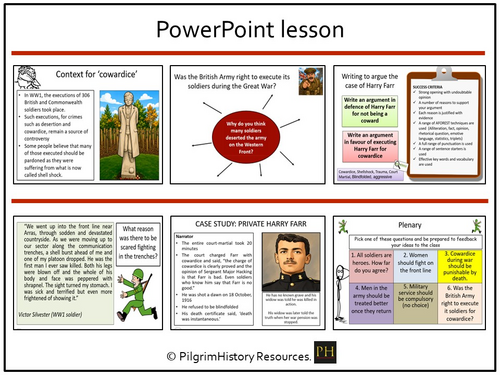
This powerful and thought-provoking lesson explores the psychological impact of fighting on the Western Front and challenges students to consider how far fear, trauma and discipline shaped soldiers’ actions during the First World War.

The lesson centres on the case of Private Harry Farr, who was shot for “misbehaving before the enemy in such a manner as to show cowardice.” Students are challenged to investigate the fairness of his punishment and decide whether his sentence was justified.

Students begin by exploring what “cowardice” means in a wartime context before examining the concept of shell shock—a condition widely misunderstood and often ignored by the military and government at the time.

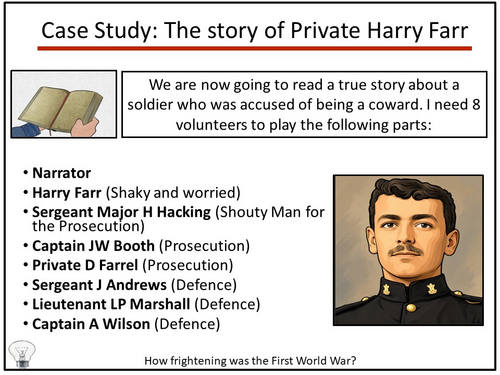
Through structured analysis of witness statements, students take part in a re-enactment of Farr’s court martial, weighing up evidence from different perspectives before reaching a verdict. This encourages empathy, evaluation, and evidence-based judgement.

Students also explore why some soldiers refused to fight on the Western Front, why desertion occurred despite severe punishments, how attitudes towards mental health differed during WWI and the role of discipline, fear, and survival in soldiers’ decisions

Using visual and written sources, students develop a deeper understanding of psychological trauma in warfare and apply higher-order thinking skills in an extended writing task at the end of the lesson.

The lesson concludes with a reflective plenary that challenges students to reconsider their initial ideas about cowardice and evaluate how their thinking has changed.

The resource also features:

An enquiry question revisited throughout the lesson and unit
Retrieval practice activities
Source-based and interpretive analysis
Structured role-play court martial activity
Differentiated materials to support all learners
Suggested teaching strategies
Fully editable PowerPoint format

Any reviews would be gratefully appreciated to aid future planning.

Get this resource as part of a bundle and save up to 37%

A bundle is a package of resources grouped together to teach a particular topic, or a series of lessons, in one place.

Bundle

KS3 World War One Full Unit Bundle (1914–1918)

This fully resourced and engaging unit provides a rich exploration of the causes, experiences and consequences of the First World War, culminating in the Peace Settlement and Treaty of Versailles. The bundle is designed to give students a clear, engaging understanding of how and why the war began, how it was fought and the lasting impact it had on Britain, Europe and the wider world. From the tensions of the alliance system and the assassination of Archduke Franz Ferdinand, through to the brutal reality of the Western Front and industrialised warfare, students build a detailed and coherent picture of the conflict. Alongside this, the unit places a strong emphasis on historical skills and debate. Students develop their understanding of causation, consequence, similarity and difference, and historical interpretation. Key areas of study include recruitment and Kitchener’s Army, life in the trenches, the role of women on the Home Front, Empire soldiers, developments in warfare and contested interpretations such as whether Field Marshal Haig deserves the label “Butcher of the Somme”. Each lesson is designed to be engaging, accessible and adaptable, with retrieval practice activities built in to support long-term learning. Lessons are also supported by suggested teaching strategies and up-to-date historical interpretations, including references to respected sources such as the BBC and wider historical scholarship. Included in this 14-lesson bundle: L1 The long-term causes of WWI L2 The short-term causes of WWI L3 Recruitment in WWI L4 Why build trenches? L5 Was life in the trenches all bad? L6 Was Haig the “Butcher of the Somme”? L7 Cowardice in WWI L8 War in the Air L9 Weapons of WWI L10 The role of women in WWI L11 Conscientious Objectors L12 The end of WWI and the Armistice L13 The Treaty of Versailles L14 Empire Soldiers Also included is a Key Word Literacy display to support vocabulary development and strengthen subject knowledge. All resources are provided in fully editable PowerPoint format, allowing you to adapt and tailor materials to suit your classes. Differentiated resources are included throughout to support learners of all abilities. These lessons are designed, adapted and classroom-tested to ensure strong engagement, clear progression and high-quality historical thinking throughout the unit. Any reviews would be greatly appreciated.

£25.00

Reviews

Something went wrong, please try again later.

This resource hasn't been reviewed yet

To ensure quality for our reviews, only customers who have purchased this resource can review it

Report this resourceto let us know if it violates our terms and conditions.
Our customer service team will review your report and will be in touch.