


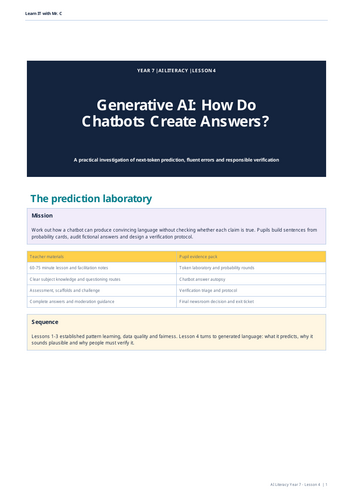
A complete 17-page Year 7 AI lesson explaining how chatbots generate answers, why confident responses can be wrong and how to verify them.
This fully resourced Key Stage 3 Computing and Digital Literacy lesson introduces generative AI and next-token prediction through practical, paper-based activities.
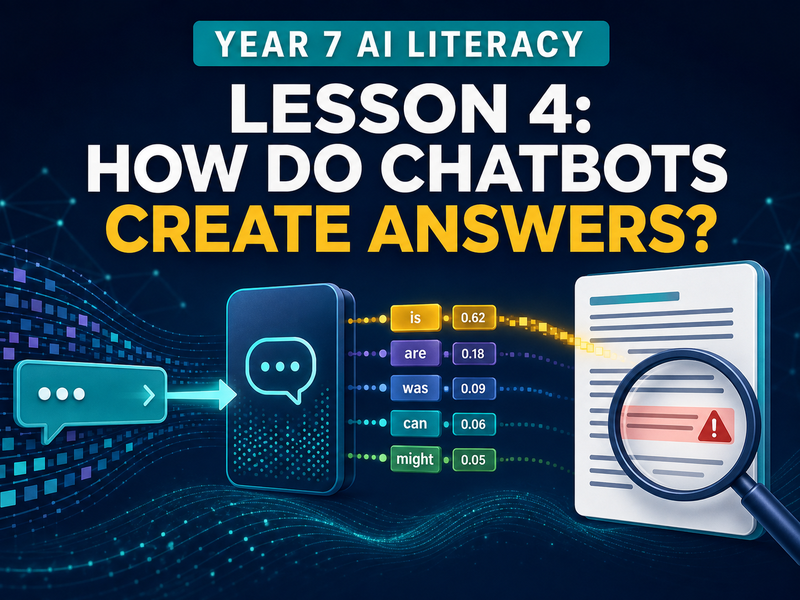
Pupils begin with a prediction laboratory, selecting likely continuations for different prompts. They learn that a chatbot repeatedly predicts probable next tokens and that probability is not a measure of factual truth.
The resource includes:
- A complete 60–75 minute lesson plan
- Learning objectives and differentiated success criteria
- Teacher subject knowledge and safeguarding guidance
- Diagnostic starter and hinge question
- Practical next-token prediction laboratory
- Probability and context activities
- Accessible model of chatbot generation
- Fictional chatbot answer and evidence pack
- Claim-by-claim answer autopsy
- Supported, contradicted and unverified classifications
- Hallucination diagnosis activity
- Risk-based verification triage
- Source-quality comparison
- Newsroom publication simulation
- Final publication decision
- Retrieval review and exit ticket
- Teacher answers and assessment rubric
- Support, challenge and misconception guidance
The fictional Bellminster Observatory case gives pupils a polished chatbot response containing incorrect dates, invented people, false precision and unsupported claims. Pupils compare each claim with the supplied evidence and write a corrected sentence.
The hallucination clinic introduces four useful failure patterns: invented entities, false precision, blended facts and gap filling. Pupils diagnose errors and prescribe suitable verification checks.
A verification-triage task asks pupils to match the level of checking to the possible consequences. Examples range from generating fictional character names to medical advice, historical quotations, accusations of cheating and computer code.
The final newsroom simulation requires teams to create a publication protocol, prioritise claims, select suitable sources and decide whether an AI-generated article should be published, corrected, held or rejected.
Differentiation includes colour coding, structured classifications, sentence frames and oral rehearsal. Higher-attaining pupils evaluate source limitations, uncertainty, risk and whether consulting another chatbot counts as independent corroboration.
No AI account, pupil login, internet access or specialist software is required. All chatbot outputs, people, places and evidence are fictional and included in the printable resource.
Suitable for Year 7 Computing, Key Stage 3 Digital Literacy, generative AI, chatbot literacy, misinformation, online safety and verification lessons.
This is Lesson 4 of the six-part Year 7 AI Literacy series.
Get this resource as part of a bundle and save up to 20%
A bundle is a package of resources grouped together to teach a particular topic, or a series of lessons, in one place.
Something went wrong, please try again later.
This resource hasn't been reviewed yet
To ensure quality for our reviews, only customers who have purchased this resource can review it
Report this resourceto let us know if it violates our terms and conditions.
Our customer service team will review your report and will be in touch.
£3.00