ClaireHopeResourcesAQA GCSE Psychology: Psychological Explanation of Addiction. (Lesson 11 of Psychological Problems) (0)
ClaireHopeResourcesAQA GCSE Psychology: Murdock’s serial position curve study (AO3). (Lesson 6 of Memory) (1)
ClaireHopeResourcesAQA GCSE Psychology: Reconstructive Memory & Bartlett War of the Ghosts (AO3). (Lesson 8 of Memory) (1)
ClaireHopeResourcesAQA A-level Psychology: Plasticity and Functional Recovery of the Brain Evaluation (Lesson 12 of Bio (0)
ClaireHopeResourcesAQA A-level Psychology: Lateralisation and Split-Brain (Lesson 9 of Biopsychology) (0)
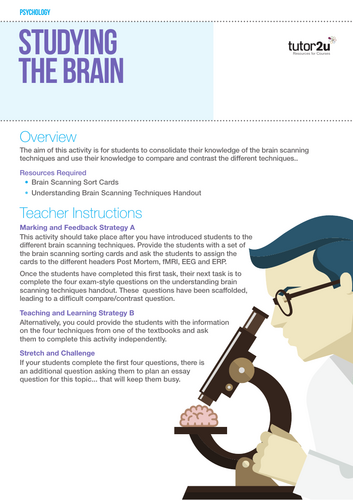
ClaireHopeResourcesAQA A-level Psychology: Ways of Studying the Brain (Lesson 5 of Biopsychology) (0)
ClaireHopeResourcesAQA GCSE Psychology: Von Frisch Bee Study. (Lesson 4 of Language, Thought & Communication) (0)
ClaireHopeResourcesAQA GCSE Psychology: Sapir-Whorf Hypothesis. (Lesson 3 of Language, Thought & Communication) (0)
ClaireHopeResourcesAQA GCSE Psychology: Darwin’s evolutionary theory of non-verbal communication as evolved and adaptiv (0)
ClaireHopeResourcesAQA GCSE Psychology: Evaluation of Yuki’s study of emoticons. (Lesson 11 of Language, Thought & Comm (0)
ClaireHopeResourcesAQA GCSE Psychology: Factors affecting Perception: Motivation. (Lesson 8 of Perception) (0)
ClaireHopeResourcesAQA GCSE Psychology: The James-Lange theory of emotion. (Lesson 3 of Brain and Neuropsychology) (0)
ClaireHopeResourcesAQA GCSE Psychology: Penfield’s study of the interpretive cortex. (Lesson 7 of Brain and Neuropsycho (0)
ClaireHopeResourcesAQA GCSE Psychology: Hebb's theory of learning and neuronal growth. (Lesson 5 of Brain and Neuropsyc (0)
ClaireHopeResourcesAQA GCSE Psychology: The use of scanning techniques. (Lesson 8 of Brain & Neuropsychology) (0)