pptx, 1.88 MB
pptx, 1.88 MB
docx, 60.65 KB
docx, 60.65 KB
docx, 146.25 KB
docx, 146.25 KB
docx, 252.47 KB
docx, 252.47 KB

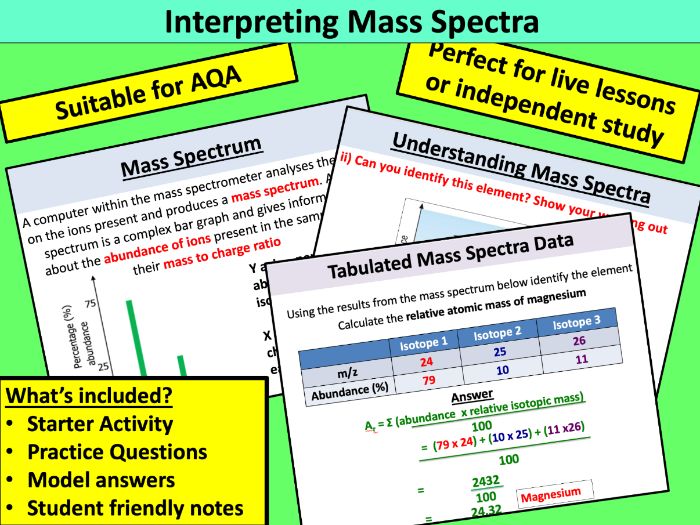
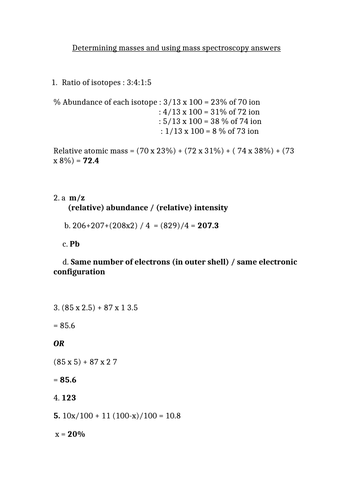
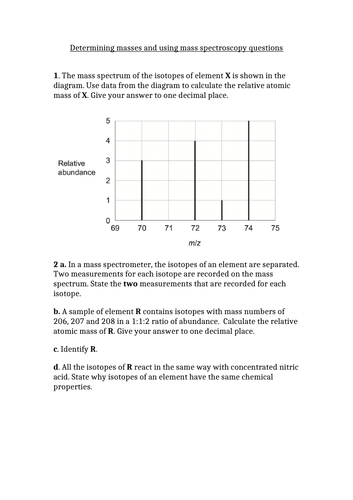
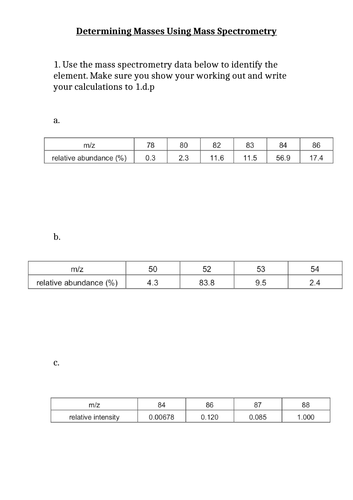
A structured KS5 lesson including starter activity, AfL work tasks and main work task all with answers on Interpreting Mass Spectra. Suitable for the AQA Specification.

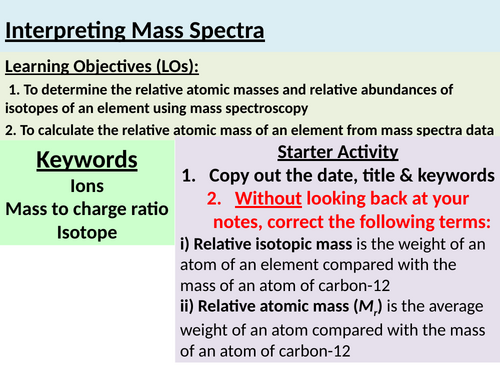
By the end of this lesson KS5 students should be able to:

LO1. To determine the relative atomic masses and relative abundances of isotopes of an element using mass spectroscopy
LO2. To calculate the relative atomic mass of an element from mass spectra data

Declaimer: Please refrain from purchasing this popular resource for an interview lesson or a formal observation. This is because planning your own lessons, including using your own lesson PowerPoints, is a fundamental skill of a qualified/unqualified teacher that will be assessed during the scenarios outlined above

Get this resource as part of a bundle and save up to 10%

A bundle is a package of resources grouped together to teach a particular topic, or a series of lessons, in one place.

Bundle

Atomic Structure (AQA)

8 Full Lesson Bundle on Atomic Structure from the AQA AS Level Chemistry specification. Please review the learning objectives below. **Lesson 1: Atomic Structure & Isotopes** 1. To describe the atomic structure of an atom 2. To describe atomic structure in terms of protons, neutrons and electrons for atoms and ions, given the atomic number, mass number and any ionic charge 3. To define the term isotopes and to identify the atomic structure of isotopes in terms of protons, neutrons and electrons **Lesson 2: Relative Masses** 1. Define the terms relative atomic mass, relative formula mass and relative molecular mass 2. Calculate the relative formula mass and relative molecular mass of compounds and molecules **Lesson 3: TOF Mass Spectrometry** 1. To understand the principles of a simple time of flight (TOF) mass spectrometer 2. To explain how the mass of an elemental ion is linked to its velocity 3. To be able to apply the kinetic energy equation (KE = ½ mv2) to complete TOF calculations **Lesson 4: Interpreting Mass Spectra** 1. To determine the relative atomic masses and relative abundances of isotopes of an element using mass spectroscopy 2. To calculate the relative atomic mass of an element from mass spectra data **Lesson 5: Atomic Orbitals (Electronic Configuration)** 1. To know that atomic orbitals are a region around the nucleus that occupy electrons 2. To illustrate the shape of s, p and d orbitals 3. To describe the number of orbitals that make up the s, p and d sub shells and the number of electrons that fill the sub shells 4. To deduce the electronic configuration of atoms and ions in the s and p-block **Lesson 6: The Structure of The Periodic Table** 1. To know how the periodic table is arranged 2. To describe the periodic trend in electron configurations across periods 2 and 3 3. To classify elements into s, p and d blocks **Lesson 7: Ionisation Energy (Part 1)** 1. To define the term ‘first ionisation energy’ and successive ionisation energies 2. To describe the factors affecting ionisation energy 3. To explain the trend in successive ionisation energies of an element **Lesson 8: Ionisation Energy (Part 2)** 1. To explain the trend in first ionisation energies down a group 2. To explain the trend in first ionisation energies across period 2 3. To explain the trend in first ionisation energies across period 3

£53.17

Reviews

Something went wrong, please try again later.

This resource hasn't been reviewed yet

To ensure quality for our reviews, only customers who have purchased this resource can review it

Report this resourceto let us know if it violates our terms and conditions.
Our customer service team will review your report and will be in touch.