Early Weimar Germany 1918–29: Complete 9-Lesson GCSE Enquiry Bundle (Edexcel / AQA / OCR)
Resource Bundle



A fully resourced, nine-lesson GCSE bundle covering the early years of the Weimar Republic, 1918–29. Through engaging enquiry questions, rich visual activities and structured evaluative tasks, students investigate how Germany navigated collapse, revolution, crisis, recovery and cultural transformation after the First World War.
Each lesson provides a complete, interactive sequence with printable resources, cut-out cards and detailed teacher notes (Purpose, Guidance, Insight, Differentiation and Timing). Designed for Edexcel GCSE (Weimar & Nazi Germany) but easily adaptable for AQA, OCR and Eduqas.
The bundle includes:
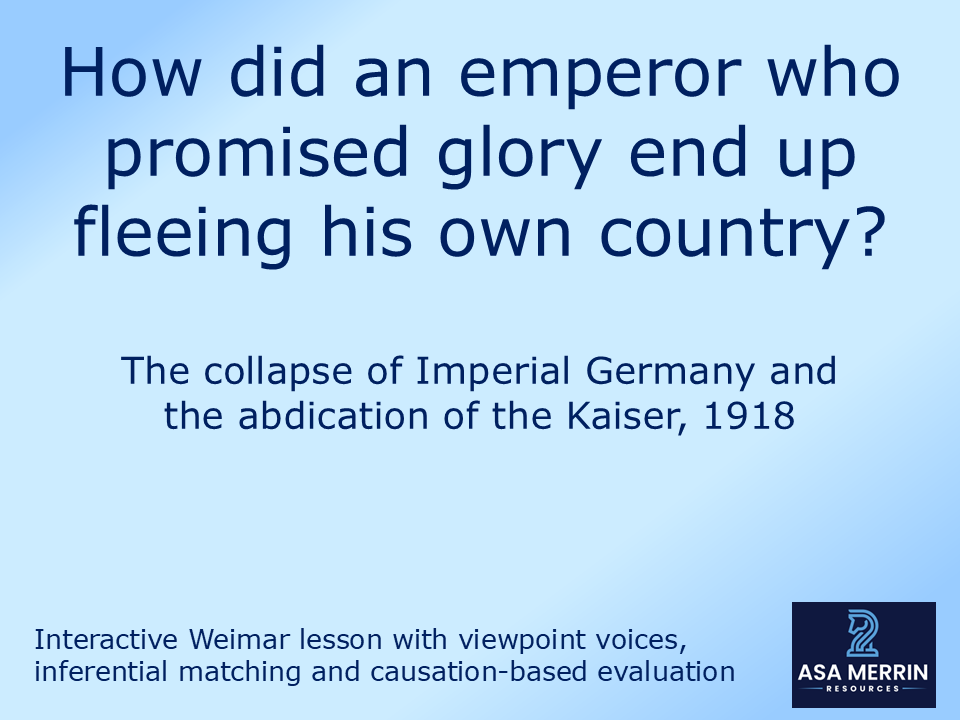
Students examine how a leader who promised glory ended up fleeing his own country. Includes a visual register starter, Kaiser quotations task, nine-option causes ranking activity, voice-matching enquiry and a structured two-part plenary.
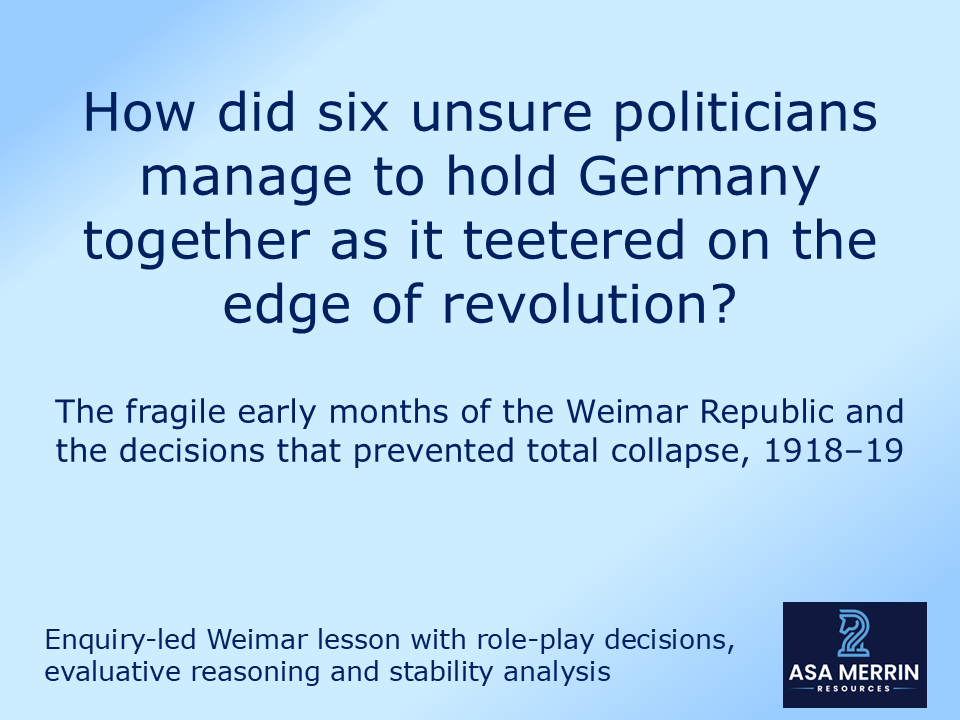
A full WWYD-style simulation exploring how Germany avoided full-scale revolution. Includes decision-making tasks inside the Reichstag, crisis dilemmas, a military scenario, business and workers’ perspectives, and a consolidation ranking plenary.
Students investigate whether the new constitution was a bold democratic breakthrough or a structural time bomb. Includes ranking tasks, constitutional role-matching, Diamond-9 evaluation and a whole-class judgement plenary.
Students explore whether the Treaty was a fair attempt at stability or a calculated humiliation that fuelled resentment and future conflict. Includes striking political cartoons, a paired discussion task, a competitive quiz, treaty-term match-up and a reflective judgement plenary.
A full investigation of early political instability, extremist threats and government responses. Includes metaphor-based starters, quizzes, political Diamond-9 ranking, a major living-graph activity and a judgement plenary.
Students examine whether hyperinflation was unavoidable or worsened by Weimar decisions. Includes a mystery starter, Cold War–style recap, WWYD simulation, character match-up, ranking tasks and a forward-looking plenary.
An enquiry into how far Stresemann truly strengthened Germany. Includes an image starter, mood analysis, continuum tasks, BBC clip questions, consolidation quiz and a structured debate plenary.
Students explore how far different groups — especially women — experienced genuine progress. Includes an image starter, AFL mapping, continuum tasks, satirical source analysis, inference modelling and an evaluative judgement activity.
A rich investigation into Weimar art, architecture, nightlife and film to judge whether culture liberated or divided Germany. Includes prediction tasks, image inference, sorting activities, a paired-reaction task and a reflective plenary.
Ideal for developing:
• Inference
• Interpretation
• Decision-making
• Source analysis
• Causation
• Continuum judgement
• Evaluative reasoning
Perfect for deepening students’ understanding of the political, economic, social and cultural forces that shaped early Weimar Germany — and why the Republic remained so fragile throughout the 1920s.
Something went wrong, please try again later.
This resource hasn't been reviewed yet
To ensure quality for our reviews, only customers who have purchased this resource can review it
Report this resourceto let us know if it violates our terms and conditions.
Our customer service team will review your report and will be in touch.