Rate Equations (AQA)
Resource Bundle


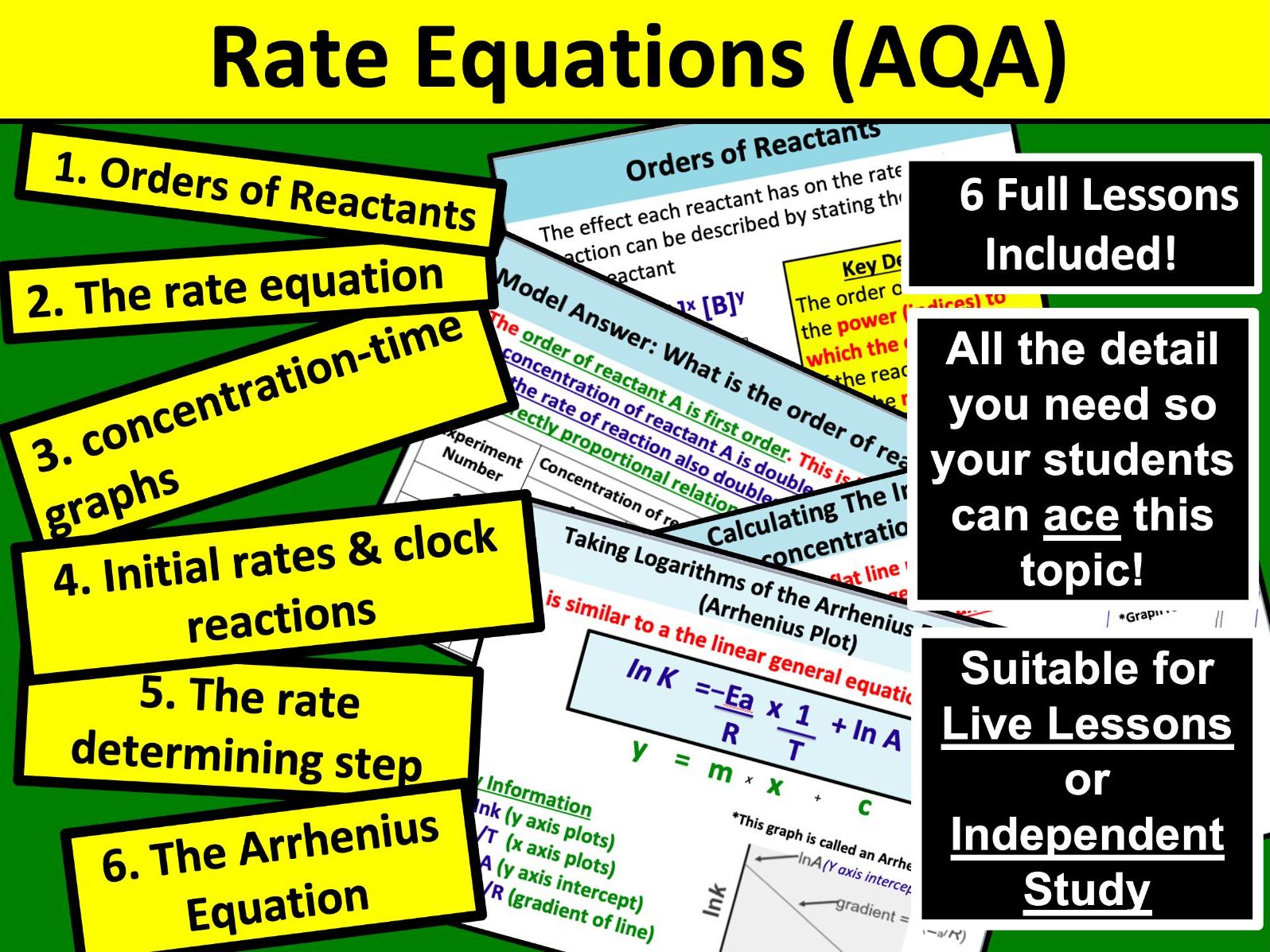


6 full lesson bundle covering the chapter: Rate Equations from the AQA A Level Chemistry Specification.
If you teach the OCR Specification, then please purchase this bundle instead: https://www.tes.com/teaching-resource/resource-12322616
Lesson 1: Order of Reactants
LO1: To recall the terms rate of reaction, order, overall order and rate constant
LO2: To describe how orders of reactants affect the rate of a reaction
LO3: To calculate the overall order of a reaction
Lesson 2: The Rate Equation
LO1: To determine the order of a reactant from experimental data
LO2: To calculate the rate constant, K, from a rate equation
LO3: To calculate the units of the rate constant
Lesson 3: Concentration-Time Graphs (Part 1)
LO1: To know the techniques and procedures used to investigate reaction rates
LO2: To calculate reaction rates using gradients from concentration-time graphs
LO3: To deduce zero & first order reactants from concentration-time graphs
LO4: To calculate the rate constant of a first order reactant using their half-life
Note: Concentration-Time Graphs (Part 2) is not applicable for the AQA specification
Lesson 4: Initial Rates and Clock Reactions
LO1: To determine the rate constant for a first order reaction from the gradient of a rate- concentration graph
LO2: To understand how rate-concentration graphs are created
LO3: To explain how clock reactions are used to determine initial rates of reactions
Lesson 5: The Rate Determining Step
LO1: To explain and use the term rate determining step
LO2: To deduce possible steps in a reaction mechanism from the rate equation and the balanced equation for the overall reaction
LO3: To predict the rate equation that is consistent with the rate determining step
Lesson 6: The Arrhenius Equation
LO1: Explain qualitatively the effect of temperature change on a rate constant,k, and hence the rate of a reaction
LO2: To Know the exponential relationship between the rate constant, k and temperature, T given by the Arrhenius equation, k = Ae–Ea/RT
LO3: Determine Ea and A graphically using InK = -Ea/RT+ InA derived from the Arrhenius equation
Declaimer: Please refrain from purchasing this popular resource for an interview lesson or a formal observation. This is because planning your own lessons, including using your own lesson PowerPoints, is a fundamental skill of a qualified/unqualified teacher that will be assessed during the scenarios outlined above
Something went wrong, please try again later.
This resource hasn't been reviewed yet
To ensure quality for our reviews, only customers who have purchased this resource can review it
Report this resourceto let us know if it violates our terms and conditions.
Our customer service team will review your report and will be in touch.