


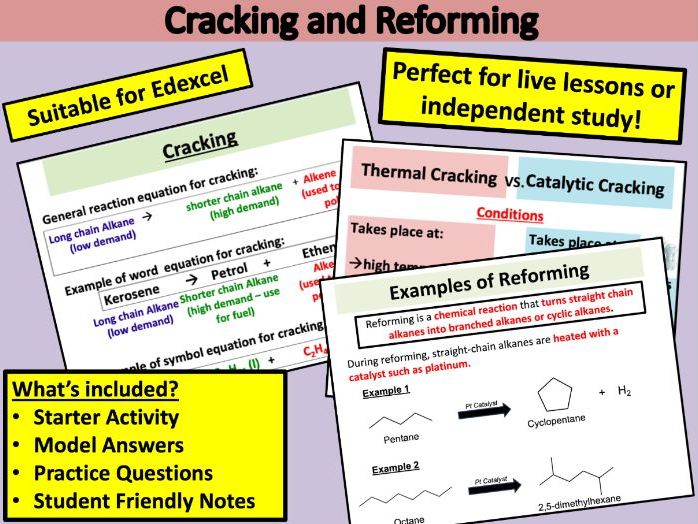
A structured lesson including starter activity, AfL work tasks on Cracking and Reforming of alkanes. Suitable for the Edexcel Specification.
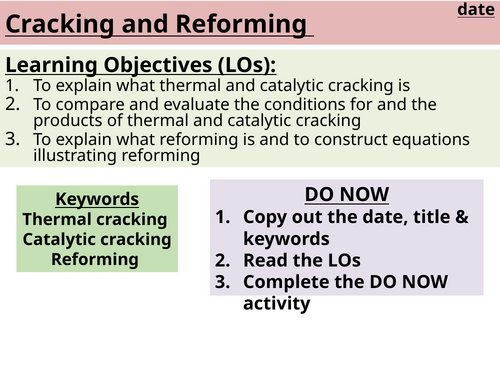
By the end of this lesson KS5 students should be able to:
- To explain what thermal and catalytic cracking is
- To compare and evaluate the conditions for and the products of thermal and catalytic cracking
- To explain what reforming is and to construct equations illustrating reforming
The teacher will be able to check students have met these learning objectives through mini AfL tasks for students to complete
Declaimer: Please refrain from purchasing this popular resource for an interview lesson or a formal observation. This is because planning your own lessons, including using your own lesson PowerPoints, is a fundamental skill of a qualified/unqualified teacher that will be assessed during the scenarios outlined above
Get this resource as part of a bundle and save up to 30%
A bundle is a package of resources grouped together to teach a particular topic, or a series of lessons, in one place.
Bundle
Organic Chemistry I (Edexcel)
20 well structured lessons covering topics in the AS Chemistry Chapter **Organic Chemistry I** suitable for the **Edexcel Specifciation** **Lesson 1: Organic and Inorganic Compounds** 1. To describe what organic and inorganic compounds are 2 To compare the strength of bonds in organic and inorganic compounds 3. To explain the molecular shape of carbon containing compounds **Lesson 2: Types of formulae** 1. To know what is meant by the terms empirical and molecular formula 2. To compare the terms general, structural, displayed and skeletal formula 3. To construct organic compounds using either of the 6 types of formulae **Lesson 3: Naming organic compounds** 1. To know the IUPAC rules for naming alkanes and alkenes 2. To know the IUPAC rules for naming aldehyde, ketones and carboxylic acids 3. To construct structural or displayed formulae from named organic compounds and name organic compounds from the structural or displayed formulae **Lesson 4: Introduction To Reaction Mechanisms** 1. To understand that reaction mechanisms are diagrams that illustrate the movement of electrons using curly arrows 2. To understand where curly arrows being and where they end 3. To identify and illustrate homolytic and heterolytic bond fission in reaction mechanisms **Lesson 5: Isomers** 1. To know what structural isomers and stereoisomers are 2. To describe the three different ways in which structural isomers can occur 3. To construct formulae of positional, functional group or chain isomers and stereoisomers of alkenes **Lesson 6: Properties of Alkanes** 1. To know alkanes are saturated alkanes containing sigma (σ)bonds that are free to rotate 2. To explain the shape and bond angle round each carbon atom in alkanes in terms of electron pair repulsion 3. To describe and explain the variations in boiling points of alkanes with different carbon chain lengths and branching in terms of London forces **Lesson 7: Free Radical Substitution of Alkanes** 1. To know what a free radical is 2. To describe the reaction mechanism for the free-radical substitution of alkanes including initiation, propagation and termination 3. To analyse the limitations of radical substitution in synthesis by formation of a mixture of organic products **Lesson 8: Fractional Distillation of Crude Oil** 1. Describe what crude oil contains and to understand its uses 2. Explain how crude oil is separated into useful fractions on an industrial scale 3. Explain how crude oil is separated into useful fractions on an industrial scale **Lesson 9: Cracking and Reforming** 1. To explain what thermal and catalytic cracking is 2. To compare and evaluate the conditions for and the products of thermal and catalytic cracking 3. To explain what reforming is and to construct equations illustrating reforming **Lesson 10: Combustion of Alkanes** 1. To understand why alkanes are good fuels 2. To recall the complete and incomplete combustions equations (both word and symbol) of alkanes 3. To explain the environmental problems associated with pollutant products when alkanes are used as fuels 4. To explain the use of catalytic convertors to remove gaseous pollutants produced during alkane combustion **Lesson 11: The Properties of Alkenes** 1. To know the general formula of alkenes 2. To explain the shape and bond angle around each carbon atom of a C=C bond 3. To describe how π and σ bonds are formed in alkenes **Lesson 12: Addition Reactions of Alkenes** 1. To know what an electrophile is 2. To understand the addition reactions of alkenes 3. To outline the mechanism for electrophilic addition **Lesson 13: Addition Polymers** 1. To know the repeat unit of an addition polymer deduced from its monomer or polymer structure 2. To identify the monomer that would produce a given section of an addition polymer 3. To understand how chemists limit the problems caused by polymer disposal by: i. developing biodegradable polymers ii. removing toxic waste gases caused by incineration of plastics **Lesson 14: Halogenoalkanes and their Reactions** 1. To Identify halogenoalkanes as primary, secondary or tertiary 2. To understand why halogenoalkanes are more reactive than alkanes 3. To outline the mechanism of nucleophilic substitution involving halogenoalkanes 4. To understand how halogenoalkanes can undergo elimination reactions to form alkenes **Lesson 15: Reactivity of Halogenoalkanes** 1. To describe how the rate of hydrolysis of haloalkanes can be determined by experiment using water, ethanol and silver nitrate solution 2. To explain the trend in the rates of hydrolysis of primary halogenoalkanes in terms of the bond enthalpies of carbon-halogen bonds 3. To describe the trend in the rates of hydrolysis of primary, secondary and tertiary halogenoalkanes **Lesson 16: Properties of Alcohols** 1. To identify and explain the intermolecular forces that are present in alcohol molecules 2. To explain the water solubility of alcohols, their low volatility and their trend in boiling points 3. To classify alcohols as primary, secondary or tertiary alcohols **Lesson 17: Oxidation of Alcohols** 1. To know that alcohols can undergo combustion reactions in the presence of oxygen 2. To know alcohols can be oxidised by an oxidising agent called acidified potassium dichromate 3. To know the products and reaction conditions for the oxidation of primary alcohols to aldehydes and carboxylic acids 4. To know the products and reaction conditions for the oxidation of secondary alcohols to ketones **Lesson 18: Dehydration and Halogenation of Alcohols** 1. To know that alkenes can be formed from alcohols by acid-catalysed elimination reactions 2. To draw the structure of alkenes formed from alcohols by acid-catalysed elimination reactions 3. To understand the reactions of alcohols with halogenating agents: PCl5, KBr & H2SO4 and PI3 **Lesson 19: Industrial Production of Ethanol and Biofuels** 1. To describe the industrial synthesis of ethanol using mechanisms and equations (where applicable) by: i) The hydration of ethene ii) The fermentation of glucose 2. To construct equations to support the statement that ethanol produced by fermentation is a carbon neutral fuel and give reasons why this statement is not valid 3. To discuss the environmental (including ethical) issues linked to decision making about biofuel use. **Lesson 20: Practical skills for organic synthesis** 1. To demonstrate knowledge, understanding and application of the use of Quickfit apparatus for distillation and heating under reflux 2. To understand the techniques for preparation and purification of an organic liquid including: * use of a separating funnel to remove an organic layer from an aqueous layer * drying with an anhydrous salt * redistillation ***Declaimer: Please refrain from purchasing this popular resource for an interview lesson or a formal observation. This is because planning your own lessons including using your own lesson PowerPoints is a fundamental skill of a qualified/unqualified teacher that will be reviewed during these scenarios outlined above***
£108.79
Bundle
Alkanes (Edexcel)
5 well structured chemistry lessons covering topics on Alkanes (Year 12) suitable for the Edexcel specification. **Lesson 1: Properties of Alkanes** 1. To know alkanes are saturated hydrocarbons containing sigma (σ)bonds that are free to rotate 2. Explain the shape and bond angle round each carbon atom in alkanes in terms of electron pair repulsion 3. Describe and explain the variations in boiling points of alkanes with different carbon chain lengths and branching in terms of London forces **Lesson 2: Free Radical Substitution of Alkanes** 1. To know what a free radical is 2. To describe the reaction mechanism for the free-radical substitution of alkanes including initiation, propagation and termination 3. To analyse the limitations of radical substitution in synthesis by formation of a mixture of organic products **Lesson 3: Fractional Distillation of Crude Oil** 1. Describe what crude oil contains and to understand its uses 2. Explain how crude oil is separated into useful fractions on an industrial scale 3. Explain how crude oil is separated into useful fractions on an industrial scale **Lesson 4: Cracking and Reforming** 1. To explain what thermal and catalytic cracking is 2. To compare and evaluate the conditions for and the products of thermal and catalytic cracking 3. To explain what reforming is and to construct equations illustrating reforming **Lesson 5: Combustion of Alkanes** 1. To understand why alkanes are good fuels 2. To recall the complete and incomplete combustions equations (both word and symbol) of alkanes 3. To explain the environmental problems associated with pollutant products when alkanes are used as fuels 4. To explain the use of catalytic convertors to remove gaseous pollutants produced during alkane combustion **Declaimer: Please refrain from purchasing this popular resource for an interview lesson or a formal observation. This is because planning your own lessons, including using your own lesson PowerPoints, is a fundamental skill of a qualified/unqualified teacher that will be assessed during the scenarios outlined above**
£34.97
Something went wrong, please try again later.
This resource hasn't been reviewed yet
To ensure quality for our reviews, only customers who have purchased this resource can review it
Report this resourceto let us know if it violates our terms and conditions.
Our customer service team will review your report and will be in touch.
£6.97